
Please enter subscribe form shortcode

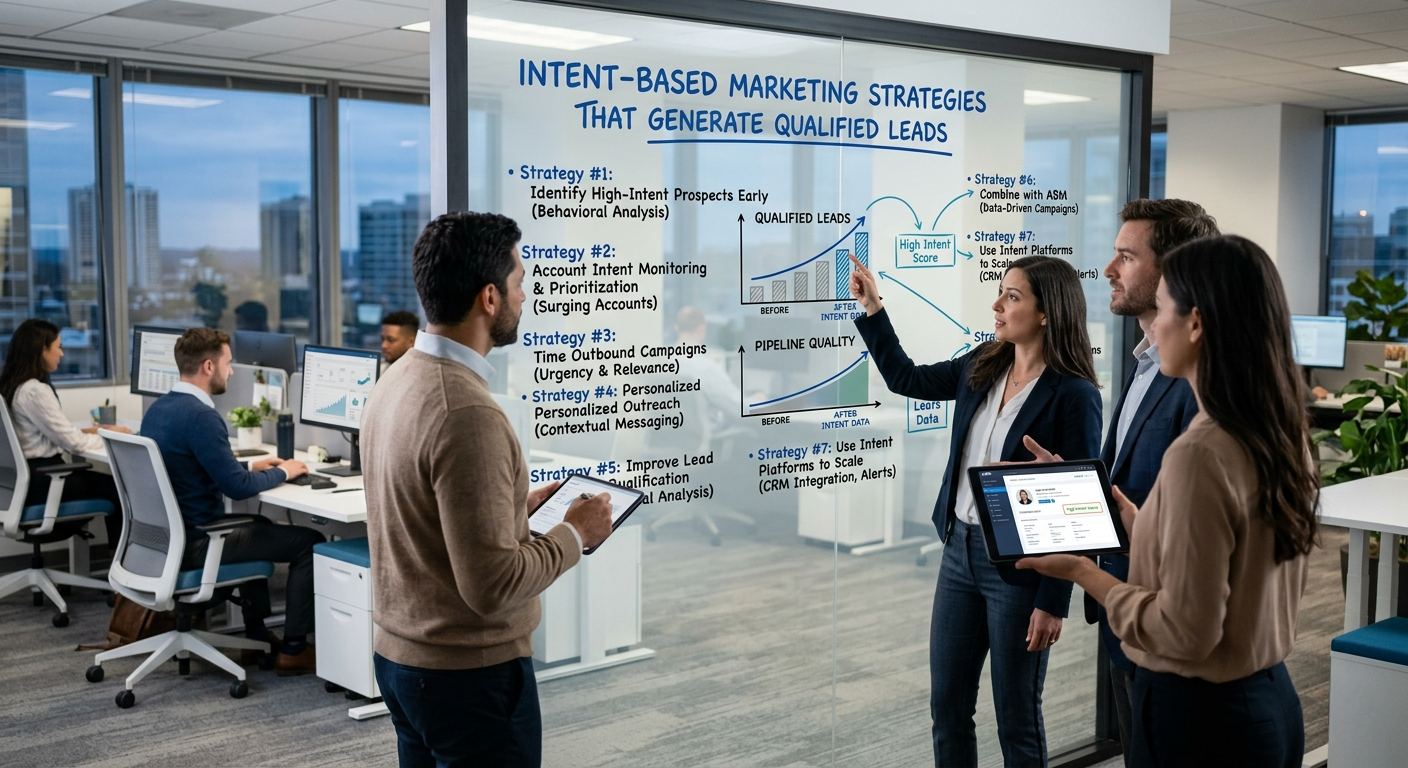
Intent-Based Marketing Strategies That Actually Generate Qualified Leads

Modern B2B buyers no longer wait for sales teams to educate them. Most decision makers research solutions long before filling out a form or replying to outreach. This shift has changed how companies approach pipeline generation. Instead of relying on broad targeting and cold prospecting alone, more businesses are investing in intent based marketing to identify buyers who are already showing signs of interest. Intent data gives sales and marketing teams visibility into buyer behavior before competitors even know an opportunity exists. It helps companies improve targeting, personalize outreach, and engage prospects at the right moment. In this guide, we will break down the most effective intent-based marketing strategies that actually generate qualified leads and improve pipeline quality. What Is Intent-Based Marketing and Why Does It Matter? Understanding the intent-based marketing definition Intent based marketing is a strategy that uses buyer behavior signals to identify prospects actively researching solutions, products, or services. Instead of relying only on static company information such as industry or company size, intent based marketing focuses on real buyer activity. These signals can include: • Website visits • Content downloads • Search activity • Webinar engagement • Product comparison research • Repeated visits to pricing pages The goal is simple. Identify demand before prospects officially enter the buying process. How B2B buyer intent data changes modern lead generation Traditional lead generation often focuses on volume. Teams build large prospect lists and send outreach hoping a small percentage responds. The problem is that most prospects are not actively looking to buy. B2B buyer intent data changes this approach by helping sales teams focus on accounts already showing interest. Instead of interrupting cold audiences, companies can engage buyers during active research stages. This improves: • Outreach relevance • Response rates • Lead quality • Pipeline efficiency Why buyer signals are more valuable than static demographics Firmographic data still matters, but it only tells part of the story. Knowing a company’s size or industry does not reveal whether they are actively evaluating solutions. Buyer signals provide real context. For example, a company researching CRM migration tools for several weeks is far more valuable than a random prospect matching an ICP profile. Behavior creates urgency. Demographics alone do not. The shift from broad outreach to intent-driven lead generation Modern revenue teams are moving toward intent-driven lead generation because buyers expect personalization and relevance. Outreach based on live behavior performs better than mass messaging. This shift allows companies to: • Reduce wasted prospecting • Improve timing • Personalize conversations • Focus SDR resources more effectively Intent based marketing creates smarter pipeline generation rather than simply increasing activity volume. Why Traditional Prospecting Misses Qualified Buyers The limitations of generic targeting in B2B outreach Many outbound campaigns fail because they treat every prospect the same way. Generic targeting assumes that every ICP-fit account is equally ready to buy. In reality, timing varies dramatically. Some companies are researching solutions today while others have no active interest at all. Without intent signals, outreach becomes guesswork. Why timing and buyer readiness matter more than volume High activity levels do not automatically create pipeline growth. Sending thousands of emails means little if buyers are not currently evaluating solutions. Timing has become one of the most important competitive advantages in B2B sales. Companies that engage buyers early often shape the buying process before competitors enter the conversation. How intent data creates a measurable competitive advantage Intent data allows businesses to identify opportunities before they become obvious. This creates several strategic advantages: • Earlier outreach opportunities • Better personalization • Faster sales cycles • Higher conversion rates • More efficient prospecting The ability to recognize active demand early helps revenue teams stay ahead of competitors. Strategy #1: Identify High-Intent Prospects Early Techniques for high-intent prospect identification High-intent prospect identification starts with monitoring buyer activity patterns. Companies should focus on behaviors that indicate serious research intent. Examples include: • Multiple visits to pricing pages • Repeated content engagement • Competitor comparison searches • Engagement with implementation content The more buying signals an account shows, the higher the likelihood of active demand. Using purchase intent signals to detect active buyers Purchase intent signals reveal where buyers are in their evaluation process. Educational content engagement may indicate early-stage interest, while demo page visits often signal stronger buying readiness. Sales teams should prioritize accounts showing bottom-of-funnel behaviors because these prospects are closer to decision-making stages. Improving early purchase intent detection through behavioral analysis Behavioral analysis helps companies understand patterns instead of isolated actions. One website visit means little. Multiple interactions across several channels create stronger intent validation. Combining behavioral trends with account data improves prioritization accuracy. Leveraging real-time buyer behavior tracking for faster engagement Real-time buyer behavior tracking allows teams to engage prospects while interest is active. This creates a significant advantage because timing directly impacts response rates. When outreach aligns with live research behavior, conversations feel more relevant and natural. Strategy #2: Use Account Intent Monitoring to Prioritize Outreach Building workflows around account intent monitoring Account intent monitoring helps sales teams focus on companies actively researching relevant topics. Instead of static lead lists, teams can prioritize accounts based on buying activity. Effective workflows include: • Daily intent signal reviews • Automated account scoring • SDR prioritization systems • Intent-triggered outreach alerts Identifying surging accounts before competitors do Intent platforms can detect research spikes before prospects contact vendors directly. These surging accounts often represent early buying opportunities. The earlier sales teams engage, the stronger their positioning becomes during evaluation cycles. Prioritizing outreach based on buyer research activity Not every lead deserves equal attention. Intent data helps teams focus on accounts demonstrating meaningful buying activity rather than spreading effort evenly across large databases. This improves efficiency across the entire pipeline. Focusing resources on targeting in-market buyers Targeting in-market buyers reduces wasted prospecting time and increases pipeline quality. SDRs spend more time having relevant conversations instead of chasing unqualified prospects. This creates better productivity and stronger revenue outcomes. Strategy #3: Time Outbound Campaigns Around
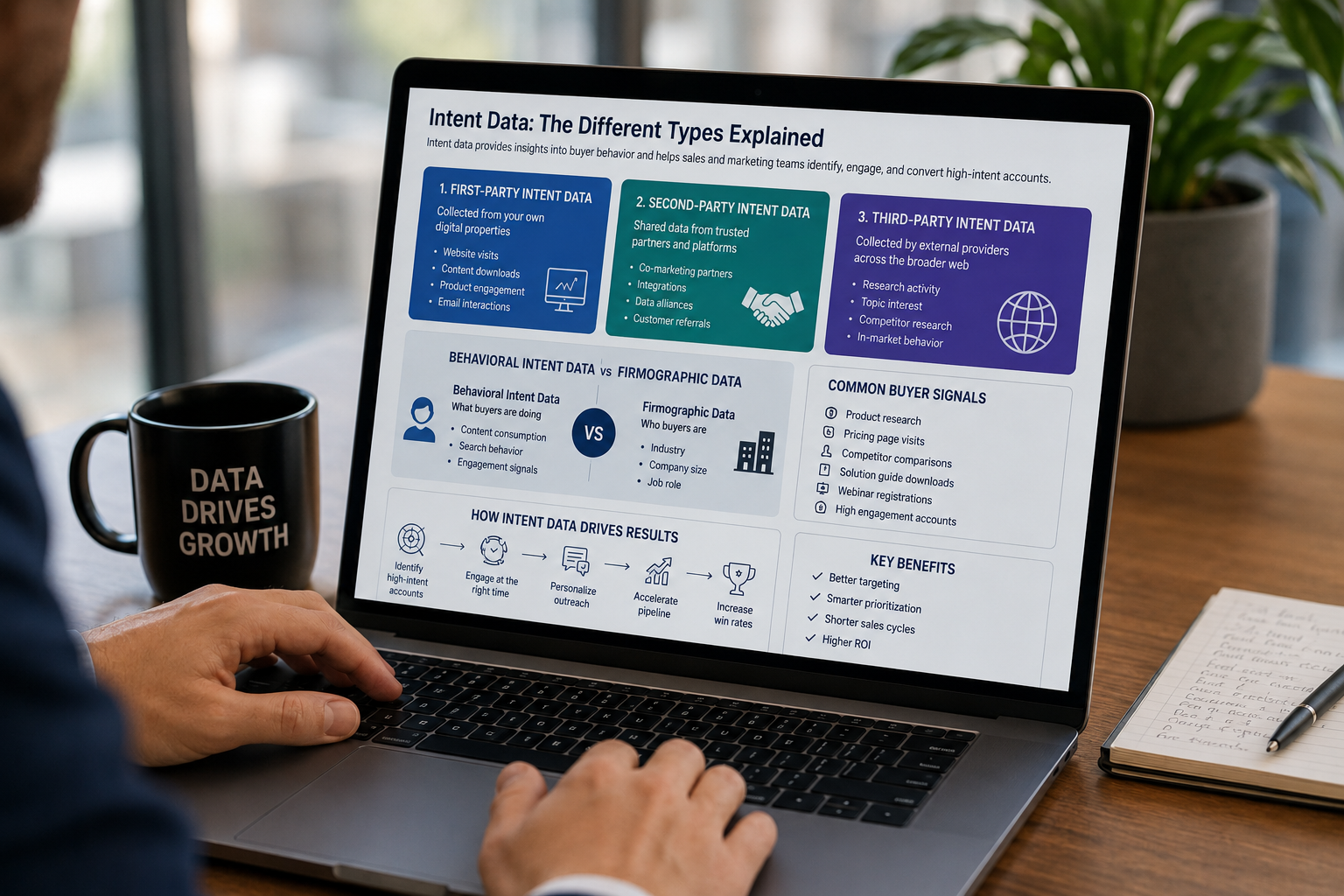

What are Intent Data? The Different Types of Intent Data Explained

Modern B2B sales teams no longer rely only on cold outreach and broad targeting to generate pipeline. Buyers now research solutions independently long before they speak with a sales rep. That shift has made intent based marketing one of the most important strategies in modern demand generation. Instead of guessing who might be interested, companies can now identify real buying behavior, prioritize high-intent accounts, and engage prospects at the right moment. The result is more efficient prospecting, stronger personalization, and shorter sales cycles. In this guide, we will break down the different types of intent data, how they work, and how sales and marketing teams can use them to create a competitive advantage. What Is Intent Data in B2B Marketing? Intent data refers to information that signals when a company or buyer may be actively researching a product, service, or business problem. These signals help revenue teams identify prospects that are more likely to enter a buying process. Understanding the intent-based marketing definition The intent-based marketing definition centers around using buyer behavior insights to guide outreach, targeting, and pipeline generation. Instead of marketing to large audiences with generic campaigns, businesses focus on prospects showing active interest. This approach helps teams move from assumption-based prospecting to evidence-based engagement. Companies can prioritize buyers based on actual research activity rather than static demographic filters alone. Why B2B buyer intent data matters in modern sales B2B buyer intent data matters because the modern buying journey is increasingly digital. Buyers consume content, compare vendors, attend webinars, and research competitors before ever speaking with sales. Without visibility into these behaviors, teams risk engaging too late or targeting accounts that are not actively considering a purchase. Intent data gives sales teams the ability to: Identify buyers earlier in the journey Improve outreach timing Prioritize accounts with stronger buying potential Increase sales efficiency through smarter targeting The connection between buyer signals and pipeline generation Buyer signals provide clues about purchasing readiness. When multiple signals appear together, they often indicate growing commercial intent. Examples include: Repeated visits to pricing pages Searches related to competitor comparisons Content downloads around specific pain points Increased engagement from multiple stakeholders These signals help pipeline generation become more predictable because sales teams spend more time engaging buyers already showing interest. How intent data supports intent-driven lead generation Intent-driven lead generation improves targeting accuracy by focusing efforts on active demand instead of passive audiences. Rather than building massive prospect lists, companies can concentrate on accounts already researching relevant topics. This improves conversion quality while reducing wasted outreach. Why Intent Data Creates a Competitive Advantage Intent data changes how companies compete for attention in crowded B2B markets. How early buyer visibility changes outbound strategy Traditional outbound prospecting often begins after competitors have already entered conversations. Intent data changes this by helping teams detect research behavior earlier. This allows sales reps to engage prospects while they are still evaluating options, creating an opportunity to influence decision-making before competitors establish strong positioning. Using intent insights for high-intent prospect identification High-intent prospect identification helps teams prioritize accounts based on buying behavior rather than assumptions. Instead of contacting every account equally, reps can focus on organizations actively researching relevant solutions. This improves both efficiency and pipeline quality. Why timing matters in competitive B2B sales environments Timing often determines whether outreach feels helpful or disruptive. When a prospect is actively researching a solution, relevant outreach is more likely to receive attention. Without proper timing, even strong messaging can fail because the buyer is not yet interested. Turning buyer behavior into a measurable competitive advantage Companies that consistently monitor buyer behavior gain insight into market demand earlier than competitors. This creates measurable advantages such as: Faster pipeline generation Higher response rates Improved sales productivity Better allocation of outbound resources First-Party Intent Data Explained First-party intent data comes directly from channels a company owns and controls. What first-party intent data includes This data includes actions prospects take on your website, product, emails, and owned digital properties. Examples include: Website visits Webinar registrations Product demo requests Email engagement Trial signups Because the data comes from your own ecosystem, it is usually highly accurate and directly relevant. Tracking website engagement and product interest Website engagement often reveals where a buyer is in the decision process. For example, someone reading educational blog content may still be in early research mode, while repeated visits to pricing or integration pages may signal stronger purchasing intent. Using real-time buyer behavior tracking on owned channels Real-time buyer behavior tracking allows teams to react quickly to engagement signals. Sales reps can prioritize outreach when buyers are actively interacting with content instead of waiting days or weeks after activity occurs. Leveraging first-party buyer signals for lead qualification First-party buyer signals strengthen lead qualification because they reflect direct engagement with your business. This helps sales teams distinguish between casual interest and genuine purchasing intent. Second-Party Intent Data Explained Second-party intent data comes from trusted external partnerships. How second-party intent data is shared between trusted partners In many B2B ecosystems, companies collaborate by sharing relevant audience insights. For example, a webinar partner may share attendee engagement data with a co-hosting organization. Common collaboration models in B2B ecosystems Common second-party collaboration models include: Co-marketing partnerships Event sponsorships Industry publication partnerships Technology integrations These relationships expand visibility into buyer activity beyond owned channels. Expanding visibility through strategic data-sharing relationships Strategic partnerships help companies access audiences they may not otherwise reach. This can improve targeting opportunities while supporting broader market visibility. Third-Party Intent Data Explained Third-party intent data is collected from external sources across the broader internet. How third-party providers collect purchase intent signals Intent data providers track content consumption and online research behavior across thousands of websites and platforms. This allows businesses to identify companies researching relevant products even before they engage directly. The role of intent data platforms in external buyer tracking Intent data platforms aggregate behavioral insights from multiple online sources. These tools help sales teams uncover: Topic research trends Competitor interest Surging

How Intent Data Helps You Find Buyers Before Competitors Do

Modern B2B sales has become increasingly competitive. Buyers now conduct extensive research long before they respond to a sales message or book a meeting. By the time many companies begin outreach, competitors may have already entered the conversation. This shift is exactly why more organizations are asking: what is intent based marketing, and how can it help sales teams identify opportunities earlier? Intent data gives companies visibility into buyer behavior before prospects formally enter the pipeline. Instead of relying on assumptions or broad outreach, sales teams can identify accounts actively researching solutions and engage them at the right moment. In today’s market, timing is no longer just an advantage. It is often the difference between winning and losing deals. Why Timing Has Become a Competitive Advantage in B2B Sales The growing importance of early buyer engagement B2B buyers are more independent than ever. Most decision-makers now research vendors, compare solutions, and consume content before speaking with sales teams. This means early engagement plays a major role in shaping buying decisions. Companies that identify prospects during the research phase gain a stronger opportunity to influence the conversation before competitors do. Early engagement also helps sales teams: Build trust sooner Position themselves as advisors rather than vendors Influence requirements before buyers finalize criteria Increase familiarity during long buying cycles When outreach happens too late, much of the buyer’s decision-making process may already be complete. Why companies lose deals before outreach even begins Many organizations still rely on static prospecting methods. Sales reps contact accounts based on industry, company size, or job titles without understanding whether buyers are actively searching for solutions. The problem is that competitors using intent data may already know: Which accounts are researching Which topics they are exploring Which pain points are driving urgency As a result, deals are often lost before traditional outreach even starts. How intent-based marketing definition reshapes pipeline strategy The modern intent-based marketing definition revolves around using behavioral signals to identify active buying interest. Instead of focusing only on demographics, sales and marketing teams prioritize accounts showing signs of engagement and research activity. This fundamentally changes pipeline strategy because outreach becomes: More timely More relevant More personalized More efficient What Intent Data Actually Reveals About Buyers Understanding B2B buyer intent data and digital research behavior B2B buyer intent data tracks online behaviors that suggest purchase interest. These behaviors can include: Reading industry articles Downloading resources Comparing vendors Searching for relevant keywords Visiting product pages repeatedly These actions provide insight into buyer intent long before prospects fill out forms or request demos. The role of purchase intent signals in identifying buying readiness Purchase intent signals help sales teams understand whether a prospect is moving closer to a buying decision. For example, a company researching CRM integrations multiple times within a short period may indicate active evaluation. This creates an opportunity for outreach that aligns directly with buyer interests. Instead of guessing who might need help, teams can focus on accounts demonstrating real interest. How real-time buyer behavior tracking uncovers active demand Real-time buyer behavior tracking allows teams to monitor shifting engagement patterns as they happen. This visibility helps sales teams respond quickly to emerging opportunities. A sudden increase in research activity may indicate: Budget approvals New initiatives Vendor evaluations Competitive replacement projects This timing advantage can dramatically improve outreach effectiveness. Detecting hidden buyer signals before prospects reach out directly One of the biggest benefits of intent data is uncovering hidden demand before buyers explicitly raise their hands. Many prospects never submit forms during early research stages. Intent data helps sales teams identify these silent buyers before competitors engage them. Early Purchase Intent Detection: Finding Buyers Before Competitors How high-intent prospect identification creates outreach opportunities earlier High-intent prospect identification allows teams to prioritize buyers showing meaningful research activity. Instead of waiting for inbound leads, sales reps can proactively engage accounts before formal evaluation processes begin. This creates earlier pipeline opportunities and increases first-mover advantage. Using account intent monitoring to detect research spikes Account intent monitoring helps teams identify sudden increases in activity around specific topics. For example: A cybersecurity company may notice spikes in ransomware-related research A SaaS provider may detect interest in workflow automation topics A biotech vendor may identify growing interest in compliance systems These spikes provide actionable outreach signals. Why early engagement increases win probability Sales teams that engage buyers earlier often gain strategic advantages: Greater influence over requirements Better relationship building Reduced competitive pressure More trust during evaluation stages Being first into the conversation can significantly improve win probability. Building a sustainable competitive advantage through timing Over time, timing becomes a repeatable competitive advantage. Organizations consistently identifying buyers earlier can generate stronger pipelines without relying solely on increased outreach volume. Targeting In-Market Buyers With Precision Moving from broad prospecting to targeting in-market buyers Traditional prospecting focuses on broad ICP matching. Intent-driven prospecting focuses on targeting in-market buyers already researching solutions. This shift improves efficiency because sales teams spend less time on uninterested accounts. The role of behavioral targeting in B2B marketing Behavioral targeting in B2B marketing uses real buyer actions rather than static demographics to guide outreach priorities. Behavioral signals often provide better context than firmographics alone because they reflect active interest rather than theoretical fit. Improving prioritization through intent signal analysis for lead qualification Intent signal analysis for lead qualification helps teams rank opportunities based on actual engagement activity. This improves: Prospect prioritization SDR efficiency Pipeline quality Meeting relevance Reducing wasted outreach on low-intent accounts Intent data reduces wasted effort by filtering out accounts with little or no buying activity. This allows teams to allocate resources more strategically. Timing Outbound Campaigns Around Buyer Signals Aligning outreach with real buying activity One of the biggest advantages of intent data is the ability to align outreach with active buyer interest. When messaging matches current research behavior, conversations feel more relevant and timely. Using predictive marketing strategies to improve campaign timing Predictive marketing strategies analyze behavior patterns to forecast when buyers are likely entering

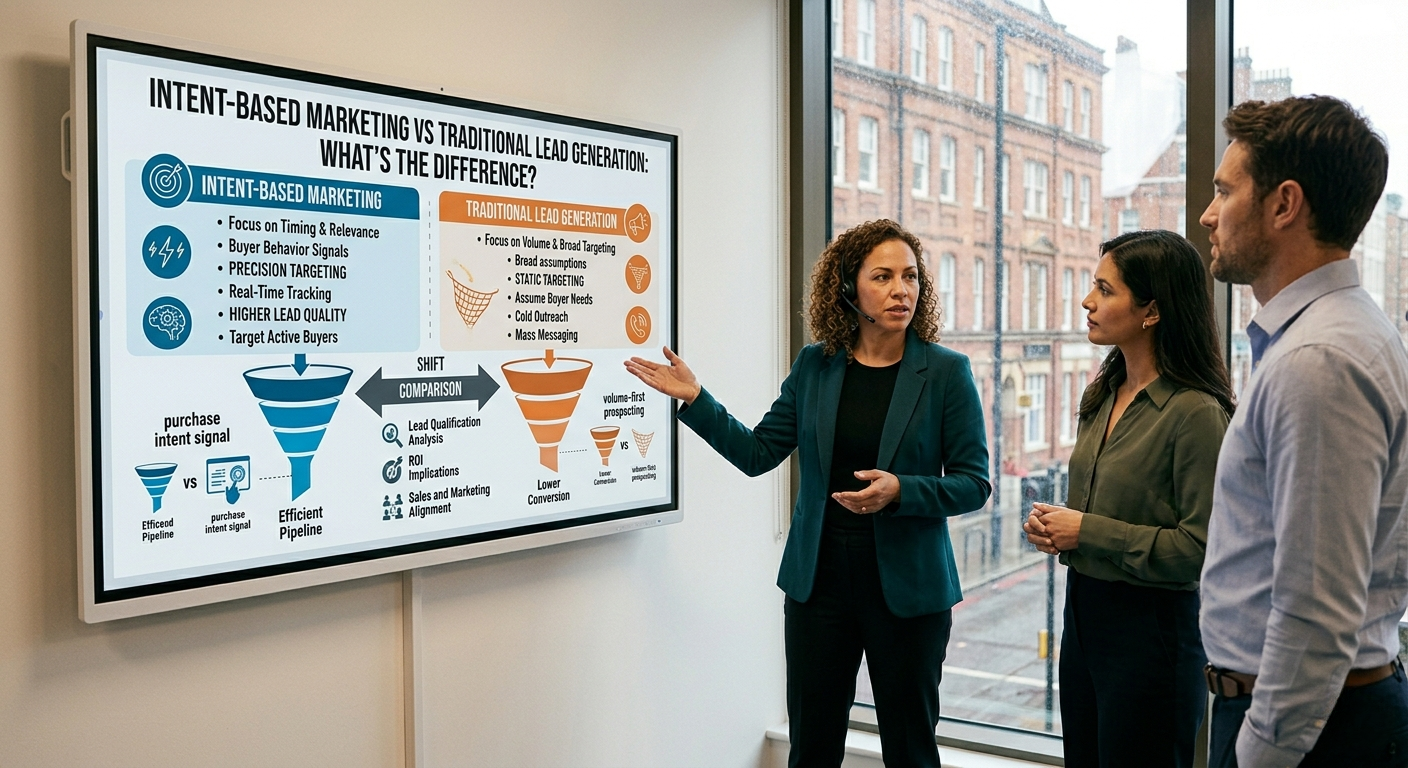
Intent-Based Marketing vs Traditional Lead Generation: What’s the Difference?

B2B sales teams now are under pressure to generate pipeline faster while improving lead quality and reducing wasted outreach. Traditional prospecting methods still exist, but buyer behavior has changed dramatically. Decision-makers now research solutions independently long before responding to a sales message. This shift is why many companies are asking: what is intent based marketing, and how does it compare to traditional lead generation? The answer lies in how businesses identify, prioritize, and engage potential buyers. Traditional lead generation often focuses on volume and broad targeting, while intent-based marketing emphasizes timing, relevance, and buyer behavior signals. Understanding the difference between these two approaches can help sales and marketing teams build more efficient and scalable pipeline generation systems. Why Traditional Lead Generation Is Being Challenged The limits of broad targeting in modern B2B sales Traditional lead generation was built around broad targeting. Teams created large prospect lists based on company size, industry, or job title and then launched outreach campaigns at scale. The problem is that these filters alone do not reveal whether someone is actively considering a purchase. A prospect may match your ideal customer profile but still have no immediate interest in your solution. As competition increases, broad targeting becomes less effective because buyers are overwhelmed with generic outreach from multiple vendors. Why generic outreach struggles to reach in-market buyers Generic messaging often fails because it assumes every prospect is equally ready to engage. In reality, only a small percentage of buyers are actively researching solutions at any given time. When outreach lacks context or relevance, it blends into the noise. Prospects are more likely to ignore messages that do not connect to their current priorities or challenges. This is why response rates have declined across many traditional outbound campaigns. The rise of intent-based marketing definition in revenue teams The growing focus on buyer behavior has pushed revenue teams toward the intent-based marketing definition. Instead of relying only on demographic data, teams now analyze digital signals that indicate real purchase interest. This shift allows organizations to identify which accounts are actively researching problems related to their solutions, making outreach more precise and timely. What Is Traditional Lead Generation? How conventional B2B lead generation models work Traditional lead generation typically relies on fixed targeting criteria and outbound campaigns designed to create awareness. The process often includes list building, cold outreach, advertising, and lead capture forms. The goal is usually to generate as many leads as possible and then qualify them later in the pipeline. Volume-first prospecting and static targeting methods Many conventional prospecting models operate with a volume-first mindset. The assumption is that more outreach equals more opportunities. Common characteristics include: Large-scale email campaigns Static contact lists Limited personalization Minimal behavioral insights While this approach can still produce results, efficiency often declines as buyer expectations evolve. Common channels used in traditional lead generation campaigns Traditional campaigns typically rely on channels such as: Cold email outreach Paid advertising Trade shows and events Purchased lead databases Basic LinkedIn prospecting These channels are still useful, but their effectiveness depends heavily on targeting quality and message relevance. What Is Intent-Based Marketing? Understanding B2B buyer intent data and buyer behavior signals To understand what is intent based marketing, it is important to look at how buyer intent data works. B2B buyer intent data tracks digital activities that suggest purchase interest. These signals may include: Researching specific topics online Visiting competitor websites Downloading industry resources Searching for solution-related keywords Together, these actions create a picture of buyer readiness. How intent-driven lead generation differs from traditional prospecting Intent-driven lead generation focuses on identifying active buyers rather than contacting broad audiences. Instead of asking, “Who fits our ICP?” the question becomes, “Who is actively searching for a solution right now?” This creates a major shift in targeting strategy. The role of purchase intent signals in identifying active buyers Purchase intent signals help sales teams prioritize accounts that show signs of real buying activity. This allows outreach to happen when interest is already developing. As a result, sales conversations often begin with stronger relevance and engagement. Why real-time buyer behavior tracking changes outreach timing Timing is one of the biggest advantages of intent-based marketing. Real-time buyer behavior tracking allows teams to engage prospects while they are actively researching problems. This creates a more natural entry point for conversations compared to random cold outreach. Cold Outreach vs Intent-Driven Outreach How traditional cold outreach relies on assumptions Traditional cold outreach often depends on assumptions about who might need a product. Sales reps reach out based on profile matching rather than demonstrated interest. This can lead to low engagement rates and wasted effort. Why targeting in-market buyers improves engagement Targeting in-market buyers significantly improves relevance because outreach aligns with active research behavior. Prospects are more likely to respond when your solution connects to a problem they are already exploring. Using personalized outreach using buyer intent for better conversations Personalized outreach using buyer intent creates stronger conversations because messaging reflects actual buyer interests rather than generic assumptions. For example, if a prospect has been researching pipeline automation, outreach can directly address workflow efficiency challenges instead of using broad messaging. Comparing outreach timing, relevance, and buyer readiness The biggest difference between traditional and intent-driven outreach comes down to: Timing Relevance Buyer readiness Intent-based outreach performs better because it aligns all three factors simultaneously. Volume vs Precision: Two Different Prospecting Philosophies Traditional outreach and the “more volume” mindset Traditional prospecting often assumes that increasing activity will automatically increase pipeline. While volume can create opportunities, it can also create inefficiency. How high-intent prospect identification improves efficiency High-intent prospect identification allows teams to focus effort where conversion probability is highest. Instead of contacting thousands of prospects, teams prioritize the accounts most likely to engage. The role of behavioral targeting in B2B marketing Behavioral targeting in B2B marketing uses buyer actions rather than static demographics to guide outreach decisions. This improves precision and increases message relevance. Why precision targeting often outperforms mass outreach Precision targeting often generates:

How Intent-based Targeting Works for Life Science Companies

Why Intent Based Targeting Matters in the Life Sciences Industry Traditional outreach often fails in life sciences because buyers rarely make decisions based on surface level interest. Scientific teams display clear, measurable signals at different points in the R&D lifecycle, and these patterns provide far more accurate insights into their buying readiness than demographic targeting alone. As research organizations adopt more digital workflows, intent based targeting has become an essential capability for CROs, CDMOs, and life science tools companies that want to align outreach with actual scientific interest. The Shift From Broad Outreach to Precision Targeting Broad outreach wastes time because scientific buyers expect relevance, depth, and workflow level understanding. Intent based targeting allows vendors to focus only on prospects showing behaviors linked to active projects, upcoming experiments, or planned scale up. This shift dramatically increases both conversion rates and sales efficiency. Why Scientific Buyers Show Clear, Trackable Intent Scientists and engineers constantly search for experimental methods, instrumentation comparisons, troubleshooting guides, and regulatory information. These patterns directly reflect their work stage and their underlying needs. Unlike traditional B2B buyers, their intent signals are highly specific to workflows, assays, and technologies, which makes them easier to interpret and act on. How CROs, CDMOs, and Tools Providers Benefit From Intent Signals Intent signals help vendors identify which accounts are planning studies, evaluating outsourcing partners, preparing for tech transfer, or comparing tools for upcoming experiments. This ensures that outreach is both timely and aligned with real scientific priorities. Instead of guessing, teams can approach prospects with credible, context driven messaging that reflects what the customer is already investigating. Understanding Scientific Intent Signals Across the R&D Lifecycle Intent signals vary depending on where the buyer is within discovery, development, scale up, or validation. Knowing the stage helps vendors tailor outreach more precisely and avoid premature or irrelevant messaging. Early Stage Research Intent Early stage research teams focus on exploration, ideation, and preliminary experimentation. Their intent signals often include the following patterns. Literature searches and publication patterns Frequent searches on specific assays, biomarkers, or experimental techniques may indicate upcoming project planning. Monitoring publication trends also reveals which labs are entering new research areas. Conference abstracts and poster topics Conference participation signals scientific direction. Poster sessions and abstracts help identify teams that are actively working on relevant modalities or workflows. Workflow specific content consumption Researchers consuming application notes, troubleshooting guides, or discovery oriented content often signal early but meaningful curiosity about potential solutions. Mid Stage Intent for Process Development and Verification As teams move into optimization, their behavior becomes more detailed and evaluation driven. Instrumentation comparisons Comparing tools, reagents, or platforms is a strong indicator that teams are narrowing down potential vendors. Protocol optimization content Downloads related to throughput, reproducibility, or assay improvement usually reflect active experimentation. Vendor benchmarking behavior When buyers start evaluating performance data or case studies, it often signals an impending shortlisting process. Late Stage Intent for Manufacturing, Tech Transfer, and Validation Late stage intent reveals readiness for scale, compliance, and operational rigor. Regulatory documentation activity Interest in validation guidelines, quality standards, or documentation templates indicates preparation for regulated work. GMP related queries Teams researching GMP considerations are usually close to selecting commercial partners. Equipment or reagent capacity research Capacity focused signals often reveal readiness for procurement or outsourcing. Intent Signals That CROs Should Pay Attention To CROs need to identify research teams that are preparing for studies or looking for external support. Demand for Specialized Assays or Study Types Searches related to immunogenicity, bioavailability, toxicology, or modality specific assays indicate clear outsourcing needs. Searches Around Compliance, Reporting, and Study Design Prospects looking for GLP reporting standards or study design templates are often preparing RFPs. Hiring Patterns That Indicate Study Outsourcing Needs New roles in biostats, study coordination, or regulatory affairs often signal expanded study volume or lack of internal bandwidth. Academic to Industry Transition Signals Grant wins, translational research announcements, and startup spin outs often predict upcoming needs for outsourced work. Intent Signals That CDMOs Can Use to Identify Scalable Projects CDMOs should look for signs that companies are preparing for scale up or manufacturing readiness. Process Development Content Consumption Teams consuming upstream or downstream bioprocessing content often indicate scale up preparation. Scale Up Challenges and Bioprocess Troubleshooting Searches Searches involving yield issues, contamination risks, or equipment limitations usually reflect mid to late stage development. Facility Expansion and Manufacturing Focused Job Posts Roles such as manufacturing supervisors or validation engineers are strong signals that companies are building capacity. Tech Transfer Readiness Indicators Interest in batch records, validation documentation, or transfer protocols suggests that organizations are approaching partner selection. Intent Signals Most Relevant to Life Science Tools Companies Tools vendors benefit from identifying buyers who are comparing instrumentation or troubleshooting workflows. Workflow Specific Searches Queries like ELISA sensitivity, HPLC troubleshooting, or single cell protocol optimization reveal distinct workflow needs. Instrument Comparison Activity Comparisons between competing instruments are powerful bottom funnel signals indicating readiness to evaluate vendors. Budget Allocation and Procurement Cycles Reflected Through Behavior Repeated visits to pricing resources or procurement guidelines usually signal purchase planning. Application Specific Reading Behavior Patterns in reading about cell therapy, genomics, or proteomics indicate which scientific domain the buyer is preparing to support. Mapping Intent Signals to Outreach Messaging The value of intent data depends on how well messaging reflects the buyer’s context. CRO Focused Messaging Reference the specific assay or study type the prospect has been researching. Provide relevant examples or past project outcomes. CDMO Focused Messaging Lead with scalability, compliance expectations, and manufacturing timelines that match the prospect’s recent behavior. Tools Vendor Messaging Highlight workflow pain points and application specific benefits instead of product features alone. Example: Converting an Instrument Comparison Signal If a prospect compares your HPLC system against competitors, respond with a message such as, “I saw interest in comparison data for HPLC performance. Many teams look for repeatability and throughput. Happy to share validated results that align with your use case.” How to Prioritize Intent Signals Not all signals have equal

Intent-Based Targeting: How it Affects Long Sales Cycles

Why Intent-Based Targeting Matters For Long Cycle Sales High ACV deals usually involve multiple decision makers, months of evaluation, and layers of internal approvals. In environments like biotechnology, enterprise SaaS, advanced manufacturing, and medtech, the need to identify true buying behavior early is essential. Intent-based targeting provides visibility into the subtle behavioral patterns that signal interest, evaluation, or readiness. The Cost of Wasted Time and Misdirected Outreach In long sales cycles, time is your most expensive resource. Reaching out to low probability accounts leads to slow pipeline movement, wasted labor, and missed opportunities with buyers who were closer to evaluating a solution. Intent-based targeting ensures that your team focuses on prospects who are signaling meaningful, observable research activity. Why Long Sales Cycles Produce More Measurable Intent Signals Long buying journeys produce more digital fingerprints. Prospects read more content, compare more solutions, and revisit vendor materials multiple times. These behaviors allow marketers to piece together a clearer picture of buying readiness, especially when they appear in sequence. How Intent Accelerates Qualification Without Sacrificing Quality Traditional qualification methods often rely on forms and self-reported interest. Intent-based targeting surfaces real behavior that reflects genuine evaluation. This speeds up qualification without lowering standards, because the signals come directly from buyer actions instead of presumptions from sales teams. The Buying Psychology of High ACV Purchases Risk Aversion and Multi-Stakeholder Decision Making High ACV deals are evaluated by committees that include technical leaders, financial reviewers, and sometimes compliance officers. Any risk perceived by one stakeholder can stall or kill the deal. Understanding the intent of each stakeholder helps you tailor outreach to reduce fear and provide clarity. Procurement, Compliance, and Budget Timeline Constraints Even when prospects want to move quickly, internal processes often slow them down. Intent-based targeting helps you detect when they approach budgeting windows, compliance reviews, or procurement cycles. This allows you to time outreach around their internal rhythm instead of your own. The Need for Early Technical Validation Before Pipeline Movement High ACV buyers rarely book meetings without early technical validation. They want to see case studies, performance data, architecture documentation, or workflow details long before speaking with a representative. Intent signals highlight when this early research begins, allowing you to warm them up before direct contact. Types of Intent Signals Most Relevant to High ACV Markets Early Stage Research and Exploration Signals These signals indicate that a problem has been identified but solutions are not being evaluated yet. Workflow specific educational content Reading troubleshooting guides, protocol overviews, or concept explainers often indicates problem definition. Technical comparison reading patterns Prospects who read “how to choose” guides are evaluating theoretical fit. Problem based searches indicating active pain Search terms tied to bottlenecks or inefficiencies reveal early awareness of a need. Mid Funnel Evaluation Signals These actions show that the buyer is comparing vendors or identifying technical constraints. Vendor comparisons and compatibility research Competitor reviews or integration checks reflect growing seriousness. Architecture, integration, or scale up queries These searches reveal deeper concerns about fit and long term viability. Case study and validation content consumption This is one of the strongest mid funnel signals in high ACV environments. Late Stage Procurement Signals These signals almost always indicate active consideration or preparation for a purchase. RFP activity and purchasing committee evaluations Teams searching for requirements or templates are in the decision phase. Budgeting cycles and funding announcements Fresh budgets or new capital often accelerate purchasing. Compliance, audit, and regulatory documentation research This is common before formal evaluation or vendor onboarding. How Intent-Based Targeting Works Across Industries With Long Sales Cycles Biotech: Scientific Workflows Show Clear Intent Milestones Assay development to validation to scale up Buyers move in predictable scientific phases, each generating intent signals. Instrumentation benchmarking as a strong buying indicator Comparisons of throughput, sensitivity, and compatibility often signal readiness. Enterprise SaaS: Integration and Security Signals Predict Readiness API documentation activity Prospects reviewing integration docs usually have technical teams evaluating fit. SOC2, HIPAA, or security comparison page visits These actions are strong indicators that compliance teams are involved. Medtech: Clinical Workflow Research Indicates Device Readiness Procedure specific content Clinicians researching workflows often explore new equipment. Training, adoption, and clinical guideline queries Training signals often precede equipment evaluation. Advanced Manufacturing: CapEx Close to Procurement Shows Intent Throughput, facility expansion, and automation research Expansion signals correlate with readiness to purchase new equipment. Vendor capability and maintenance cost comparisons These searches indicate procurement driven due diligence. Building a Multi Signal Intent Model for High ACV Buying Cycles Signal Depth A weak signal is a single blog visit. A strong signal is a full content sequence that maps to a workflow. Signal Recency Fresh activity is more predictive than research conducted months ago. Signal Correlation Two or more related behaviors within a short period dramatically increase probability. How to Convert Intent Signals Into Pipeline Without Being Aggressive Tailor Outreach to the Buyer’s Phase, Not Your Quota Push too hard and you create resistance. Move too slowly and competitors win. Lead With Evidence, Case Data, and Application Expertise High ACV buyers want clarity, not persuasion. Offer Low Friction CTAs That Match High ACV Behavior Workflow reviews Application specific demos Technical discovery calls All of these offer value without pressure. Common Mistakes Teams Make When Using Intent for High ACV Markets Overreacting to Single, Weak Intent Signals One page view does not justify outreach. Sending Bottom Funnel Messaging Too Early Jumping into pricing or demos prematurely can push buyers away. Ignoring Procurement Timelines and Budget Cycles Intent without timing awareness leads to wasted effort. Focusing on Volume Instead of Deal Probability The goal is not to fill the top of the funnel. It is to prioritize high quality opportunities. Framework: Turning Intent Into Opportunities in Long Sales Cycles Step 1: Group prospects by intent phase Early, mid, or late funnel behaviors. Step 2: Match messaging to technical or business pain Your message must align with their specific workflow. Step 3: Use credibility anchors to reduce perceived risk Case studies, benchmarks, or SME

Intent-based Targeting Not Working? When Intent Signals are Misleading and How to Better Interpret Them

Introduction: The Hidden Risks of Misreading Intent Signals Intent signals are one of the most powerful tools in modern B2B marketing. They allow teams to prioritize accounts based on behavior instead of guesswork, helping marketers deliver the right message at the right time. But despite their value, intent signals are not foolproof. They can be noisy, misleading, and even counterproductive when interpreted in isolation. Why intent is powerful—but not foolproof Intent-based targeting gives marketers behavioral context beyond traditional demographics or firmographics. But relying on any single action—whether a content download or a pricing page visit—sets teams up for false assumptions. Intent is directional, not definitive. The danger of chasing “false positives” in B2B A spike in engagement may look like buying intent when in reality it comes from job seekers, students, bots, or competitors. Misreading this data can waste sales resources, inflate pipeline expectations, and strain SDR bandwidth. Why marketers must blend data with context and judgment Intent signals work best when interpreted through a combination of: Behavioral patterns ICP fit Buying stage Frequency and recency Human judgment Without these layers, marketers end up chasing noise instead of true opportunities. The Difference Between High-Quality and Low-Quality Intent Signals Not all signals have equal weight. Understanding the differences helps marketers score leads accurately and prioritize high-value accounts. Signal depth: how strong or weak the action is Examples of strong signals: Pricing page visits Competitor comparison views Demo interactions Examples of weak signals: Blog post views Email opens One-time website visits Depth matters because some behaviors clearly indicate evaluation, while others merely reflect curiosity. Signal frequency: how often the activity occurs Multiple return visits, repeat searches, or sequential content engagement are far more telling than one-off interactions. Frequency suggests: Growing interest Internal discussions Momentum in the buying journey Signal recency: how fresh the behavior is A prospect who binged your content six months ago but has been inactive since does not hold the same value as an account showing activity in the last three days. Signal relevance: whether it aligns with your ICP and solution You can’t call it meaningful intent if: The account is outside your vertical The persona is irrelevant The behavior does not relate to your core use case Relevance ensures you don’t misinterpret activity that has nothing to do with actual buying readiness. Common Situations Where Intent Signals Mislead Marketers Even the most sophisticated systems can produce false positives. Here are the most common cases. 1. High content engagement that has nothing to do with buying Students, researchers, and job seekers driving up views Educational audiences often download content for learning purposes—not purchasing. Educational interest vs commercial interest Just because someone reads your whitepaper doesn’t mean their company is evaluating vendors. 2. Pricing page visits from existing customers or competitors Renewal research, benchmarking, or competitive intelligence Customers might be checking upgrades, while competitors often analyze pricing models. This can look like buying intent but has zero pipeline value. 3. Webinar registrations that never get attended Low commitment vs true evaluation intent Registrations reflect curiosity, not intent. Attendance with active participation is what matters. 4. Website traffic spikes from bots or low-quality referral sources How to filter spam or irrelevant traffic Traffic from suspicious geographic regions, unknown referral sites, or automated browsing patterns should be excluded from scoring. 5. Funding announcements that don’t relate to your solution Why new capital doesn’t always mean new buying needs Funding is a directional signal. But unless your solution aligns with their new initiatives, it means nothing for your pipeline. 6. Job postings that don’t imply actual buying readiness Hiring ≠ purchasing; understanding the nuance A company hiring a scientist doesn’t necessarily need new lab tools. Context matters. How to Properly Interpret Intent Signals Without Making Wrong Assumptions Avoiding misinterpretation requires structured analysis rather than reacting to isolated behaviors. Looking for patterns, not isolated signals A single action means little. A sequence is meaningful. Layering multiple signals for stronger predictions For example: Pricing page visit Multiple return visits Case study downloads LinkedIn engagements This stack is far more reliable than any one action alone. Using behavioral sequences to understand true intent A prospect who moves from educational content → product pages → demo tour is clearly progressing in the buying journey. Aligning signals with buying stage (ToFu, MoFu, BoFu) Mapping engagement to funnel stages prevents premature outreach. The Role of ICP Alignment in Avoiding False Positives Intent only matters when it comes from the right type of account. Why intent without the right ICP = wasted effort A non-ICP company reading your content is not a real opportunity. Ensuring industry, role, and workflow fit Lead scoring should penalize engagement from: Non-target industries Junior roles Unrelated domains Avoiding the trap of “chasing every signal” More signals do not equal better signals. Quality beats quantity every time. Timing Sensitivity: When Intent Signals Look Real but Are Too Early (or Too Late) Timing can distort your perception of intent. Early-stage research disguised as buying behavior Some prospects dive deep into content long before they have budget, authority, or urgency. Late-stage evaluations where you’re already out of the running If the account has already done vendor comparisons, you may be too late. When to follow up, slow down, or disengage Signals should dictate pacing: Early stage → nurture Mid stage → educate Late stage → engage immediately How to Fix Misleading Intent Data in Your Lead Scoring Model Improving your model reduces noise and strengthens pipeline quality. Adjusting weights for signal strength and relevance Pricing page visit > blog view Case study download > social like Score accordingly. Adding negative signals (drop-offs, time gaps, bounces) Intent decays. Your model should reflect that. Setting thresholds before passing leads to sales Do not send a lead to sales unless it crosses a multi-signal threshold. Best Practices for Validating Intent Before Outreach Before contacting a prospect, validate the signal using simple checks. Confirming behavior with soft-touch emails or LinkedIn interactions Examples: “Saw you were exploring X topic. Happy to

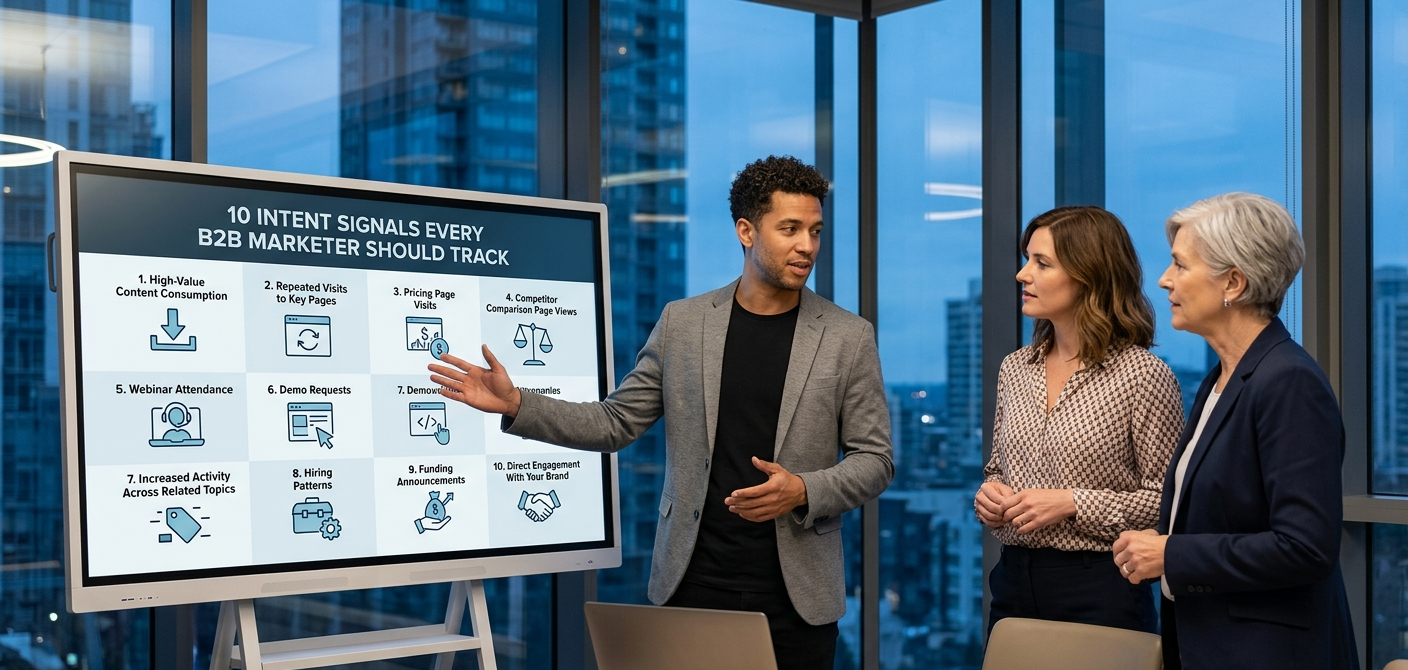
10 Intent Signals Every B2B Marketer Should Track in 2026

Introduction: Why Intent Signals Matter More Than Ever In modern B2B marketing, demographic targeting is no longer enough to identify high-quality prospects. Companies now generate overwhelming volumes of digital activity; content downloads, page visits, webinar registrations, and more. Hidden within these actions is behavioral intelligence that reveals which accounts are actively researching solutions. This is where intent-based targeting becomes one of the most powerful growth levers. When marketers understand what prospects are doing (not just who they are), it becomes possible to prioritize high-probability accounts, deliver better personalization, and engage buyers at the exact moment they’re open to conversations. Ultimately, timing becomes the biggest differentiator between winning early and losing late. In today’s blogpost, we’ll be covering the top 10 intent signals you should keep watch for in 2026 so you will be ready with an accurate intent-based targeting to start the year! 1. High-Value Content Consumption Signals High-value assets like whitepapers, case studies, application notes, technical guides, and industry benchmark reports are some of the strongest indicators of buyer intent. These types of content require time, cognitive effort, and genuine interest in understanding a workflow, evaluating a solution, or comparing approaches. When a prospect consumes these resources, they are signaling much more than casual curiosity. They are revealing that they have a specific problem they want to solve and are actively seeking insight, validation, or a competitive advantage. Unlike short blog posts or high-level marketing content, these deep-dive materials attract prospects who are already aligned with your value proposition. They demonstrate that the buyer is exploring the scientific, technical, or operational details behind a solution, which typically corresponds to mid- to late-funnel stages. This is why high-value content interactions are considered one of the most reliable signals in intent-based targeting. Prospects engaging with long-form educational or technical materials are often: Evaluating whether your approach fits their workflow Comparing your methodology to alternative solutions Assessing performance benchmarks, limitations, and feasibility Looking for evidence to support internal discussions with stakeholders Preparing for a procurement conversation or vendor shortlist This level of engagement provides an opportunity to tailor outreach with context, relevance, and precision. Signal strength: High This is one of the strongest indicators that a prospect is problem-aware and actively gathering information to move toward a decision. How to Activate This Signal in Outbound and Retargeting To make the most of high-value content consumption, align your outreach with the specific workflow, challenge, or industry segment represented in the downloaded asset. The follow-up should reflect that you understand what the reader is trying to solve and offer the next logical step in their evaluation journey. Here are ways to activate the signal effectively: 1. Reference the specific asset directly This creates instant relevance and shows the outreach is tailored. Example: “I noticed you accessed our case study on reducing cycle time in upstream optimization. If it helps, I can share the updated benchmarks we collected during the latest trials.” 2. Provide the next piece of value in the workflow If they consumed a case study, send an application note.>If they downloaded a whitepaper, offer a short technical comparison.>If they viewed a benchmark guide, share data from relevant customer segments. This creates a natural progression, not a cold jump to a demo request. 3. Segment retargeting around the problem, not the product Instead of serving generic ads, match retargeting to the problem category. Example segments: “Improving throughput in analytical workflows” “Automating upstream QC steps” “Enhancing reproducibility in cell-based assays” This dramatically improves CTR and engagement because it reinforces the topic the prospect already cares about. 4. Use this behavior to trigger SDR outreach with a context-first angle Have SDRs frame their message with awareness of what the reader consumed. Example: “Many teams who review that application note are usually evaluating methods for reducing sample prep variability. If that’s relevant for you, I can share a quick breakdown of approaches used by similar labs.” 5. Add a soft CTA tied to the buyer’s evaluation stage Avoid pushing for a meeting too early. Instead, offer small steps forward: “Want the protocol version of this workflow?” “Would it help to see how other teams implemented this?” “Happy to send the dataset behind the case study.” Soft CTAs work especially well when the prospect is still validating. 2. Repeated Visits to Key Web Pages When a prospect returns multiple times to key sections of your website, it is one of the clearest behavioral indicators that they are evaluating whether your solution is a match for their needs. Unlike high-value content downloads, which show focused research, repeated page visits reflect active comparison, internal discussion, and ongoing validation. These behaviors often occur when prospects are refining their requirements, aligning stakeholders, or narrowing their shortlist. The most important pages to monitor include: Solution pages Product feature pages Pricing-adjacent content (but not the pricing page itself) Industry or use-case pages Integration or compatibility pages Technical workflow breakdowns These pages tie directly to relevance, feasibility, and workflow alignment. When someone revisits them, they are almost always assessing fit. Signal strength: Medium to high The strength depends heavily on frequency and depth. One visit can be casual. Two visits suggests curiosity. Three or more visits usually means the buyer is entering an evaluation mindset. How to Interpret Visit Depth and Frequency To use this intent signal effectively, you need to understand how pattern behavior reflects where the buyer is in their journey. Not every repeated visit is equal, and the nuances matter. 1. Long-duration page views If a visitor spends several minutes on a solution or product page, it indicates they are absorbing technical details, comparing your approach to known alternatives, or checking alignment with their workflow. Long-duration visits often correlate with: Mid-funnel research Early technical validation Internal stakeholder review 2. Repeated loops across similar pages When prospects move between multiple related pages in a short window—such as product features, use cases, and compatibility sections—they are likely: Mapping your offering to their specific environment Checking whether you support their equipment or data

5 Proven Ways to Personalize Outreach Using Intent-Based Marketing

  Why Intent-Based Personalization Outperforms Traditional Outreach The problem with generic messaging in complex B2B buying cycles Traditional outreach relies heavily on demographic or firmographic data, such as job titles, industries, or company size. While useful, this information tells you nothing about what a buyer is thinking right now. Modern, intent-based marketing made B2B buying cycles involve long research phases, multiple decision makers, and dozens of digital touchpoints. Generic messaging gets lost because it doesn’t match the buyer’s current priorities. How intent signals reveal real-time buyer priorities Intent data changes the game. It shows what topics buyers are actively researching, which competitors they are evaluating, and what content they are consuming. This gives sales and marketing teams a real-time window into what matters most at this exact moment. Why personalization based on context beats personalization based on identity Personalizing based on job title or industry creates surface-level relevance. Personalizing based on intent creates contextual relevance. Identity tells you who the buyer is. Intent tells you what the buyer cares about today. A quick comparison: intent-based personalization vs traditional segmentation Traditional segmentation: “Hi Sarah, as a Director of Operations in biotech…” Intent-based personalization: “I noticed your team has been researching analytical method validation, which usually comes up when labs prepare for scale-up…” The second message always wins because it connects to the buyer’s mindset, not just their profile. Personalization Strategy #1 — Tailor Messaging to the Prospect’s Active Research Topics How to identify trending keyword clusters and content themes Tools like Bombora, ZoomInfo, G2, or Demandbase reveal keyword clusters linked to heightened research activity. These clusters help you understand what themes are gaining traction across the account. Mapping email and LinkedIn messaging to the exact intent topic Once you know what the account is researching, adjust your angle accordingly. If the topic is “scalability,” you talk about throughput and efficiency. If the topic is “compliance,” you highlight risk reduction. Avoiding over-personalization that feels intrusive Do not say, “We saw you Googled X.” Anchor your message around trends, not surveillance. Example for cold email “Saw your team researching single-use bioreactor scalability. Most teams look into this right before optimizing downstream throughput…” Example for LinkedIn Comment on or share content related to the research topic. Use subtle relevance, not explicit mention of intent. Example for retargeting ads Serve ads aligned with the research topic such as scalability, compliance, automation, or cost reduction. Topic-aligned ads outperform generic product ads. Personalization Strategy #2 — Prioritize Accounts Showing Surge Behavior or Spike in Buying Signals What a “surge” or “spike” means in intent data A surge occurs when an account’s research activity on a topic significantly exceeds its historical baseline. This often indicates early evaluation or deeper internal discussions. How to adjust outreach intensity based on signal strength Low surge: light touches and educational content. Medium surge: targeted outreach with value-based messaging. High surge: immediate outreach with tailored CTAs and competitive positioning. Creating dynamic outreach tiers based on surge levels Tier 1: high-surge accounts Tier 2: moderate activity Tier 3: exploratory researchers This prevents SDRs from treating all intent as equal. Example for cold email “Noticed a surge in interest around lab automation workflow optimization. This usually shows up right before teams begin evaluating vendors…” Example for LinkedIn Prioritize surging accounts for personalized DMs or insightful comments on their leadership posts. Example for retargeting ads Show urgency-driven ads such as comparison guides, analyst reports, or ROI tools. Personalization Strategy #3 — Reference Competitor-Intent Signals to Position Your Advantage Understanding when it’s appropriate to use competitor-intent data Competitor-intent signals tell you when an account is evaluating alternatives. Use this insight carefully and only when the account is showing strong buying behavior. How to position without sounding confrontational Focus on your differentiation, not the competitor’s flaws. Avoid negativity. Stick to outcomes and customer experiences. Ethical considerations for competitor-intent messaging Keep it high-level and respectful. Never imply insider knowledge or surveillance. Example for cold email “Teams exploring Competitor X usually hit a bottleneck around throughput visibility. Here’s how we approached it differently…” Example for LinkedIn Share a customer success story that subtly compares your strengths. Example for retargeting ads “Evaluating options? Here’s a side-by-side breakdown.” Personalization Strategy #4 — Use Buying Stage Indicators to Match Tone and CTA Distinguishing early-stage vs mid-stage vs late-stage intent signals Early-stage: broad topic searches, educational content. Mid-stage: comparison guides, vendor categories. Late-stage: pricing pages, product-specific content. Matching message length, tone, and CTA to the buyer’s stage Early-stage: short, helpful, educational. Mid-stage: tailored, insightful, problem-focused. Late-stage: direct, value-driven CTA. Avoiding aggressive CTAs for early-stage researchers Early intent requires nurturing, not pressure. Example for cold email Early-stage: “Thought this resource might help as you explore solutions.” Late-stage: “If you’re already comparing vendors, here’s a quick 2-minute breakdown.” Example for LinkedIn Early-stage: share light insights. Late-stage: offer a demo or ROI review. Example for retargeting ads Awareness ads → mid-stage guides → late-stage demos. Personalization Strategy #5 — Customize Outreach Based on Role-Specific Intent Patterns Different roles consume different intent signals Engineers research technical capabilities. Procurement researches pricing and compliance. Executives research ROI and efficiency. Adjusting messaging to pain points of each persona Technical roles want details. Leadership wants strategic business outcomes. Procurement wants clarity and cost stability. Creating multi-threaded outreach based on cross-role intent activity If multiple stakeholders show intent, don’t rely on one contact. Activate a multi-threaded approach. Example for cold email Engineer intent: “Saw your team researching method validation workflow. Most labs struggle with…” Leadership intent: “Your leadership team has been consuming content around cost efficiency in downstream processing…” Example for LinkedIn Comment across multiple stakeholders, not just the primary contact. Example for retargeting ads Engineering: technical whitepapers. Leadership: ROI calculators or case studies. Bonus: How to Operationalize Intent-Based Personalization Across SDR, Marketing, and RevOps The minimum tech stack needed One intent provider, a CRM connection, and a sequencing tool. Everything else is optional until you scale. How SDR teams should structure daily intent-driven workflows SDRs should start their day with high-surge

Top 7 Benefits of Intent-Based Marketing for B2B Lead Generation in 2026

Why Intent-Based Marketing Matters More Than Ever in B2B The shift from volume-based outreach to precision targeting For years, B2B teams relied on high-volume outreach to generate pipeline. More emails. Endless ads. Numerous forms. The assumption was simple: the more you push into market, the more leads you get back. Modern buying behavior has made that approach outdated. Today’s buyers research silently, independently, and across dozens of digital touchpoints before engaging with sales. Intent-based marketing fills the visibility gap and helps teams target only the accounts that show true interest. Why traditional lead scoring can’t keep up with modern buying behavior Standard lead scoring models rely on simplistic triggers. A single ebook download or webinar registration often inflates the score of a prospect who may not be anywhere near ready to buy. Intent data reveals deeper patterns such as sustained topic research or multi-channel engagement. This provides a more accurate view of where a buyer sits in the journey and prevents premature handoffs. How intent data supports multi-stakeholder B2B buying journeys B2B deals rarely involve one decision maker. Several team members research solutions at different times and for different reasons. Intent data uncovers this shared activity across an account and helps sales understand which stakeholders are involved and what topics matter to them. Sharper Targeting That Reduces Waste in the Funnel Identifying accounts actively researching your solutions Intent-based marketing helps you identify which companies are already exploring your space. These signals reflect genuine interest, which means your outreach lands with far more relevance. Filtering out low-probability leads before they drain resources Without intent, SDRs spend time chasing accounts that are not ready or not interested. Intent filters out the noise and allows teams to focus on prospects with real buying potential. Aligning messaging with the exact topics prospects care about Intent data shows not only who is researching but what they are researching. This allows marketing and SDR teams to align messaging with the content, pain points, or solutions the prospect has already shown interest in. How intent data improves audience segmentation beyond demographics Traditional segmentation uses industry, job title, or company size. Intent adds behavior. This creates a richer, more dynamic segmentation model that boosts relevance across emails, ads, and social engagement. Higher Conversion Rates Across the Pipeline Converting “silent researchers” before competitors even know they exist Buyers often spend weeks researching online without filling out a single form. Intent uncovers this hidden activity and helps teams engage prospects before competitors show up. Personalizing outreach with real-time interest signals When SDRs know exactly what a prospect has been researching, they can personalize message angles, subject lines, and value propositions with precision. Improving SDR performance through contextual conversation starters Instead of generic outreach, SDRs can begin conversations with insights such as: “I noticed your team has been researching data security frameworks. Happy to share what we’re seeing across your industry.” Context increases reply rates and strengthens credibility. Increasing MQL-to-SQL and SQL-to-opportunity conversion rates By focusing on accounts that are already in research mode, the entire funnel becomes more efficient. Leads convert faster, and opportunities progress with fewer stalls. Lower Customer Acquisition Cost (CAC) Through Efficient Spend Reducing paid ad waste by focusing on in-market accounts Intent allows marketers to stop spending money on broad audiences and instead retarget accounts that have demonstrated interest in your category. Lowering sales cycle fatigue by engaging buyers at the right moment When outreach happens before a buyer starts vendor evaluations, the sales cycle becomes shorter and smoother. Preventing marketing overspend on leads with low intent Low-intent leads cost money but rarely convert. Intent data helps teams throttle back spend on unqualified segments. How intent-based prioritization drives a healthier CAC-to-LTV ratio When you target the right accounts and engage them at the right time, acquisition cost drops and lifetime value increases. That combination drives healthier unit economics. Stronger Sales and Marketing Alignment Giving sales visibility into what each account is researching Sales teams often struggle with insight gaps. Intent solves this by showing real-time research behaviors at the account level. Creating shared definitions of intent-qualified leads Both teams can align on what constitutes a meaningful signal and what qualifies an account for outreach. Enabling coordinated touchpoints that match the buyer’s journey When both teams see the same signals, marketing can warm the account while sales reaches out strategically. Improving trust between teams through more predictable results Intent-driven programs reduce the guesswork. When SDRs see that intent-qualified accounts convert more often, confidence grows. More Predictable and Scalable Pipeline Growth Using intent trends to forecast demand Intent data reveals patterns in market behavior. If topic research surges across an industry, demand is likely rising. Identifying new markets and industries showing emerging interest You can spot new verticals that are starting to explore your category, even if they have never engaged with your website. Scaling ABM programs with data-driven targeting Intent helps ABM teams build account lists with higher precision and prioritize top-tier accounts. Reducing the unpredictability of top-of-funnel generation Traditional demand gen often feels like guesswork. Intent adds structure and predictability to pipeline development. Better Personalization With Less Manual Research Auto-populating buyer signals into outreach templates Intent tools can feed SDR sequences with research topics, keywords, and activity patterns. Crafting highly relevant content journeys for each segment Marketing teams can build nurture flows aligned with specific pain points and interests. Enabling SDRs to deliver “hyper-contextual” touches at scale Personalization no longer requires hours of research. Intent insights provide the context automatically. More accurate content recommendations based on research topics You can deliver the right content at the right time, which increases engagement throughout the funnel. Competitive Advantage Through Early Engagement Engaging buyers before they build a shortlist Early contact builds familiarity and positions your brand as a trusted guide. Intercepting prospects when they are still problem-aware You can educate and influence their thinking before other vendors enter the conversation. Using competitor-intent signals to win head-to-head deals Many intent tools track competitor research. This insight helps sales