

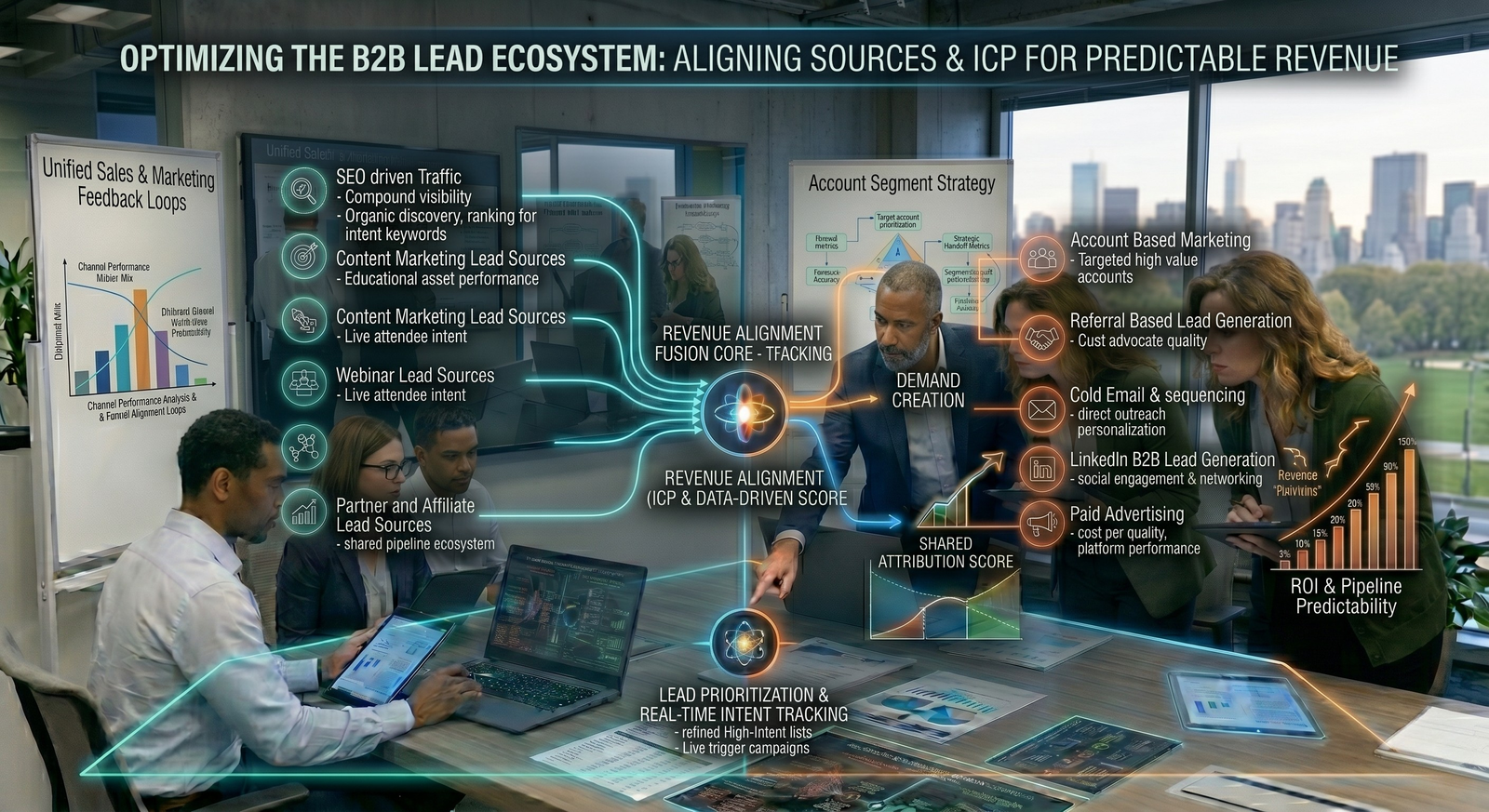
How to Identify the Best B2B Lead Sources for Your Business
Choosing the right B2B lead sources is one of the most important decisions in building a predictable sales pipeline. Many teams struggle not because they lack lead volume, but because they rely on channels that do not align with their ideal customer profile or revenue goals.
In reality, the “best” lead sources are not universal. They depend on your sales cycle, target market, and how your buyers actually discover and evaluate solutions. A channel that works for one company may underperform for another, even in the same industry.
This guide breaks down how to evaluate, compare, and select the most effective B2B lead sources so you can focus your efforts on channels that consistently generate qualified opportunities instead of just traffic.
Understanding What “Best B2B Lead Sources” Really Means
How B2B lead generation channels influence lead quality and volume
Different B2B lead generation channels produce very different outcomes. Some channels prioritize scale, while others prioritize precision. For example, paid ads may deliver volume quickly, while referral networks often produce fewer but higher quality leads.
Understanding this trade off is essential. A strong lead source is not just about how many leads it generates, but how many of those leads convert into revenue.
Defining sources of B2B leads based on business goals
B2B lead sources should be defined by outcomes rather than activity. If your goal is pipeline velocity, outbound and paid channels may dominate. If your goal is long term growth, organic search and content marketing become more important.
This alignment ensures you are not optimizing for the wrong metrics.
Why “best” depends on your sales cycle and buyer profile
A short sales cycle often benefits from direct-response channels like outbound email or paid campaigns. Longer, complex sales cycles tend to rely on trust-building sources such as content marketing, webinars, and ABM.
Your buyer profile also matters. Technical buyers may respond better to educational content, while executive buyers may engage more through peer referrals or account-based outreach.
Aligning lead sources with revenue outcomes, not just traffic
Traffic is not the goal. Revenue is. The most effective B2B teams evaluate lead sources based on conversion rates, deal size, and sales cycle influence rather than surface-level metrics like clicks or impressions.
Mapping Lead Acquisition Channels for Businesses
How lead acquisition channels for businesses shape pipeline consistency
Lead acquisition channels determine how predictable your pipeline becomes. A business relying on a single channel risks volatility, while diversified channels create stability.
Consistency is often more valuable than spikes in performance.
Categorizing channels by inbound, outbound, and hybrid models
Most B2B lead sources fall into three categories:
- Inbound: SEO, content, organic search
- Outbound: cold email, calling, direct outreach
- Hybrid: LinkedIn, ABM, partnerships
Each plays a different role in pipeline development.
Matching channels to different stages of the buyer journey
Early stage awareness often comes from inbound channels. Mid stage evaluation may be influenced by email nurturing or webinars. Late stage conversion is frequently driven by outbound or account based engagement.
Mapping channels to stages improves efficiency.
Building a structured view of all available lead sources
Instead of treating channels independently, businesses should build a unified map of all lead sources. This makes it easier to identify gaps, overlaps, and opportunities for optimization.
Evaluating Inbound Lead Sources for Long-Term Growth
How inbound lead sources attract high-intent prospects
Inbound leads are often self-qualified. When prospects find your business through search or content, they are usually already exploring a solution, which increases conversion probability.
Assessing SEO, content, and organic discovery performance
SEO and content marketing are the backbone of inbound lead generation. Evaluating keyword rankings, organic traffic quality, and conversion paths helps determine effectiveness.
Measuring quality vs quantity in inbound leads
High traffic does not always mean high value. The key is to measure:
- Lead-to-opportunity rate
- Time to conversion
- Customer lifetime value
These metrics reveal real inbound performance.
When inbound becomes your primary growth engine
Inbound becomes dominant when your content ecosystem consistently attracts qualified traffic and converts it into predictable pipeline without heavy sales intervention.
Outbound Lead Sourcing Strategies for Predictable Pipeline
How outbound lead sourcing strategies drive consistent outreach results
Outbound provides control over targeting. You decide who to reach, when, and how, making it one of the most predictable lead sources when executed well.
Evaluating cold email, calling, and direct outreach effectiveness
Each outbound channel has strengths:
- Email: scalable and measurable
- Calling: high engagement but resource intensive
- Direct outreach: strong for personalization
The best mix depends on your ICP.
Matching outbound efforts with ideal customer profiles
Outbound works best when tightly aligned with your ideal customer profile. Poor targeting leads to low response rates and wasted effort.
Optimizing outbound for scalability and conversion
Scaling outbound requires automation, segmentation, and messaging relevance. Without these, performance declines quickly as volume increases.
Account Based Marketing Lead Sources for High Value Deals
How account-based marketing lead sources improve targeting precision
ABM focuses on quality over quantity. Instead of targeting individuals, it targets high value accounts with coordinated outreach.
Identifying and prioritizing high-value accounts
The success of ABM depends on selecting the right accounts using firmographic data, intent signals, and engagement behavior.
Aligning marketing and sales for ABM success
ABM requires tight alignment between sales and marketing teams. Without coordination, messaging becomes inconsistent and less effective.
Measuring ROI from account focused campaigns
ABM ROI is measured by deal size, conversion rate, and account penetration rather than lead volume.
Referral Based Lead Generation as a Trust Driven Source
How referral-based lead generation produces high conversion leads
Referrals convert at higher rates because they come with built-in trust and credibility.
Leveraging customer advocacy for new opportunities
Satisfied customers can become your strongest lead source when actively encouraged to refer peers.
Building systems for consistent referrals
Referral programs should be structured, not accidental. Incentives and engagement loops help maintain consistency.
Evaluating referral quality vs other sources
Referral leads often have shorter sales cycles and higher lifetime value compared to cold acquisition channels.
Content Marketing Lead Sources for Sustainable Demand
How content marketing lead sources support inbound growth
Content builds authority and attracts organic traffic over time, creating compounding lead generation effects.
Mapping content to buyer intent stages
Different content types support different stages:
- Awareness: educational blogs
- Consideration: comparisons
- Decision: case studies
Evaluating SEO content performance for lead generation
Performance should be measured by conversions, not just rankings.
Scaling content as a long-term acquisition channel
Content becomes more powerful over time as authority builds and rankings compound.
LinkedIn B2B Lead Generation as a Core Channel
How LinkedIn B2B lead generation supports both inbound and outbound
LinkedIn functions as both a content distribution and direct outreach channel, making it highly versatile.
Evaluating engagement quality from LinkedIn outreach
Meaningful engagement such as replies and conversations is more important than impressions.
Building authority and trust through content and networking
Consistent posting and engagement help establish credibility within your target market.
Converting social interactions into qualified leads
Relationships built on LinkedIn can naturally evolve into sales conversations.
Email Outreach Lead Generation Channels for Direct Conversion
How email outreach lead generation channels perform in B2B sales
Email remains one of the most reliable outbound channels when properly segmented.
Measuring response rates and engagement quality
Open rates, reply rates, and meeting conversions are key performance indicators.
Segmenting email lists for better targeting
Segmentation improves relevance and significantly increases engagement.
Improving personalization for higher conversion rates
Personalized messaging based on intent and behavior performs significantly better than generic outreach.
Event and Webinar Lead Sources for High Intent Prospects
How event and webinar lead sources generate qualified engagement
Participants in events and webinars are often high intent prospects actively seeking solutions.
Evaluating attendee intent and engagement behavior
Attendance duration, participation, and questions indicate lead quality.
Post-event nurturing for pipeline conversion
Follow-up sequences are critical for converting event leads into opportunities.
Using events to validate high-value leads
Events often surface the most engaged prospects in your funnel.
Paid Advertising for B2B Leads and Scalable Acquisition
How paid advertising for B2B leads drives fast pipeline results
Paid channels deliver immediate visibility and controlled lead flow.
Evaluating cost per lead vs lead quality
Low cost per lead does not always mean high ROI. Quality matters more.
Choosing platforms based on audience behavior
LinkedIn, Google, and niche platforms each serve different targeting needs.
Scaling paid campaigns effectively
Scaling requires continuous optimization of targeting and messaging.
Organic Search Lead Generation for Compounding Growth
How organic search lead generation builds long-term authority
SEO creates sustainable inbound traffic that compounds over time.
Evaluating keyword intent and traffic quality
High intent keywords often convert better than broad informational searches.
Reducing dependency on paid acquisition
Strong organic presence reduces reliance on advertising budgets.
Scaling SEO for consistent lead flow
Consistent publishing and optimization drive long term results.
Partner and Affiliate Lead Sources for Expansion
How partner and affiliate lead sources extend market reach
Partnerships allow access to new audiences without building everything internally.
Evaluating partner quality and alignment
Not all partners are equal. Alignment with ICP is critical.
Building co-marketing and referral ecosystems
Collaborative campaigns increase reach and trust simultaneously.
Tracking performance from partner channels
Attribution ensures clarity on ROI from each partnership.
Data Driven Lead Sourcing Strategies for Better Decision Making
How data-driven lead sourcing strategies improve channel selection
Data helps identify which channels actually produce revenue, not just leads.
Using analytics to compare lead source performance
Metrics like CAC, conversion rate, and LTV provide clarity.
Identifying high ROI channels through data insights
Top performing channels should receive more investment.
Continuously optimizing lead sourcing decisions
Lead sourcing should evolve as market behavior changes.
How to Choose the Best B2B Lead Sources for Your Business
Aligning lead sources with revenue goals and ICP
Start with your ideal customer profile and reverse engineer channels.
Balancing short-term vs long-term acquisition channels
A healthy mix ensures immediate pipeline and future growth.
Building a diversified lead generation system
Relying on one source creates risk. Diversification builds stability.
Continuously testing and optimizing lead sources
Regular experimentation ensures ongoing performance improvement.
Final Thoughts
Identifying the best B2B lead sources is not about following trends but about understanding your buyers, your sales cycle, and your revenue goals. The strongest strategies combine multiple channels into a structured system that balances predictability, scalability, and long-term growth.
When evaluated properly, your lead sources become less about guessing and more about building a repeatable engine for revenue.
Find what you’re reading informative so far? Then why not read more by visiting our blog? We keep you up-to-date every week with how-to guides and strategies to B2B lead generation every single week! Click here to get started!