

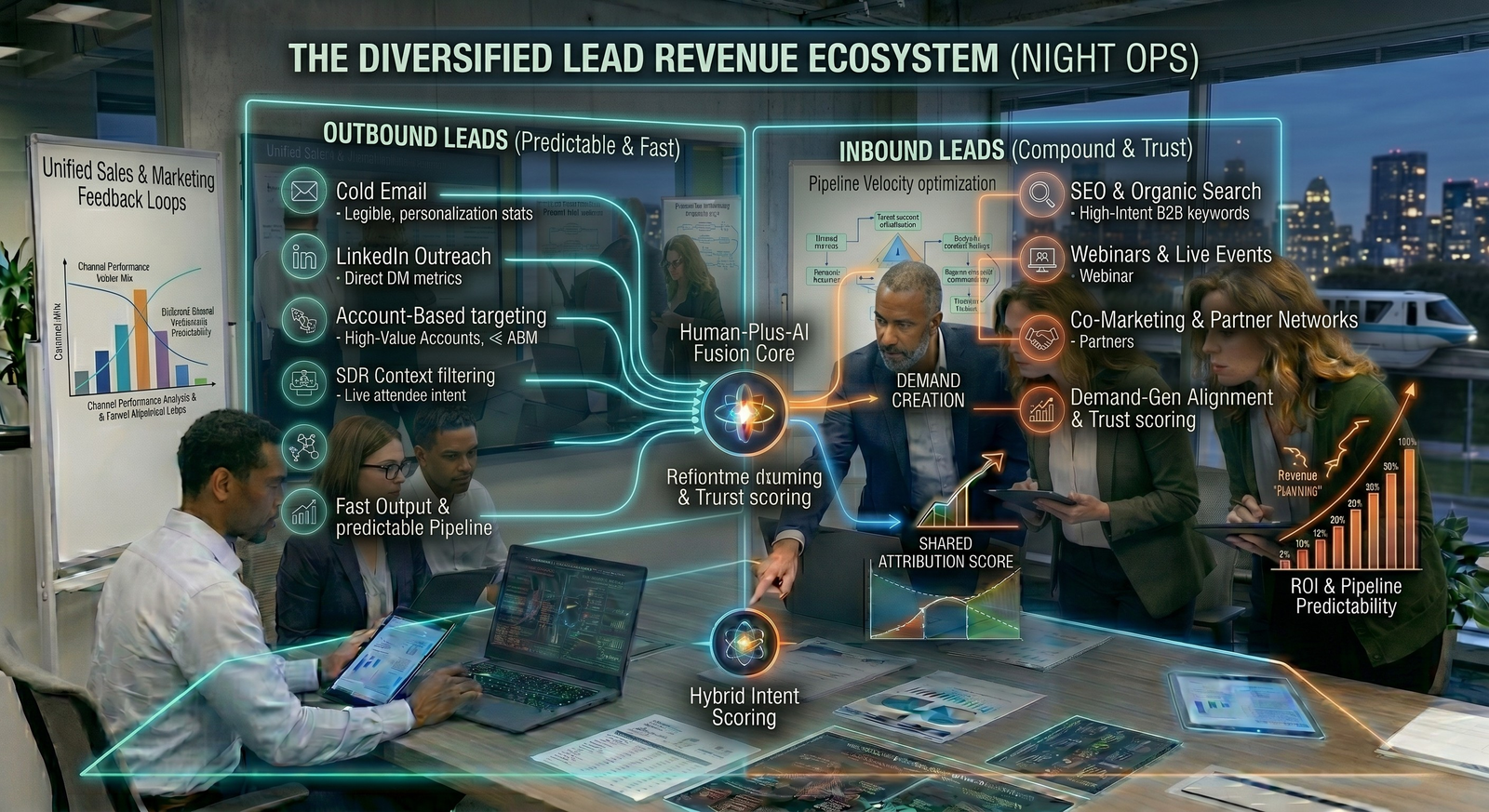
The Most Effective B2B Lead Sources for High-Growth Companies
High-growth companies rarely depend on a single way of generating leads. Instead, they build a structured mix of B2B lead sources that continuously feed their pipeline with qualified opportunities. The goal is not just volume, but consistency and quality across every stage of the buyer journey.
In practice, the strongest revenue engines come from companies that understand how each lead source performs, where it fits, and how it contributes to predictable growth. Some channels bring speed, others bring scale, and a few bring long-term compounding value. This article breaks down the most effective options and how to use them strategically.
Understanding High-Performing B2B Lead Generation Channels
How B2B lead generation channels drive scalable growth
B2B lead generation channels act as the entry points into your pipeline. They determine how prospects discover your business and how consistently new opportunities appear.
Key characteristics of scalable channels include:
- Repeatable lead flow over time
- Ability to optimize performance
- Predictable conversion outcomes
In short, scalable channels are not one-time wins. They are systems that improve as you refine them.
At a deeper level, strong channels reduce uncertainty in revenue planning because they provide measurable and consistent input into your sales pipeline.
What defines high-performing sources of B2B leads
A high-performing B2B lead source is not defined by traffic or activity alone. It is defined by outcome quality.
Typically, strong sources share:
- High conversion rates into opportunities
- Strong alignment with your ideal customer profile
- Efficient cost per acquisition over time
This means a smaller, more relevant audience often outperforms a large but unfocused one. Quality always compounds faster than volume in B2B environments.
Balancing inbound and outbound for consistent pipeline
A stable pipeline usually comes from combining inbound and outbound efforts rather than relying on one.
To simplify:
- Inbound brings “ready or researching” buyers
- Outbound creates proactive opportunities
When combined, they balance each other. If inbound slows down, outbound fills the gap. If outbound takes time, inbound builds long-term momentum.
This balance reduces volatility in revenue forecasting.
Why high-growth companies diversify lead acquisition
Diversification is not optional for scaling companies. It is a risk control strategy.
Main benefits include:
- Protection against channel dependency
- More stable pipeline across seasons
- Access to different buyer segments
Different buyers also prefer different discovery paths, so multiple B2B lead sources increase total market coverage.
Lead Acquisition Channels for Businesses That Scale Fast
How lead acquisition channels for businesses impact revenue growth
Lead acquisition channels directly shape how quickly a company can scale revenue. Strong channels reduce friction in the buying process and shorten time to opportunity.
In practical terms:
- Faster channels = quicker pipeline impact
- Slower channels = long-term compounding value
High-growth companies usually combine both for balance.
Matching channels to customer journey stages
Different channels perform better at different stages of the funnel.
For example:
- Awareness stage → SEO, content marketing
- Consideration stage → webinars, LinkedIn
- Decision stage → outbound, ABM
This mapping ensures that messaging aligns with buyer readiness, improving conversion efficiency.
Evaluating performance across different acquisition models
Not all channels should be judged equally. Each has its own purpose and performance style.
Key evaluation metrics include:
- Cost per qualified lead
- Conversion rate to opportunity
- Sales cycle length
These metrics give a more realistic picture than surface-level metrics like clicks or impressions.
Building a multi-channel lead generation system
A strong system is built like an ecosystem, not isolated tactics.
Core structure often includes:
- One or two primary growth channels
- Supporting secondary channels
- Testing channels for experimentation
This structure ensures both stability and innovation in lead generation.
Outbound Lead Sourcing Strategies That Deliver Fast Results
How outbound lead sourcing strategies support predictable pipeline growth
Outbound is one of the most controllable B2B lead sources. It allows teams to decide exactly who to target and when.
Key advantages:
- Predictable output
- Direct targeting control
- Fast feedback loops
This makes outbound ideal for early traction and pipeline stabilization.
Cold email as a core outbound engine for high-growth teams
Cold email remains one of the most efficient outbound tools because it scales easily while staying relatively low cost.
It works best when:
- Lists are highly targeted
- Messaging is relevant and specific
- Follow-ups are structured
Without these, performance drops quickly.
LinkedIn outreach for targeted prospect engagement
LinkedIn adds a human layer to outbound. It helps establish familiarity before or after email outreach.
Strong use cases include:
- Connecting with decision makers
- Engaging with content before outreach
- Building credibility through visibility
This improves trust before conversations even begin.
Combining outbound channels for higher conversion rates
The strongest outbound strategies are multi-touch.
A simple pattern:
- Email introduces
- LinkedIn reinforces
- Follow-up closes
This repetition increases response rates because prospects see multiple touchpoints over time.
Cold Email as a High-Converting B2B Lead Source
How email outreach lead generation channels drive direct conversations
Cold email works because it removes friction. It allows direct communication with decision makers without gatekeepers.
Why it performs well:
- Scalable outreach
- Measurable engagement
- Fast feedback on messaging
It remains one of the most consistent B2B lead sources when properly executed.
Personalization strategies for cold email success
Personalization is not optional. It is the difference between ignored emails and responses.
Effective personalization includes:
- Role-specific messaging
- Industry context
- Trigger-based outreach
This makes emails feel relevant instead of generic.
Scaling outreach without losing relevance
Scaling cold email requires structure. Without it, quality drops quickly.
Common methods include:
- Segmented lists
- Template variations
- Controlled automation
The goal is to maintain relevance even at higher volume.
Improving reply rates through intent-based messaging
Intent signals significantly improve timing. When outreach aligns with real buyer activity, response rates increase naturally.
Examples of intent signals:
- Website visits
- Content engagement
- Tool comparisons
These signals help identify when prospects are actually in-market.
LinkedIn B2B Lead Generation for High Value Prospects
How LinkedIn B2B lead generation supports outbound and inbound growth
LinkedIn works in both directions. It supports outbound prospecting and inbound visibility through content.
This dual role makes it one of the most flexible B2B lead sources.
Building authority through content and engagement
Authority is built over time through consistent presence.
Key actions include:
- Posting insights regularly
- Engaging with industry content
- Sharing case studies or perspectives
This builds familiarity before direct outreach happens.
Direct messaging strategies for decision makers
Messaging on LinkedIn works best when it is contextual.
Effective approaches:
- Reference shared content
- Keep messages short
- Focus on relevance over pitch
This reduces resistance and improves response rates.
Converting profile views into qualified leads
Profile views are often overlooked signals. They indicate early interest.
When combined with follow-up messaging, they can convert into conversations.
SEO and Organic Search Lead Generation for Long-Term Growth
How organic search lead generation builds sustainable inbound traffic
SEO creates long-term visibility by capturing users actively searching for solutions.
It compounds over time, unlike paid channels.
Using content marketing lead sources to attract qualified leads
Content attracts users based on intent. Educational and problem-solving content performs best for lead generation.
Ranking for high-intent B2B keywords
High-intent keywords bring users closer to buying decisions.
Examples include:
- Solution comparisons
- Problem-specific searches
- “Best tools for” queries
Reducing reliance on paid acquisition over time
As organic visibility grows, dependency on paid ads decreases, reducing overall acquisition costs.
Paid Advertising for B2B Leads and Scalable Acquisition
How paid advertising for B2B leads accelerates pipeline growth
Paid ads provide immediate exposure, making them ideal for fast scaling.
Optimizing campaigns for lead quality vs volume
High-growth companies prioritize quality over sheer numbers.
Better targeting improves:
- Conversion rates
- Sales efficiency
- ROI stability
Using intent targeting in paid media campaigns
Intent targeting improves efficiency by focusing on users already showing interest.
Scaling ad spend efficiently in high-growth companies
Scaling requires continuous optimization to avoid rising costs and declining quality.
Webinars and Events as High-Intent Lead Sources
How event and webinar lead sources generate qualified prospects
These channels attract engaged audiences who already show interest in solutions.
Capturing high intent engagement during live sessions
Behavior during events reveals intent:
- Questions asked
- Time spent attending
- Interaction level
Converting attendees into pipeline opportunities
Follow-up timing is critical to conversion success.
Post-event nurturing for long-term conversion
Not all attendees convert immediately, so structured nurturing is essential.
Partnerships and Referral-Based Lead Generation for Scalable Growth
How partner and affiliate lead sources expand market reach
Partners help access new audiences without building from scratch.
Leveraging referral-based lead generation for trust-driven leads
Referrals convert faster because trust already exists.
Building co-marketing partnerships for shared pipeline growth
Joint campaigns allow both sides to benefit from shared audiences.
Tracking ROI from partner-driven channels
Clear attribution ensures you know which partnerships actually drive revenue.
Account Based Marketing Lead Sources for High Value Deals
How account-based marketing lead sources improve targeting precision
ABM focuses on fewer, higher-value accounts for stronger efficiency.
Aligning ABM campaigns with sales priorities
Sales alignment ensures focus on the right accounts at the right time.
Identifying high-value accounts using intent signals
Intent data helps identify accounts actively researching solutions.
Increasing conversion rates through account focus
Focused account targeting often leads to larger deal sizes.
Data Driven Lead Sourcing Strategies for High Growth Companies
How data-driven lead sourcing strategies improve channel performance
Data helps determine which channels actually generate revenue.
Measuring ROI across all lead generation channels
Metrics like CAC and LTV give a clearer performance picture.
Optimizing channel mix based on performance data
High-performing channels receive more investment over time.
Building scalable and repeatable growth systems
Data turns lead generation into a system, not guesswork.
Why Multi Channel B2B Lead Generation Wins in High Growth Companies
Combining inbound and outbound for consistent pipeline
Multi-channel systems reduce dependency and improve stability.
Reducing dependency on a single lead source
This protects revenue from market fluctuations.
Increasing conversion rates through channel synergy
Channels reinforce each other and improve overall performance.
Building a resilient and scalable lead generation engine
The strongest companies build systems, not single-channel strategies.
Final Thoughts
The most effective B2B lead sources are not isolated tactics but interconnected systems. High-growth companies succeed because they combine inbound, outbound, paid, and partnership-driven channels into one coordinated engine.
When these sources are aligned with buyer behavior and revenue goals, they create a predictable, scalable, and resilient growth system that compounds over time.
Find what you’re reading informative so far? Then why not read more by visiting our blog? We keep you up-to-date every week with how-to guides and strategies to B2B lead generation every single week! Click here to get started!