

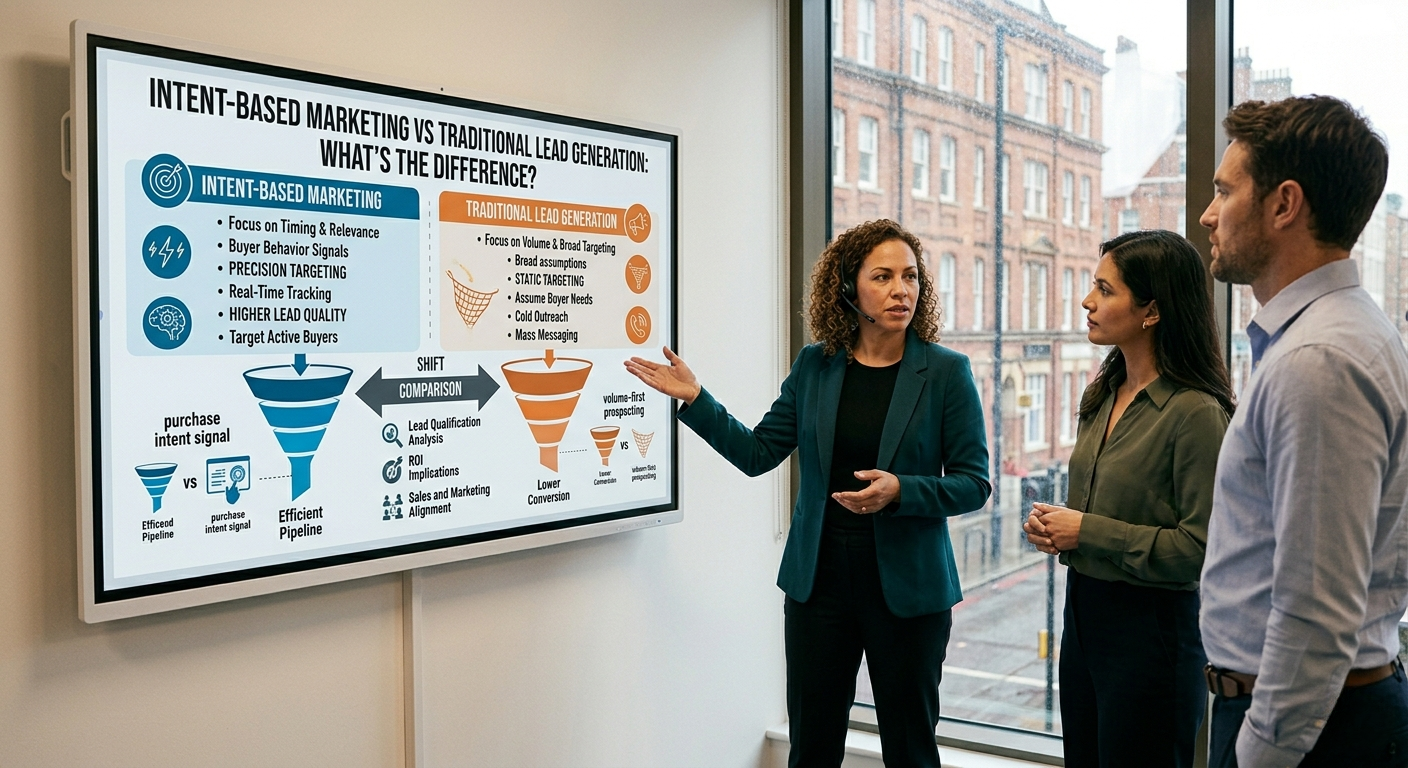
Intent-Based Marketing vs Traditional Lead Generation: What’s the Difference?
B2B sales teams now are under pressure to generate pipeline faster while improving lead quality and reducing wasted outreach. Traditional prospecting methods still exist, but buyer behavior has changed dramatically. Decision-makers now research solutions independently long before responding to a sales message.
This shift is why many companies are asking: what is intent based marketing, and how does it compare to traditional lead generation?
The answer lies in how businesses identify, prioritize, and engage potential buyers. Traditional lead generation often focuses on volume and broad targeting, while intent-based marketing emphasizes timing, relevance, and buyer behavior signals.
Understanding the difference between these two approaches can help sales and marketing teams build more efficient and scalable pipeline generation systems.
Why Traditional Lead Generation Is Being Challenged
The limits of broad targeting in modern B2B sales
Traditional lead generation was built around broad targeting. Teams created large prospect lists based on company size, industry, or job title and then launched outreach campaigns at scale.
The problem is that these filters alone do not reveal whether someone is actively considering a purchase. A prospect may match your ideal customer profile but still have no immediate interest in your solution.
As competition increases, broad targeting becomes less effective because buyers are overwhelmed with generic outreach from multiple vendors.
Why generic outreach struggles to reach in-market buyers
Generic messaging often fails because it assumes every prospect is equally ready to engage. In reality, only a small percentage of buyers are actively researching solutions at any given time.
When outreach lacks context or relevance, it blends into the noise. Prospects are more likely to ignore messages that do not connect to their current priorities or challenges.
This is why response rates have declined across many traditional outbound campaigns.
The rise of intent-based marketing definition in revenue teams
The growing focus on buyer behavior has pushed revenue teams toward the intent-based marketing definition. Instead of relying only on demographic data, teams now analyze digital signals that indicate real purchase interest.
This shift allows organizations to identify which accounts are actively researching problems related to their solutions, making outreach more precise and timely.
What Is Traditional Lead Generation?
How conventional B2B lead generation models work
Traditional lead generation typically relies on fixed targeting criteria and outbound campaigns designed to create awareness. The process often includes list building, cold outreach, advertising, and lead capture forms.
The goal is usually to generate as many leads as possible and then qualify them later in the pipeline.
Volume-first prospecting and static targeting methods
Many conventional prospecting models operate with a volume-first mindset. The assumption is that more outreach equals more opportunities.
Common characteristics include:
- Large-scale email campaigns
- Static contact lists
- Limited personalization
- Minimal behavioral insights
While this approach can still produce results, efficiency often declines as buyer expectations evolve.
Common channels used in traditional lead generation campaigns
Traditional campaigns typically rely on channels such as:
- Cold email outreach
- Paid advertising
- Trade shows and events
- Purchased lead databases
- Basic LinkedIn prospecting
These channels are still useful, but their effectiveness depends heavily on targeting quality and message relevance.
What Is Intent-Based Marketing?
Understanding B2B buyer intent data and buyer behavior signals
To understand what is intent based marketing, it is important to look at how buyer intent data works. B2B buyer intent data tracks digital activities that suggest purchase interest.
These signals may include:
- Researching specific topics online
- Visiting competitor websites
- Downloading industry resources
- Searching for solution-related keywords
Together, these actions create a picture of buyer readiness.
How intent-driven lead generation differs from traditional prospecting
Intent-driven lead generation focuses on identifying active buyers rather than contacting broad audiences. Instead of asking, “Who fits our ICP?” the question becomes, “Who is actively searching for a solution right now?”
This creates a major shift in targeting strategy.
The role of purchase intent signals in identifying active buyers
Purchase intent signals help sales teams prioritize accounts that show signs of real buying activity. This allows outreach to happen when interest is already developing.
As a result, sales conversations often begin with stronger relevance and engagement.
Why real-time buyer behavior tracking changes outreach timing
Timing is one of the biggest advantages of intent-based marketing. Real-time buyer behavior tracking allows teams to engage prospects while they are actively researching problems.
This creates a more natural entry point for conversations compared to random cold outreach.
Cold Outreach vs Intent-Driven Outreach
How traditional cold outreach relies on assumptions
Traditional cold outreach often depends on assumptions about who might need a product. Sales reps reach out based on profile matching rather than demonstrated interest.
This can lead to low engagement rates and wasted effort.
Why targeting in-market buyers improves engagement
Targeting in-market buyers significantly improves relevance because outreach aligns with active research behavior. Prospects are more likely to respond when your solution connects to a problem they are already exploring.
Using personalized outreach using buyer intent for better conversations
Personalized outreach using buyer intent creates stronger conversations because messaging reflects actual buyer interests rather than generic assumptions.
For example, if a prospect has been researching pipeline automation, outreach can directly address workflow efficiency challenges instead of using broad messaging.
Comparing outreach timing, relevance, and buyer readiness
The biggest difference between traditional and intent-driven outreach comes down to:
- Timing
- Relevance
- Buyer readiness
Intent-based outreach performs better because it aligns all three factors simultaneously.
Volume vs Precision: Two Different Prospecting Philosophies
Traditional outreach and the “more volume” mindset
Traditional prospecting often assumes that increasing activity will automatically increase pipeline. While volume can create opportunities, it can also create inefficiency.
How high-intent prospect identification improves efficiency
High-intent prospect identification allows teams to focus effort where conversion probability is highest. Instead of contacting thousands of prospects, teams prioritize the accounts most likely to engage.
The role of behavioral targeting in B2B marketing
Behavioral targeting in B2B marketing uses buyer actions rather than static demographics to guide outreach decisions. This improves precision and increases message relevance.
Why precision targeting often outperforms mass outreach
Precision targeting often generates:
- Higher engagement rates
- Better meeting quality
- Faster sales cycles
- Improved conversion efficiency
Quality becomes more important than sheer outreach volume.
Lead Quality Comparison Between Traditional and Intent-Based Approaches
Improving qualification through intent signal analysis for lead qualification
Intent signal analysis for lead qualification improves targeting by helping teams identify accounts with genuine interest.
This creates stronger alignment between outreach and buyer readiness.
Comparing lead readiness and engagement quality
Intent-driven leads are often more prepared for conversations because they are already researching solutions independently.
This usually leads to:
- More productive meetings
- Better discovery conversations
- Higher conversion potential
Reducing wasted outreach through better targeting accuracy
Better targeting accuracy reduces wasted outreach efforts and allows teams to focus resources more efficiently.
The impact of account intent monitoring on pipeline quality
Account intent monitoring improves pipeline quality by ensuring sales teams spend more time on accounts with real buying signals.
Conversion Rate Differences and Sales Efficiency
Why intent data improves conversion opportunities
Intent data improves conversion opportunities because outreach happens closer to the moment of active interest.
Measuring engagement through buyer activity signals
Buyer activity signals provide measurable insights into engagement levels, helping teams prioritize follow-up actions.
How predictive marketing strategies shorten sales cycles
Predictive marketing strategies use intent signals to anticipate buyer behavior, allowing teams to engage earlier in the decision-making process.
Increasing pipeline efficiency with intent-driven outreach
Intent-driven outreach improves pipeline efficiency by reducing time spent on low-probability prospects.
ROI Implications of Intent-Based Marketing
Comparing acquisition costs between broad and intent-driven campaigns
Intent-driven campaigns often produce lower acquisition costs because resources are focused on accounts more likely to convert.
How intent data improves sales productivity and CAC efficiency
Intent data increases productivity by helping sales teams prioritize their time more effectively, improving CAC efficiency over time.
The long-term ROI advantages of targeting active buyers
Long-term ROI improves because targeting active buyers increases conversion probability and reduces wasted spend.
Reducing wasted spend with more relevant outreach
Relevant outreach reduces inefficiencies across advertising, prospecting, and sales engagement efforts.
The Role of Intent Data Platforms and ABM
How intent data platforms support modern sales teams
Modern intent data platforms help teams monitor buyer behavior, identify research activity, and prioritize outreach opportunities.
Combining data-driven account-based marketing (ABM) with buyer intent
Combining data-driven account-based marketing (ABM) with intent data creates highly targeted campaigns focused on high-value accounts.
Aligning outreach and personalization using behavioral insights
Behavioral insights help teams personalize outreach more effectively by aligning messaging with real buyer interests.
Sales and Marketing Alignment Through Intent Data
Creating stronger collaboration between sales and marketing teams
Intent data creates shared visibility between sales and marketing, improving collaboration around account prioritization.
Using shared intent signals to prioritize accounts
Shared signals help teams align around the same high-potential opportunities instead of operating independently.
Building coordinated outreach around real buyer behavior
Coordinated outreach becomes more effective when both teams respond to actual buyer activity rather than assumptions.
Which Strategy Works Better for Modern B2B Teams?
When traditional lead generation still makes sense
Traditional lead generation still works for broad awareness campaigns, new market entry, and industries with lower digital intent visibility.
Where intent-based marketing creates the biggest advantage
Intent-based marketing performs best in competitive B2B environments where timing and relevance strongly influence conversion rates.
Combining outbound fundamentals with intent-driven insights
The most effective teams combine strong outbound fundamentals with intent-driven insights rather than replacing one with the other entirely.
The future of B2B prospecting and predictive targeting systems
As buyer behavior continues evolving, predictive targeting systems and intent data will likely become central components of modern B2B prospecting strategies.
Final Thoughts
Understanding what is intent based marketing is essential for modern B2B teams looking to improve targeting, engagement, and pipeline efficiency. Traditional lead generation still has value, but its limitations become more visible as buyers expect more relevant and timely interactions. Intent-based marketing shifts the focus from broad outreach to identifying active buyers through behavioral signals and real-time engagement data. Companies that combine intent-driven insights with strong outbound fundamentals will be better positioned to create efficient, scalable, and high-converting sales systems in the years ahead.
Find what you’re reading informative so far? Then why not read more by visiting our blog? We keep you up-to-date every week with how-to guides and strategies to B2B lead generation every single week! Click here to get started!