

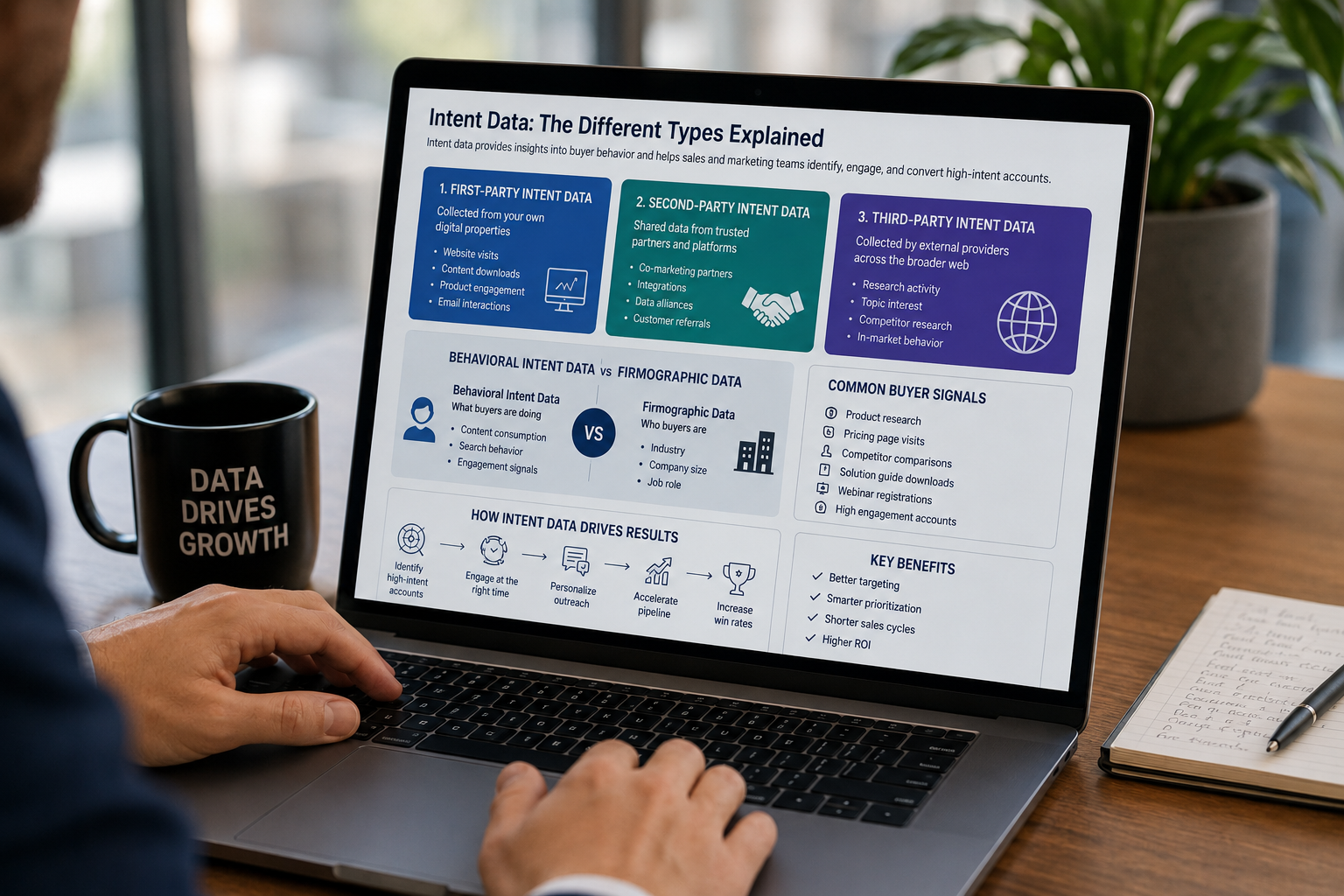
What are Intent Data? The Different Types of Intent Data Explained
Modern B2B sales teams no longer rely only on cold outreach and broad targeting to generate pipeline. Buyers now research solutions independently long before they speak with a sales rep. That shift has made intent based marketing one of the most important strategies in modern demand generation.
Instead of guessing who might be interested, companies can now identify real buying behavior, prioritize high-intent accounts, and engage prospects at the right moment. The result is more efficient prospecting, stronger personalization, and shorter sales cycles.
In this guide, we will break down the different types of intent data, how they work, and how sales and marketing teams can use them to create a competitive advantage.
What Is Intent Data in B2B Marketing?
Intent data refers to information that signals when a company or buyer may be actively researching a product, service, or business problem. These signals help revenue teams identify prospects that are more likely to enter a buying process.
Understanding the intent-based marketing definition
The intent-based marketing definition centers around using buyer behavior insights to guide outreach, targeting, and pipeline generation. Instead of marketing to large audiences with generic campaigns, businesses focus on prospects showing active interest.
This approach helps teams move from assumption-based prospecting to evidence-based engagement. Companies can prioritize buyers based on actual research activity rather than static demographic filters alone.
Why B2B buyer intent data matters in modern sales
B2B buyer intent data matters because the modern buying journey is increasingly digital. Buyers consume content, compare vendors, attend webinars, and research competitors before ever speaking with sales.
Without visibility into these behaviors, teams risk engaging too late or targeting accounts that are not actively considering a purchase.
Intent data gives sales teams the ability to:
- Identify buyers earlier in the journey
- Improve outreach timing
- Prioritize accounts with stronger buying potential
- Increase sales efficiency through smarter targeting
The connection between buyer signals and pipeline generation
Buyer signals provide clues about purchasing readiness. When multiple signals appear together, they often indicate growing commercial intent.
Examples include:
- Repeated visits to pricing pages
- Searches related to competitor comparisons
- Content downloads around specific pain points
- Increased engagement from multiple stakeholders
These signals help pipeline generation become more predictable because sales teams spend more time engaging buyers already showing interest.
How intent data supports intent-driven lead generation
Intent-driven lead generation improves targeting accuracy by focusing efforts on active demand instead of passive audiences.
Rather than building massive prospect lists, companies can concentrate on accounts already researching relevant topics. This improves conversion quality while reducing wasted outreach.
Why Intent Data Creates a Competitive Advantage
Intent data changes how companies compete for attention in crowded B2B markets.
How early buyer visibility changes outbound strategy
Traditional outbound prospecting often begins after competitors have already entered conversations. Intent data changes this by helping teams detect research behavior earlier.
This allows sales reps to engage prospects while they are still evaluating options, creating an opportunity to influence decision-making before competitors establish strong positioning.
Using intent insights for high-intent prospect identification
High-intent prospect identification helps teams prioritize accounts based on buying behavior rather than assumptions.
Instead of contacting every account equally, reps can focus on organizations actively researching relevant solutions. This improves both efficiency and pipeline quality.
Why timing matters in competitive B2B sales environments
Timing often determines whether outreach feels helpful or disruptive.
When a prospect is actively researching a solution, relevant outreach is more likely to receive attention. Without proper timing, even strong messaging can fail because the buyer is not yet interested.
Turning buyer behavior into a measurable competitive advantage
Companies that consistently monitor buyer behavior gain insight into market demand earlier than competitors.
This creates measurable advantages such as:
- Faster pipeline generation
- Higher response rates
- Improved sales productivity
- Better allocation of outbound resources
First-Party Intent Data Explained
First-party intent data comes directly from channels a company owns and controls.
What first-party intent data includes
This data includes actions prospects take on your website, product, emails, and owned digital properties.
Examples include:
- Website visits
- Webinar registrations
- Product demo requests
- Email engagement
- Trial signups
Because the data comes from your own ecosystem, it is usually highly accurate and directly relevant.
Tracking website engagement and product interest
Website engagement often reveals where a buyer is in the decision process.
For example, someone reading educational blog content may still be in early research mode, while repeated visits to pricing or integration pages may signal stronger purchasing intent.
Using real-time buyer behavior tracking on owned channels
Real-time buyer behavior tracking allows teams to react quickly to engagement signals.
Sales reps can prioritize outreach when buyers are actively interacting with content instead of waiting days or weeks after activity occurs.
Leveraging first-party buyer signals for lead qualification
First-party buyer signals strengthen lead qualification because they reflect direct engagement with your business.
This helps sales teams distinguish between casual interest and genuine purchasing intent.
Second-Party Intent Data Explained
Second-party intent data comes from trusted external partnerships.
How second-party intent data is shared between trusted partners
In many B2B ecosystems, companies collaborate by sharing relevant audience insights.
For example, a webinar partner may share attendee engagement data with a co-hosting organization.
Common collaboration models in B2B ecosystems
Common second-party collaboration models include:
- Co-marketing partnerships
- Event sponsorships
- Industry publication partnerships
- Technology integrations
These relationships expand visibility into buyer activity beyond owned channels.
Expanding visibility through strategic data-sharing relationships
Strategic partnerships help companies access audiences they may not otherwise reach. This can improve targeting opportunities while supporting broader market visibility.
Third-Party Intent Data Explained
Third-party intent data is collected from external sources across the broader internet.
How third-party providers collect purchase intent signals
Intent data providers track content consumption and online research behavior across thousands of websites and platforms.
This allows businesses to identify companies researching relevant products even before they engage directly.
The role of intent data platforms in external buyer tracking
Intent data platforms aggregate behavioral insights from multiple online sources.
These tools help sales teams uncover:
- Topic research trends
- Competitor interest
- Surging account activity
- Industry demand patterns
Identifying research behavior across the broader web
Third-party data provides visibility into research happening outside your own channels.
This is valuable because buyers often begin research anonymously before visiting vendor websites.
Using third-party data for targeting in-market buyers
Third-party intent data helps companies target in-market buyers more effectively by identifying accounts actively consuming relevant information.
This improves prospecting precision and reduces wasted outreach.
Behavioral Intent Data vs Firmographic Data
Behavioral and firmographic data serve different purposes in B2B targeting.
Understanding behavioral targeting in B2B marketing
Behavioral targeting focuses on what buyers are doing rather than who they are.
This includes content engagement, research activity, and digital interactions.
Why firmographics alone are no longer enough
Firmographics such as company size or industry provide useful context, but they do not indicate buying readiness.
A company may fit your ICP perfectly while having no active interest in your solution.
Combining company fit with buyer behavior insights
The strongest targeting strategies combine firmographic alignment with behavioral signals.
This creates a more accurate picture of both fit and timing.
Buyer Signals and Early Purchase Intent Detection
Recognizing buyer signals early creates a major competitive advantage.
The most common buyer signals sales teams should monitor
Key buyer signals include:
- Increased website engagement
- Competitor research
- Topic consumption spikes
- Repeat visits from multiple stakeholders
- Webinar attendance
How early purchase intent detection improves outreach timing
Early purchase intent detection allows sales teams to engage before the buying process becomes crowded with competitors.
This improves the likelihood of meaningful conversations.
Recognizing research spikes before competitors do
Research spikes often indicate growing urgency or active evaluation.
Companies that identify these patterns early can position themselves ahead of slower competitors.
Using account intent monitoring to identify active accounts
Account intent monitoring helps teams continuously track buying behavior across target accounts.
This creates a more proactive outbound strategy.
Using Intent Data to Time Outbound Campaigns
Timing dramatically affects outreach performance.
Why timing outbound campaigns impacts conversion rates
Outreach is more effective when buyers are already thinking about relevant challenges.
Intent data helps teams engage prospects during active research periods instead of relying on random timing.
Coordinating outreach around active buying behavior
Sales and marketing teams can coordinate campaigns around specific buying signals to improve engagement consistency.
Using predictive marketing strategies to improve campaign timing
Predictive marketing strategies analyze behavioral patterns to anticipate when prospects are likely entering buying cycles.
Reducing wasted outreach through intent-driven prioritization
Intent-driven prioritization helps reps avoid spending time on low-probability accounts.
This improves productivity while increasing response quality.
Intent Signal Analysis for Better Lead Qualification
Intent analysis improves qualification accuracy.
Applying intent signal analysis for lead qualification
Intent signals provide additional context that strengthens qualification decisions.
This allows teams to prioritize accounts with stronger buying potential.
Filtering out low-intent prospects more efficiently
Not every lead deserves immediate sales attention.
Intent analysis helps filter out low-intent prospects so reps can focus on active demand.
Improving sales productivity through smarter prioritization
Smarter prioritization leads to:
- Better pipeline efficiency
- Higher-quality conversations
- Improved rep productivity
- Faster deal progression
Intent Data and Account-Based Marketing (ABM)
Intent data strengthens ABM strategies significantly.
Strengthening data-driven account-based marketing (ABM) with intent signals
Intent signals help ABM teams identify which strategic accounts are actively researching relevant topics.
Prioritizing strategic accounts based on real engagement
Instead of targeting every large account equally, teams can focus on accounts showing active buying behavior.
Improving personalization across buying committees
Intent insights reveal what specific stakeholders care about, improving personalization across multiple decision-makers.
Personalized Outreach Using Buyer Intent
Personalization becomes stronger when powered by real buyer behavior.
Building personalized outreach using buyer intent insights
Intent insights allow reps to tailor messaging around actual prospect interests instead of generic assumptions.
Aligning messaging with buyer research behavior
Messaging becomes more relevant when aligned with the topics buyers are actively researching.
Increasing response rates through contextual relevance
Relevant outreach naturally generates stronger engagement because it matches current buyer priorities.
How Intent Data Helps Shorten Sales Cycles
Intent-informed selling often accelerates deal progression.
Engaging buyers earlier in the decision process
Early engagement allows companies to influence buying criteria before competitors dominate conversations.
Improving qualification speed with intent insights
Intent data reduces guesswork during qualification, helping reps identify stronger opportunities faster.
Reducing delays caused by mistimed outreach
Mistimed outreach slows sales cycles by forcing reps to nurture uninterested buyers.
Intent data improves timing accuracy significantly.
Why intent-informed selling helps shorten sales cycles
When outreach aligns with active buyer interest, deals move faster because conversations start with stronger relevance.
Choosing the Right Intent Data Strategy for Your Team
Not every business requires the same intent strategy.
Matching intent sources to your sales motion
Companies should align intent sources with their specific sales process, market size, and deal complexity.
Integrating intent insights into daily workflows
Intent data creates the most value when embedded directly into CRM and outbound workflows.
Building scalable systems around buyer intelligence
Scalable intent systems combine technology, workflows, and prioritization frameworks to improve long-term efficiency.
The future of intent-driven B2B prospecting
The future of B2B sales will increasingly rely on timing, behavioral insights, and relevance. Companies that adopt intent-based marketing early will gain stronger competitive positioning and more predictable pipeline growth.
Final Thoughts
Intent based marketing is reshaping how modern B2B sales and marketing teams identify, prioritize, and engage buyers. Instead of relying on broad outreach and assumptions, businesses can now use behavioral insights and purchase intent signals to focus on accounts actively researching solutions.
Understanding the different types of intent data allows teams to build smarter outbound strategies, improve personalization, shorten sales cycles, and increase pipeline efficiency. Whether using first-party engagement data, second-party partnerships, or third-party intent platforms, the goal remains the same: reaching buyers at the right moment with the right message.
As competition continues increasing across B2B markets, companies that leverage buyer intelligence effectively will gain a lasting advantage through better timing, stronger targeting, and more relevant engagement.
Find what you’re reading informative so far? Then why not read more by visiting our blog? We keep you up-to-date every week with how-to guides and strategies to B2B lead generation every single week! Click here to get started!