

Please enter subscribe form shortcode

The Psychology Behind Why B2B Buyers Respond to Some Outreach (And Ignore Others)

Most b2b lead generation outreach doesn’t fail because of bad tools or weak lists. It fails because it ignores how buyers actually think. In B2B environments, decisions are not impulsive. They are filtered through attention, trust, relevance, and timing. If your message doesn’t align with these psychological filters, it gets ignored—no matter how well it’s written or how strong your offer is. This article breaks down the psychology behind buyer response behavior and what separates outreach that gets ignored from outreach that gets replies. Understanding Buyer Psychology in Modern B2B Lead Generation How cognitive overload impacts B2B lead generation strategies B2B buyers are constantly processing: Emails LinkedIn messages Ads Internal priorities This creates cognitive overload, forcing them to ignore most outreach automatically. Why buyers filter most outreach automatically Buyers don’t evaluate every message. They scan and filter based on: Familiarity Relevance Urgency If a message doesn’t pass this filter instantly, it’s ignored. The role of trust, relevance, and timing in engagement Three factors determine response: Trust: Do I recognize or trust this source? Relevance: Does this matter to me right now? Timing: Am I in a buying window? Why attention is the real currency in outreach In modern b2b lead generation, attention is more valuable than impressions. Without attention, nothing else matters. Why Most Outreach Gets Ignored in Qualified Lead Generation Weak personalization in qualified lead generation for businesses Generic outreach signals lack of effort: “Hi [First Name]” is no longer personalization Surface-level references don’t create relevance Irrelevant messaging and poor targeting signals If messaging doesn’t align with: Industry Role Current challenges It gets ignored immediately. Over-saturation in buyer inboxes and channels Buyers are overwhelmed. They have learned to ignore anything that feels: Salesy Generic Interruptive Lack of perceived value in first contact If the first message doesn’t offer immediate value, it gets discarded. The Psychology of High-Quality B2B Leads and Attention What defines high-quality B2B leads in behavioral terms High-quality leads are not just fit—they are: Actively engaged Problem-aware Open to solutions How perceived relevance drives engagement People respond when they feel: “This was meant for me.” Relevance is the trigger, not volume. Emotional triggers behind response behavior Common psychological triggers include: Curiosity Urgency Risk reduction Opportunity gain Why intent matters more than demographic fit A perfect ICP with no intent is less valuable than a slightly off-fit lead showing active buying behavior. Sales Funnel Lead Generation and Buyer Decision Triggers How sales funnel lead generation aligns with buyer psychology Funnels mirror psychology: Awareness = learning Consideration = comparison Decision = commitment Psychological shifts between awareness, consideration, and decision Each stage requires different messaging: Awareness: educate Consideration: differentiate Decision: validate Why messaging must match funnel stage intent Mismatch creates friction. Buyers disengage when messaging feels too advanced or too basic. Where most outreach fails in the funnel Most outreach fails by jumping directly to sales before trust is built. Why Outbound Lead Generation Campaigns Fail to Connect Common mistakes in outbound lead generation campaigns Typical failures include: Generic templates No timing strategy Weak targeting Lack of relevance and timing in cold outreach Even good messages fail if sent at the wrong time. Why generic messaging reduces trust instantly Buyers associate generic messaging with: Low effort Low credibility The importance of emotional resonance in first touch First contact must feel human, relevant, and specific to create engagement. Inbound Lead Generation Methods and Buyer Control Psychology How inbound lead generation methods align with buyer autonomy Inbound works because buyers feel in control of the journey. Why buyers prefer self-directed discovery Modern buyers want to: Research privately Compare options Avoid pressure Trust-building through content consumption Each content interaction builds: Credibility Familiarity Confidence The psychological advantage of inbound engagement Inbound leads convert more easily because trust is pre-established. Account-Based Marketing (ABM) and Perceived Relevance How account-based marketing (ABM) lead generation improves response rates ABM increases relevance by targeting specific accounts with tailored messaging. Psychological impact of account-specific messaging When a buyer sees their company referenced, attention increases immediately. Why personalization increases perceived value Personalized outreach signals: “This message was created for you.” Building familiarity before outreach Repeated exposure builds recognition, reducing resistance. Why Multi-Channel B2B Marketing Influences Buyer Attention Role of multi-channel B2B marketing strategies in reinforcement Multiple touchpoints reinforce memory and trust. Why repeated exposure builds trust over time Familiarity reduces skepticism and increases openness. Channel consistency and psychological familiarity Consistent messaging across email, ads, and social builds coherence. Avoiding cognitive fatigue across platforms Too many inconsistent messages create confusion and disengagement. Lead Nurturing Strategies in B2B and Trust Building How lead nurturing strategies in B2B shape decision confidence Nurturing builds confidence over time through education and relevance. Gradual persuasion vs aggressive selling Gradual persuasion respects buyer psychology. Aggressive selling creates resistance. Psychological importance of timing and sequence Right message, wrong time = ignored message. Building credibility through consistent engagement Consistency signals reliability and expertise. Data-Driven Lead Generation and Behavioral Understanding Using data-driven lead generation to predict response likelihood Behavioral data helps predict who is likely to respond. Understanding behavioral patterns behind engagement Patterns reveal: Interest level Buying readiness Content preferences Reducing guesswork in outreach targeting Data replaces assumptions with real behavior signals. Aligning messaging with observed buyer behavior When messaging reflects behavior, relevance increases dramatically. Prospecting Strategies for B2B Companies That Respect Buyer Psychology Modern prospecting strategies for B2B companies based on intent Modern prospecting prioritizes: Intent signals Engagement activity Timing Why interruption-based outreach is becoming less effective Interruptions feel intrusive, especially in saturated markets. Improving relevance through segmentation and timing Segmentation ensures the right message reaches the right buyer. Aligning outreach with buyer readiness signals Outreach should match where the buyer is in their journey. Conversion-Focused Lead Generation and Decision Triggers How conversion-focused lead generation leverages psychology Conversion improves when messaging aligns with decision triggers. Reducing friction in decision-making pathways Friction slows down decisions. Simplicity speeds them up. Using clarity and value to drive response Clear value propositions outperform complex messaging. Why simplicity increases conversion rates Simple messages are


The Difference Between “Interested Leads” and “In-Market Leads” in B2B Lead Generation

Modern b2b lead generation is no longer just about capturing as many leads as possible. The real performance gap comes from understanding what type of lead you are actually dealing with. Not all leads are equal. Some are simply exploring. Others are actively preparing to buy. Confusing these two groups is one of the biggest reasons pipelines underperform, SDR teams waste time, and conversion rates stay inconsistent. In this article, we’ll break down the difference between “interested leads” and “in-market leads” and how this distinction changes everything in your revenue system. Why Understanding Lead Intent Is Critical in Modern B2B Lead Generation How misclassifying leads weakens B2B lead generation strategies When teams treat all leads the same, they: Over-contact low-intent prospects Under-engage high-intent buyers Waste sales capacity on poor-fit opportunities This creates inefficiency across the entire b2b lead generation system. The shift from volume-based targeting to intent-based prioritization Old models focused on volume: More leads = more revenue Modern models focus on intent: Better leads = higher conversion rates Why timing and buying readiness matter more than engagement alone A lead clicking your content is not the same as a lead ready to buy. Timing is often the difference between: Losing a deal Closing it quickly Impact on pipeline efficiency and revenue predictability Correctly identifying intent improves: Forecast accuracy Sales velocity Pipeline quality What Are “Interested Leads” in B2B Marketing? Role of awareness-stage prospects in qualified lead generation for businesses Interested leads are early-stage prospects. They are: Exploring problems Consuming content Learning about solutions They are not ready to buy yet. Engagement signals that indicate curiosity, not buying intent Examples include: Blog visits Social media engagement Newsletter signups Webinar attendance without follow-up action How interested leads interact with inbound lead generation methods These leads usually come through: SEO content Educational resources Organic discovery channels They are a core part of inbound b2b lead generation, but not yet sales-ready. Why these leads still require long-term nurturing Interested leads need: Education Trust building Consistent engagement They often convert later, not immediately. What Are “In-Market Leads” in B2B Sales? Understanding high-intent behavior in high-quality B2B leads In-market leads are actively evaluating solutions. They are: Comparing vendors Seeking pricing Engaging with product-specific content Using B2B buyer intent data to identify active buyers These leads show signals like: Repeated website visits Pricing page views Demo requests Product comparisons Key purchase signals that define in-market accounts Strong indicators include: High engagement frequency Multi-stakeholder activity Short time between visits Why in-market leads convert faster in the sales funnel Because they already: Understand the problem Have urgency Are evaluating solutions They move quickly through the funnel. Sales Funnel Lead Generation: Where the Difference Becomes Clear How sales funnel lead generation separates interest from intent Funnels naturally split leads into: Top of funnel → interested leads Bottom of funnel → in-market leads Mapping interested vs in-market leads across funnel stages • Interested leads → awareness and consideration stages • In-market leads → decision stage Why most pipelines fail due to misclassification When teams treat interested leads as ready buyers: Conversion rates drop Sales cycles extend Trust decreases Improving funnel accuracy with intent-based segmentation Segmentation allows teams to: Route leads correctly Prioritize outreach Improve conversion flow Lead Nurturing Strategies in B2B for Interested Leads Designing lead nurturing strategies in B2B for long-term engagement Interested leads require structured nurturing: Educational emails Thought leadership content Retargeting campaigns Building trust before purchase readiness The goal is not immediate conversion. It is: Familiarity Authority Credibility Using content and education to move leads forward Effective content includes: Case studies Industry insights Problem-focused guides When not to rush interested leads into sales conversations Pushing too early often results in: Low response rates Poor engagement Lost opportunities Converting In-Market Leads Through Faster Sales Cycles Why in-market leads accelerate conversion-focused lead generation In-market leads are already decision-ready, making them highly valuable. Prioritizing urgency in messaging and outreach Effective approaches include: Direct value propositions Clear differentiation Fast response times Shortening sales cycles through timely engagement Speed matters. Delayed outreach often leads to lost deals. Aligning sales actions with buyer readiness signals Sales teams should act immediately when signals appear. Account-Based Marketing (ABM) and In-Market Identification Strengthening account-based marketing (ABM) lead generation with intent signals ABM becomes more powerful when focused on in-market accounts. Identifying in-market accounts before competitors Early detection gives a competitive advantage. Coordinating sales and marketing around active accounts Alignment ensures: Consistent messaging Faster response times Higher engagement Improving ABM precision through behavioral insights Behavior helps prioritize accounts showing real buying activity. Outbound Lead Generation Campaigns: Timing Matters Optimizing outbound lead generation campaigns for in-market leads Outbound works best when aligned with intent signals. Avoiding wasted outreach on non-ready prospects Targeting uninterested leads leads to: Low response rates Poor efficiency Using timing and intent to improve response rates Reaching leads during active research increases success rates. Increasing efficiency through signal-based targeting Behavioral signals make outbound more precise. Data-Driven Lead Generation for Better Segmentation Improving data-driven lead generation with intent classification Data helps distinguish between curiosity and intent. Separating curiosity signals from buying signals This prevents misalignment in outreach strategies. Using analytics to refine lead prioritization Analytics improves: Scoring models Targeting accuracy Building smarter targeting models for better conversion Better segmentation leads to higher ROI. Multi-Channel B2B Marketing Strategies for Both Lead Types Managing multi-channel B2B marketing strategies across intent levels Different lead types require different messaging. Nurturing interested leads while activating in-market ones • Interested → nurture campaigns • In-market → sales outreach Aligning messaging across channels based on intent stage Consistency improves trust and engagement. Avoiding inconsistent outreach across touchpoints Misalignment creates confusion and reduces conversion rates. Pipeline Generation for Sales Teams: Why the Distinction Matters Improving pipeline generation for sales teams with intent clarity Clear segmentation improves pipeline accuracy. Reducing wasted SDR effort on low-intent leads SDRs focus only on high-impact opportunities. Increasing conversion efficiency with better prioritization Better prioritization leads to: Faster closes Higher win rates Creating predictable pipeline flow through segmentation Intent

Why Data Quality Is the Most Overlooked Factor in B2B Lead Generation

Most teams optimizing b2b lead generation focus on channels, messaging, and tools. Very few focus on the foundation everything depends on: data quality. And yet, poor data silently undermines targeting, segmentation, personalization, reporting, and ultimately revenue performance. It does not break systems suddenly. It slowly erodes them until results become unpredictable. This article breaks down why data quality is the hidden factor behind most lead generation failures and how improving it can transform performance across your entire revenue engine. Why Data Quality Matters More Than Most B2B Teams Realize How poor data silently breaks B2B lead generation strategies Bad data does not stop campaigns from running. It simply makes them inefficient. Common issues include: Wrong contact information Outdated company details Incorrect job titles Duplicated records These small errors compound across every stage of b2b lead generation. The hidden cost of inaccurate or outdated prospect information Poor data leads to: Wasted SDR time Higher acquisition costs Lower conversion rates Poor campaign performance Most teams underestimate how expensive bad data becomes at scale. Why high volume does not equal high performance pipelines A large pipeline filled with low-quality records creates a false sense of success. In reality: Volume increases noise Conversion rates drop Sales teams waste effort on unqualified leads The link between data quality and revenue predictability Clean data creates predictable pipelines. Dirty data creates volatility. If inputs are unreliable, forecasting becomes guesswork. The Impact of Bad Data on Qualified Lead Generation Why qualified lead generation for businesses depends on clean inputs Qualification is only as strong as the data behind it. If inputs are wrong, outputs will be wrong. Misalignment between targeting and real buyer profiles Bad data leads to: Incorrect ICP mapping Misclassified industries Wrong seniority targeting How bad data reduces conversion potential When outreach is misaligned: Messaging becomes irrelevant Engagement drops Conversion rates suffer The difference between leads and truly qualified opportunities Not all leads are equal. Poor data makes it harder to distinguish: Interested prospects From irrelevant contacts How Data Quality Affects Data-Driven Lead Generation Why data-driven lead generation fails without clean datasets Data-driven systems rely on accuracy. Without it, decisions are flawed. Garbage-in, garbage-out: how errors scale across systems Bad data spreads across: CRM systems Marketing automation tools Sales dashboards Once corrupted, it affects everything. The role of data validation in improving accuracy Validation ensures: Emails are deliverable Contacts are active Company data is current Building trust in your reporting and analytics Clean data leads to: Reliable dashboards Accurate forecasting Better decision-making Sales Funnel Lead Generation Breaks Without Clean Data How broken sales funnel lead generation creates leakage Funnels depend on continuity. Bad data creates breaks in that flow. Incorrect segmentation across funnel stages Leads are often placed in wrong stages due to: Missing behavioral data Inaccurate attributes Outdated records Poor attribution and misread conversion performance Dirty data leads to incorrect assumptions about: Channel effectiveness Campaign performance ROI Why funnel optimization depends on accurate data You cannot optimize what you cannot measure correctly. High-Quality B2B Leads Depend on Clean Data Foundations Why high-quality B2B leads start with data hygiene Clean data ensures only relevant prospects enter the pipeline. Eliminating duplicates, outdated contacts, and invalid records Key hygiene steps include: Removing duplicates Updating job changes Validating company info Improving lead scoring accuracy with reliable inputs Lead scoring becomes meaningful only when data is accurate. The direct link between data quality and pipeline performance Better data leads to: Higher conversion rates Faster sales cycles Stronger pipeline health Outbound Lead Generation Campaigns and Data Accuracy Why outbound lead generation campaigns fail with poor data Outbound depends heavily on precision targeting. Bad data destroys that precision. Incorrect targeting and wasted outreach effort Common outcomes: Emails sent to wrong personas Irrelevant industries targeted Low response rates Low deliverability and engagement due to outdated records Old data leads to: Email bounces Spam flags Reduced sender reputation Improving campaign ROI through better data management Cleaner data improves: Deliverability Response rates Conversion efficiency Inbound Lead Generation Methods and Data Integrity How inbound lead generation methods suffer from poor enrichment Inbound leads often lack complete profiles. Missing or incomplete lead capture data Common issues include: Missing job titles No company size data Incomplete contact fields Poor segmentation of inbound leads Without enrichment, segmentation becomes inaccurate. Improving conversion with enriched lead profiles Enrichment helps: Personalize messaging Improve scoring Increase conversion rates Account-Based Marketing (ABM) Lead Generation Requires Clean Data Why account-based marketing (ABM) lead generation fails without accurate accounts ABM depends on precise account identification. Incorrect firmographic and account mapping issues Errors include: Wrong company affiliations Duplicate accounts Misclassified industries Misalignment between sales and marketing account lists When lists differ: Campaigns lose focus Outreach becomes inconsistent Improving ABM precision through data standardization Standardized data ensures alignment across teams. Lead Nurturing Strategies in B2B Depend on Reliable Data Why lead nurturing strategies in B2B break with poor segmentation Nurturing depends on knowing who the lead is and what they need. Incorrect timing and irrelevant messaging Bad data leads to: Wrong email sequences Poor timing of outreach Missing behavioral and demographic updates Without updates, nurturing becomes outdated. Improving engagement through accurate lifecycle data Accurate lifecycle tracking improves: Timing Relevance Engagement Pipeline Generation for Sales Teams Suffers from Data Issues How pipeline generation for sales teams is distorted by bad data Sales pipelines become unreliable when data is inconsistent. Misreported pipeline stages and forecasting errors Bad data leads to: Inflated pipeline value Inaccurate forecasting Lack of visibility into true deal quality Teams struggle to identify real opportunities. Improving pipeline accuracy through structured data governance Governance ensures consistency across systems. Prospecting Strategies for B2B Companies Rely on Clean Data Why prospecting strategies for B2B companies fail without accurate lists Prospecting depends on targeting accuracy. Outdated contacts and irrelevant targeting Bad lists lead to wasted outreach efforts. Lack of segmentation precision in outreach Without segmentation: Messaging becomes generic Engagement drops Improving prospecting efficiency with validated data Validated data improves: Response rates Conversion efficiency Conversion-Focused Lead Generation Needs Data Accuracy Why

How to Use Behavioral Signals to Improve B2B Lead Generation Results

Modern B2B lead generation is no longer about who fits your ICP on paper. It is about who is actively showing intent through behavior. Clicks, page visits, content engagement, email interactions, and product research patterns now reveal more about buying readiness than static firmographic data ever could. The shift is clear. Companies that understand and act on behavioral signals are consistently outperforming those still relying on traditional targeting methods. In this article, we’ll break down how behavioral intelligence transforms b2b lead generation and how to apply it across your entire revenue system. Why Behavioral Signals Are Changing Modern B2B Lead Generation The evolution of B2B lead generation strategies toward behavior-first targeting B2B marketing has shifted from identity-based targeting to behavior-based targeting. Instead of asking “who is this company,” teams now ask: What are they doing right now How often are they engaging What signals show buying intent Why traditional targeting methods miss high-intent buyers Static targeting misses buyers because it ignores real-time activity. For example: A low-ICP company actively researching your solution may be highly valuable A perfect ICP account with no engagement may not be ready to buy Understanding how buyer behavior shapes conversion outcomes Behavior is one of the strongest predictors of conversion because it reflects: urgency interest level decision stage The shift from static lists to dynamic intent-driven systems Modern systems no longer rely on fixed lists. They adapt based on behavior such as: repeated visits content depth engagement multi-channel interaction What Behavioral Signals Reveal About B2B Buyers How behavioral data improves qualified lead generation for businesses Behavioral signals help teams identify which leads are actually worth pursuing by filtering out noise and highlighting real engagement. Key digital actions that indicate purchase readiness High-intent behaviors include: Multiple website visits within a short period Pricing or demo page views Repeat content engagement Webinar or product page interactions Differentiating curiosity from buying intent Not all engagement equals intent. For example: Curiosity = single blog visit Intent = repeated visits + product research + email engagement Turning engagement patterns into actionable insights When behavior is tracked consistently, it becomes possible to: prioritize accounts trigger outreach personalize messaging Using Behavioral Data to Strengthen Data-Driven Lead Generation Improving data-driven lead generation with real-time insights Behavioral data adds a real-time layer to data-driven lead generation, improving timing and accuracy. Combining behavioral signals with CRM and intent data The strongest systems integrate: CRM records behavioral analytics third-party intent signals This creates a complete view of the buyer journey. Reducing guesswork in targeting and outreach Instead of guessing who to contact, teams can rely on: engagement frequency content interest interaction depth Increasing accuracy in lead prioritization Behavioral scoring helps rank leads based on real activity, not assumptions. Behavioral Targeting in B2B Demand Generation Enhancing B2B demand generation tactics with behavioral insights Behavior helps refine demand generation by showing what topics and content actually resonate. Aligning messaging with observed buyer actions Messaging becomes more relevant when based on behavior such as: downloaded content viewed product pages attended webinars Identifying content engagement patterns across channels Behavioral tracking reveals: which channels drive interest which content converts attention into intent Improving awareness-to-conversion pathways By understanding behavior, teams can guide prospects more effectively through the funnel. How Behavioral Signals Improve Sales Funnel Lead Generation Optimizing sales funnel lead generation with engagement data Funnels become more predictable when behavior is used to guide progression. Tracking movement between funnel stages using behavior Examples include: awareness → blog engagement consideration → product research decision → pricing page visits Identifying drop-off points and friction in the funnel Behavioral data highlights where users disengage, helping improve funnel design. Improving conversion flow through behavioral insights Fixing friction points increases overall conversion rates. High-Quality B2B Leads Through Behavioral Intelligence Generating high-quality B2B leads using engagement signals Behavioral intelligence ensures only active, engaged prospects are prioritized. Filtering low-intent activity from real buying behavior This helps remove: passive visitors irrelevant traffic one-time clicks Improving lead scoring accuracy with behavioral indicators Behavior improves scoring by adding context to engagement levels. Increasing conversion rates through better qualification Better qualification leads directly to higher close rates. Account-Based Marketing (ABM) Powered by Behavioral Signals Strengthening account-based marketing (ABM) lead generation with behavior tracking ABM becomes more powerful when based on real engagement data rather than static account lists. Monitoring account-level engagement across stakeholders Behavioral signals often come from multiple stakeholders within the same company. Prioritizing accounts showing active research behavior Accounts with repeated engagement should always be prioritized. Improving ABM precision with real-time insights Real-time behavior allows teams to adjust campaigns dynamically. Outbound Lead Generation Campaigns Driven by Behavior Improving outbound lead generation campaigns with intent signals Outbound becomes more effective when based on active behavior rather than cold lists. Timing outreach based on engagement activity Reaching out when a prospect is already engaging increases response rates. Increasing response rates with behavior-based messaging Messaging becomes more relevant when aligned with observed actions. Reducing wasted outreach through smarter targeting Behavior ensures teams contact only accounts showing interest. Inbound Lead Generation Methods Enhanced by Behavioral Data Optimizing inbound lead generation methods using engagement tracking Behavior reveals what inbound content actually drives qualified interest. Understanding content consumption patterns Teams can identify: top-performing topics high-engagement content types Converting anonymous traffic into qualified leads Behavioral tools help identify and score anonymous visitors based on activity. Aligning inbound content with buyer behavior Content strategies improve when aligned with real engagement patterns. Lead Nurturing Strategies in B2B Using Behavioral Signals Strengthening lead nurturing strategies in B2B with behavioral triggers Nurturing becomes more effective when triggered by behavior. Personalizing follow-ups based on engagement history Follow-ups can reflect: pages visited content consumed level of engagement Automating nurturing workflows using behavior thresholds Automation ensures timely engagement at scale. Improving long-cycle engagement with relevant messaging Behavior-based nurturing keeps leads warm over long decision cycles. Pipeline Generation for Sales Teams Through Behavioral Insights Improving pipeline generation for sales teams with behavioral scoring Behavior improves pipeline predictability by prioritizing high-intent leads. Prioritizing opportunities based on

The Hidden Bottlenecks in B2B Lead Generation (And How to Fix Them)

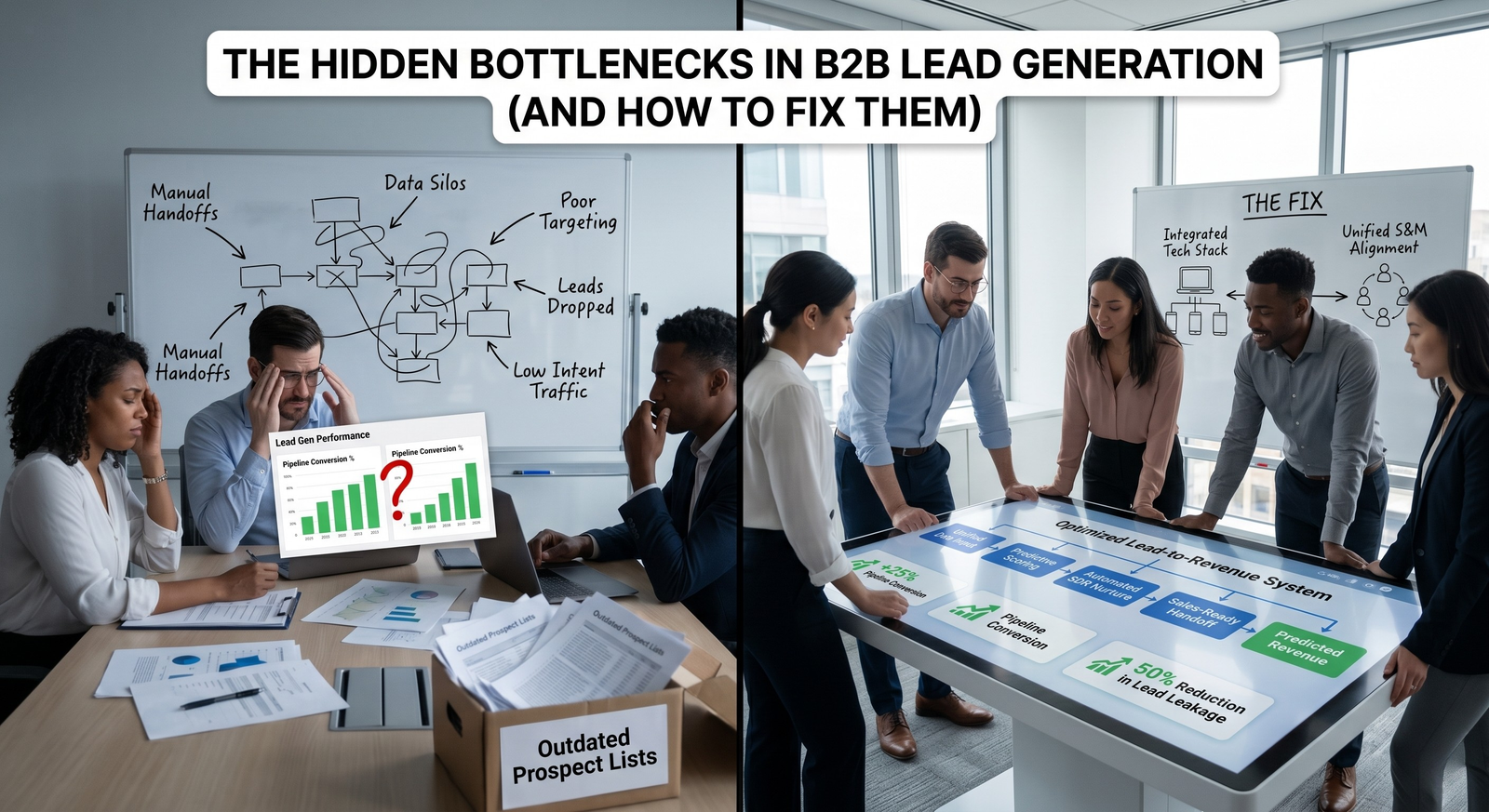
B2B lead generation often appears to be working on the surface while quietly failing underneath. Campaigns run, leads come in, dashboards look healthy, yet revenue remains inconsistent and pipeline quality fluctuates. This disconnect is not random. It is usually caused by hidden bottlenecks that compound over time inside the system. The real issue is not lack of activity. It is friction inside the system that prevents consistent performance. In this article, we will break down the most common hidden bottlenecks in b2b lead generation and how to fix them so your pipeline becomes more predictable, scalable, and conversion focused. Why B2B Lead Generation Breaks Down Behind the Scenes Common failures in modern B2B lead generation strategies Most systems fail quietly due to structural weaknesses rather than obvious mistakes. Common issues include: • Weak targeting definitions • Inconsistent messaging across channels • Poor follow up processes • Lack of alignment between marketing and sales These issues do not stop lead generation completely. Instead, they slowly reduce efficiency until performance declines. Why performance looks good on the surface but fails in execution Dashboards often show positive signals such as impressions, clicks, and form fills. However, these metrics do not always translate into revenue. The gap happens because: • Engagement does not equal intent • Leads are not properly qualified • Sales readiness is misjudged The hidden friction points in scalable acquisition systems Hidden friction usually exists in: • Data flow between tools • Lead qualification steps • Handovers between teams These small inefficiencies are often ignored until scale exposes them. How small inefficiencies compound into major pipeline issues Even a small drop in conversion rate at each stage can lead to major revenue loss downstream. Over time, this creates unstable pipeline performance and unpredictable growth. Weak Foundations in Scalable Lead Generation Systems Why most teams struggle to build scalable lead generation systems Scalability requires structure, not just activity. Many teams operate reactively instead of systemically. Over reliance on manual processes and disconnected tools When systems depend on manual work, performance becomes inconsistent. Common problems include: • Manual list building • Manual outreach tracking • Fragmented reporting across platforms Lack of repeatable workflows across acquisition channels Without repeatable workflows, every campaign feels like a new experiment instead of a predictable engine. The absence of system wide optimization loops High performing systems continuously improve. Most systems fail because they do not have feedback loops to identify what is working and what is not. Data Bottlenecks in Data Driven Lead Generation Why data driven lead generation breaks without clean inputs Data driven systems are only as strong as the data they rely on. Poor inputs lead to poor decisions. Poor segmentation and targeting accuracy When segmentation is unclear: • Messaging becomes generic • Conversion rates drop • High intent prospects are missed Incomplete or outdated CRM data Outdated data leads to wasted effort, including: • Contacting irrelevant accounts • Targeting inactive leads • Misaligned outreach timing How bad data leads to wasted outreach and low conversion Poor data quality creates inefficiency at every stage of b2b lead generation, from prospecting to closing. Funnel Friction in Sales Funnel Lead Generation Breakdowns in sales funnel lead generation stages Funnels often break because stages are not clearly defined or properly managed. Lead leakage between marketing and sales handoffs One of the biggest leaks occurs during handoff, where: • Marketing passes leads too early • Sales rejects unqualified leads • Follow up is inconsistent Misalignment between funnel stages and buyer intent Not all leads move linearly. Many systems fail to account for varying buyer readiness. Why conversion drops happen mid funnel Conversion drops often occur due to: • Lack of nurturing • Slow response times • Weak qualification criteria Outbound Lead Generation Campaign Bottlenecks Inefficiencies in outbound lead generation campaigns Outbound systems often degrade over time when not optimized. Poor targeting and list quality issues Bad lists lead to: • Low response rates • High bounce rates • Wasted outreach effort Messaging fatigue and low engagement rates Repeated use of generic messaging reduces engagement over time. Lack of personalization at scale Without personalization, outreach becomes irrelevant, leading to declining performance. Inbound Lead Generation Method Gaps Weak inbound lead generation methods and inconsistent traffic quality Inbound systems often struggle with inconsistent lead quality. Content that fails to attract high intent prospects Not all content attracts buyers. Many assets generate traffic but not revenue. Search engine optimization and distribution gaps in demand capture Even strong content fails without proper distribution and visibility. Why inbound alone cannot sustain pipeline growth Inbound is powerful but unpredictable without complementary outbound and account based strategies. Problems in Qualified Lead Generation for Businesses Inconsistent qualified lead generation for businesses Many systems fail to define what a qualified lead actually is. Misaligned qualification criteria across teams Marketing and sales often use different definitions, creating friction. Over prioritizing volume over intent High volume does not guarantee high quality. Lack of structured lead scoring systems Without scoring systems, prioritization becomes subjective. Why High Quality B2B Leads Are Hard to Sustain Declining high quality b2b leads due to weak targeting Poor targeting leads to inconsistent lead quality over time. Poor ideal customer profile definition and segmentation issues Without clear ideal customer profiles, outreach becomes unfocused. Lack of behavioral insights in lead selection Behavioral data helps identify real buying intent, which is often missing. How to fix quality degradation in pipelines Improve targeting by combining: • Firmographic data • Behavioral signals • Engagement history Account Based Marketing Execution Bottlenecks Weak account based marketing lead generation execution Account based marketing fails when it is not structured properly. Lack of coordination between sales and marketing teams Misalignment leads to inconsistent messaging and poor account coverage. Poor account prioritization strategies Without prioritization, resources are spread too thin across accounts. Why account based marketing fails without intent and data alignment ABM requires accurate timing and behavioral insight to succeed. Prospecting Strategy Inefficiencies Ineffective prospecting strategies for B2B companies Many prospecting efforts are still manual

Why Most B2B Lead Generation Systems Fail After 3 Months

Most b2b lead generation systems don’t fail because the strategy is wrong. They fail because the system was never designed to last. What often starts as an exciting new acquisition engine quickly turns into inconsistent results, declining performance, and eventually, complete breakdown after just a few months. The issue is not effort. It is structure. In this article, we’ll break down why most systems collapse after 90 days and what separates short-lived setups from sustainable revenue engines. The Reality Behind Short-Lived B2B Lead Generation Systems Why many B2B lead generation strategies lose effectiveness over time Most systems start strong because early activity benefits from novelty, urgency, and low competition within the new setup. But over time: Response rates decline Target audiences become saturated Messaging loses impact The gap between setup and sustainable execution Teams often focus heavily on launching campaigns but neglect ongoing optimization. This creates a gap between: Initial execution Long-term maintenance And that gap is where performance drops. Why early wins don’t translate into long-term success Early success is often misleading. It comes from: Untested audiences Fresh messaging Temporary attention spikes Without systems, those wins fade quickly. The illusion of scalability in early-stage systems Early traction often creates false confidence. What looks scalable is usually: Manual effort disguised as a system Unstable processes Non-repeatable results Lack of Scalable Lead Generation Systems Why most teams fail to build scalable lead generation systems Scalability requires structure, not activity. Most teams never move beyond tactical execution. Over-reliance on short-term tactics instead of repeatable processes Common issue: Running campaigns instead of building systems Chasing short-term wins instead of compounding results Failure to systemize acquisition workflows Without systems: Lead flow is inconsistent Execution depends on individuals Growth cannot be repeated reliably Breaking when volume increases beyond manual capacity When outreach scales, manual systems collapse: Response handling slows Personalization breaks Lead quality drops Weak Foundations in Data-Driven Lead Generation Poor data-driven lead generation leads to inconsistent results Without data, decisions are based on assumptions instead of performance. Inaccurate targeting and broken segmentation Common problems include: Misaligned ICP definitions Broad targeting lists Lack of behavioral segmentation Lack of feedback loops for optimization Many teams fail to ask: What is working? What is converting? What should be removed? Why data quality determines long-term performance Poor data leads to: Wasted outreach Low conversion rates Unstable pipeline generation Over-Reliance on Single Acquisition Channels Fragility of isolated outbound lead generation campaigns Outbound alone often breaks due to: Email fatigue Domain saturation Declining response rates Limitations of standalone inbound lead generation methods Inbound alone suffers from: Slow ramp-up time High dependency on content volume Inconsistent traffic quality Why multi-channel balance is essential for stability Stable systems combine: Outbound Inbound Paid distribution ABM strategies Channel fatigue and diminishing returns over time Every channel eventually declines without optimization and diversification. Poorly Structured Sales Funnel Lead Generation Broken sales funnel lead generation systems Funnels fail when stages are not clearly defined or aligned. Weak alignment between top, middle, and bottom funnel stages Common breakdown: Marketing attracts leads Sales cannot convert them No alignment on qualification Why leads drop off before conversion Drop-offs happen due to: Slow follow-up Poor nurturing Weak qualification processes Lack of optimization across funnel transitions Each stage must be continuously refined to improve flow. Failure to Generate High-Quality B2B Leads Consistently Decline in high-quality B2B leads over time As systems scale, quality often decreases due to weaker targeting. Misaligned targeting and poor qualification processes Without clear criteria: Low-intent leads enter pipelines Sales cycles become inefficient Quantity over quality in early campaign stages Many teams prioritize volume, which leads to poor downstream performance. Why qualification systems break under pressure When volume increases, weak qualification systems cannot keep up. Weak Account-Based Marketing (ABM) Execution Poorly structured account-based marketing (ABM) lead generation ABM fails when it lacks structure and focus. Lack of account prioritization and focus Common issue: Too many accounts No clear tiering system No prioritization model Ineffective coordination between sales and marketing Without alignment: Messaging becomes inconsistent Outreach lacks coherence Why ABM requires long-term consistency to succeed ABM is not a short-term tactic. It requires sustained execution. Outbound Lead Generation Campaign Fatigue Why outbound lead generation campaigns lose performance quickly Outbound performance declines due to repetition and saturation. Messaging fatigue and overused templates Prospects quickly recognize: Generic sequences Repetitive messaging Lack of originality Lack of personalization at scale When personalization is not scalable: Efficiency drops Engagement declines Declining response rates over time Without iteration, outbound performance steadily decreases. Weak Prospecting Strategies That Don’t Scale Ineffective prospecting strategies for B2B companies Manual prospecting is difficult to sustain long-term. Manual processes that cannot scale beyond early traction Early wins often rely on: Founder-led outreach Small datasets High manual effort Lack of segmentation and prioritization Without segmentation: Efforts are wasted High-value accounts are missed Over-reliance on short-term prospect lists Static lists quickly become outdated and ineffective. Failure in Lead Nurturing Strategies Broken lead nurturing strategies in B2B pipelines Many leads are lost due to lack of follow-up. Ignoring long sales cycles and delayed buying behavior B2B buyers often take months to convert. Lack of structured follow-up systems Without nurturing: Leads go cold Opportunities are lost Leads going cold due to inconsistent engagement Inconsistent communication kills pipeline momentum. Pipeline Generation Breakdowns in Sales Teams Unstable pipeline generation for sales teams Unpredictable pipelines lead to unstable revenue. Lack of coordination between marketing and SDRs Misalignment causes: Poor lead handoffs Duplicate efforts Poor visibility into pipeline health Without data visibility, forecasting becomes unreliable. Failure to maintain consistent deal flow Systems must generate steady, not sporadic, pipeline. Lack of Conversion-Focused Optimization Weak conversion-focused lead generation strategies Many systems focus on acquisition but ignore conversion efficiency. No iteration or performance optimization Without optimization: Performance stagnates ROI declines Failure to improve messaging and targeting over time Messaging must evolve based on real feedback. Ignoring conversion bottlenecks in the system Small bottlenecks compound into major revenue loss. Missing B2B Demand Generation Strategy Weak or absent B2B demand generation tactics Without

How to Build a Predictable B2B Lead Generation System

Building a consistent b2b lead generation system is one of the biggest challenges for modern revenue teams. Most companies don’t struggle with generating leads. They struggle with generating predictable leads that convert into revenue consistently over time. Unpredictability creates issues like: Unstable pipeline performance Inconsistent monthly revenue Over-reliance on one channel Difficulty forecasting growth The solution is not more activity. It is a system that combines data, channels, messaging, and timing into a repeatable engine. This article breaks down how to build a predictable b2b lead generation system step by step. What Makes a B2B Lead Generation System Predictable Understanding modern B2B lead generation strategies that scale Predictable systems are not built on random campaigns. They are built on repeatable mechanisms that consistently produce outcomes. A scalable system usually includes: Clear targeting rules Defined acquisition channels Consistent messaging frameworks Measurable performance feedback loops Why unpredictability happens in most acquisition systems Most lead generation fails because it depends on isolated efforts instead of structured systems. Common causes include: Over-reliance on one channel No feedback loop for optimization Inconsistent qualification standards Random outbound execution The difference between random leads and high-quality B2B leads Random leads: Come from inconsistent sources Lack buying intent Rarely convert High-quality leads: Show behavioral signals Match ICP precisely Enter the pipeline at the right time Building consistency instead of relying on one-off wins Predictability comes from repetition, not spikes. Instead of chasing viral campaigns, focus on: Repeatable outreach systems Continuous inbound flow Structured ABM targeting Ongoing optimization loops Designing the Foundation of a Scalable Lead Engine Creating scalable lead generation systems for long-term growth A scalable system is built to grow without breaking. Key elements include: Defined ICP and segmentation Multi-channel acquisition setup Automated qualification layers Performance tracking dashboards Structuring your pipeline for repeatable outcomes A predictable pipeline requires structure at every stage: Lead capture Qualification Nurturing Conversion Each stage should have clear entry and exit criteria. Aligning marketing and sales around shared goals Without alignment, systems break down. Teams must agree on: What qualifies as a lead What counts as sales-ready How accounts are prioritized Turning acquisition into a system, not a campaign Campaigns end. Systems compound. The goal is to build acquisition that runs continuously rather than episodically. Using Data-Driven Lead Generation as the Core Engine Why data-driven lead generation improves predictability Data removes guesswork. It helps identify what actually drives conversions instead of assumptions. Using insights to refine targeting and messaging Performance data helps improve: Audience segmentation Messaging relevance Channel effectiveness Reducing guesswork in prospecting and qualification Instead of relying on intuition, teams can use: Behavioral signals Engagement history Conversion patterns Improving decision-making with performance data Data enables teams to: Double down on high-performing channels Eliminate low-quality sources Improve ROI over time Building Multi-Channel Acquisition for Stability Implementing multi-channel B2B marketing strategies Predictable systems do not rely on a single channel. They combine: Email outreach LinkedIn engagement Paid ads SEO and content Balancing inbound and outbound acquisition channels Outbound creates control. Inbound creates compounding demand. A balanced system uses both. Avoiding dependency on a single lead source Single-channel dependency creates risk: Algorithm changes Rising ad costs Platform saturation Creating redundancy in your demand generation system Redundancy ensures stability when one channel underperforms. Outbound Lead Generation Campaigns That Drive Predictability Structuring effective outbound lead generation campaigns Effective outbound requires structure: Defined ICP lists Clear messaging angles Sequenced outreach Improving targeting for consistent response rates Better targeting leads to: Higher reply rates More qualified conversations Stronger pipeline consistency Scaling outreach without losing personalization Scale comes from systems, not volume. Use: Templates with dynamic personalization Segmented messaging tracks Behavioral triggers Using outbound as a controllable pipeline driver Outbound is one of the most controllable levers in b2b lead generation, making it essential for predictability. Inbound Lead Generation Methods for Long-Term Consistency Strengthening inbound lead generation methods for steady flow Inbound provides long-term stability through organic discovery. Content and SEO as predictable lead sources High-performing inbound channels include: SEO-driven content Educational articles Thought leadership posts Converting inbound traffic into qualified opportunities Traffic alone is not enough. Conversion systems are required: Lead magnets Email capture flows Retargeting campaigns Aligning inbound with sales funnel stages Content should map to: Awareness Consideration Decision Account-Based Marketing (ABM) for Predictable Revenue Using account-based marketing (ABM) lead generation for precision targeting ABM focuses efforts on high-value accounts instead of broad audiences. Prioritizing high-value accounts for stable pipeline growth This ensures resources are spent where revenue potential is highest. Coordinating sales and marketing on key accounts ABM requires alignment on: Account targeting Messaging strategy Outreach timing Increasing conversion consistency through focused outreach Focused engagement improves: Response rates Deal velocity Conversion predictability Demand Generation Tactics That Stabilize Your Pipeline Applying B2B demand generation tactics for sustained interest Demand generation builds awareness before conversion. Building awareness before direct outreach Educated buyers convert faster and more consistently. Creating demand across multiple touchpoints This includes: Ads Content Social engagement Improving long-term lead flow predictability Demand generation smooths pipeline volatility. Prospecting Strategies That Ensure Consistent Lead Flow Modern prospecting strategies for B2B companies Modern prospecting combines: Intent signals Segmentation Multi-touch outreach Identifying high-intent buyers earlier in the cycle Early identification improves conversion rates. Using segmentation to improve outreach relevance Segmentation ensures: Better messaging alignment Higher engagement rates Building repeatable prospecting workflows Repeatability is key to predictability. Sales Funnel Optimization for Predictable Conversions Structuring sales funnel lead generation for clarity A clear funnel improves visibility and forecasting. Reducing drop-off between funnel stages Common fixes include: Better qualification Improved messaging alignment Faster follow-ups Aligning messaging with buyer readiness Different stages require different messaging approaches. Increasing funnel efficiency through optimization Small improvements compound into predictable revenue. Lead Nurturing Strategies That Improve Conversion Rates Strengthening lead nurturing strategies in B2B Nurturing keeps prospects engaged over long cycles. Engaging prospects across long buying cycles This includes: Email sequences Retargeting ads Educational content Using timing and relevance to improve engagement Well-timed messaging increases conversion likelihood. Turning cold leads into sales-ready opportunities Nurturing bridges the gap between

Why B2B Lead Generation Is Harder Than Ever (And How to Fix It)

B2B lead generation has entered a more complex era. What used to work such as cold emails, gated content, and simple outbound lists no longer delivers predictable pipeline results. Buyers are more informed, competition is higher, and attention is fragmented across multiple platforms. Today, successful b2b lead generation is no longer about volume. It is about precision, timing, and alignment across marketing and sales systems. In this article, we’ll break down: Why lead generation has become more difficult What has changed in buyer behavior How modern teams are adapting to fix pipeline performance Why Modern B2B Lead Generation Has Become More Difficult The rising complexity of B2B lead generation strategies Modern buyers no longer follow predictable funnels. Instead, they: Move across multiple channels before engaging Consume content independently Engage only when timing is right This shift makes lead generation less about pushing messages and more about detecting intent early. Why buyer journeys are longer and less predictable B2B decisions now involve more stakeholders and more internal alignment. This leads to: Longer decision cycles More fragmented research behavior Less predictable conversion paths The challenge of generating high-quality B2B leads at scale Scaling lead generation introduces a key tension: More volume often means lower quality Higher quality often means lower volume This makes consistent pipeline growth harder to sustain. Increasing competition across all acquisition channels Every major channel is saturated: Email inboxes are crowded LinkedIn feeds are noisy Paid ads are increasingly expensive SEO is highly competitive Standing out now requires sharper targeting and stronger relevance. The Breakdown of Traditional Lead Generation Models Why outdated sales funnel lead generation no longer works Traditional funnels assume buyers move step by step: Awareness → Interest → Decision In reality, buyers: Enter at different stages Skip stages entirely Re-enter after months of inactivity This makes linear funnel thinking outdated. The decline of single-channel acquisition effectiveness Relying on one channel is no longer sustainable. Modern buyers require: Multiple touchpoints Cross-channel reinforcement Repeated exposure before engagement Limits of legacy inbound lead generation methods Inbound still works, but with limitations: Gated content often attracts low-intent leads Form fills do not guarantee purchase intent High traffic does not equal high revenue Why cold outreach alone struggles in modern markets Cold outreach has become less effective because: Buyers expect context before engagement Generic messaging is ignored Trust must be built before response happens The Rise of Multi-Channel Complexity in B2B Marketing Managing multi-channel B2B marketing strategies at scale Modern b2b lead generation requires coordination across: Email LinkedIn Paid ads Sales outreach Without alignment, messaging becomes fragmented and inconsistent. Fragmented buyer attention across digital platforms Buyers now split attention across: Social media Search engines Review sites Industry content This makes capturing attention more difficult than ever. Coordinating outbound lead generation campaigns effectively Outbound must now align with: Intent signals Content engagement Behavioral triggers This ensures outreach feels relevant, not random. Aligning messaging across touchpoints without losing consistency Consistency is critical because buyers compare messages across channels. Misalignment leads to: Confusion Lower trust Reduced conversion rates Why Qualified Lead Generation Has Become Harder Challenges in qualified lead generation for businesses today The core issue is not lead volume, but lead quality. Many leads: Fit ICP on paper But show no buying intent Never progress to pipeline Poor targeting and low-intent prospect noise Without intent data, teams often target accounts that are not ready to buy. This creates: Wasted outreach Low response rates Inefficient sales effort Why data quality impacts conversion outcomes Bad data leads to: Incorrect targeting Irrelevant messaging Poor timing All of which reduce conversion performance. The gap between leads and sales-ready opportunities Most pipelines fail because: Leads are captured too early Intent is not validated Qualification is inconsistent The Role of Demand Generation in Fixing the Problem Demand generation shifts the focus from immediate conversion to long-term interest building. Instead of chasing leads, it builds awareness first. Key benefits: Warmer audiences over time Higher trust before outreach Better conversion rates later in the funnel Account-Based Marketing (ABM) as a Solution for Precision ABM improves b2b lead generation by focusing on fewer, higher-value accounts. This includes: Prioritizing strategic accounts Aligning sales and marketing teams Building tailored engagement strategies per account Instead of casting a wide net, ABM focuses effort where revenue potential is highest. Why Data-Driven Lead Generation Outperforms Traditional Methods Data-driven systems improve targeting by using real behavioral signals. This leads to: Higher accuracy in targeting Less wasted outreach Better segmentation of accounts Stronger pipeline quality Behavioral signals are especially powerful because they reflect real buyer interest, not assumptions. Improving Pipeline Generation for Sales Teams To build predictable pipelines, teams need structured systems. This includes: Clear qualification criteria Alignment between marketing and SDRs Defined handoff processes When this breaks, pipelines become inconsistent and unpredictable. Building Scalable Lead Generation Systems Scalable systems replace manual effort with repeatable processes. Key components include: Automation for repetitive tasks Personalization for high-value outreach Standardized workflows for qualification The goal is consistency, not one-off campaign success. Prospecting Strategies That Actually Work Today Modern prospecting works best when combining multiple approaches: Inbound + outbound integration Intent-based prioritization Multi-touch engagement strategies The key shift is simple: Focus on relevance, not volume. How to Build Conversion-Focused Lead Generation Systems High-performing systems focus on conversion, not just lead capture. This requires: Messaging aligned with buyer readiness Strong follow-up systems Effective nurturing sequences Reduced friction across the funnel The Future of B2B Lead Generation The future will be defined by hybrid systems that combine: Inbound marketing Outbound prospecting ABM strategies AI-driven intent data AI and automation will handle scale, while human strategy ensures relevance. The winning formula will be: Smarter systems, not more activity. Final Thoughts B2B lead generation is no longer a numbers game. It is a systems game. The companies that win will not be the ones generating the most leads, but the ones building the most intelligent systems to: Identify the right accounts Engage them at the right time Convert them with precision In the end, success

The Future of Intent-Based Marketing in the AI Era

The future of B2B growth is being rewritten in real time. As buying journeys become more digital, fragmented, and self-directed, companies are shifting toward intent-based marketing as the foundation of modern revenue strategy. Instead of relying on static lists, assumptions, or past behavior, teams now use AI-powered systems to detect real-time buyer intent and predict where demand is emerging. This shift is not incremental—it is structural. We are moving from “who fits our ICP” to “who is actively in-market right now—and how fast can we engage them?” The Evolution of Intent-Based Marketing in the AI Era Understanding the modern intent-based marketing definition Intent-based marketing is the practice of using behavioral signals—such as content engagement, search activity, and digital interactions—to identify accounts actively researching solutions. It replaces demographic targeting with behavioral intelligence. How AI is reshaping B2B growth strategies AI has fundamentally changed how teams interpret buyer behavior. Instead of manually analyzing signals, systems now process millions of data points across channels to surface high-intent accounts in real time. The shift from static targeting to dynamic buyer intelligence Traditional targeting frameworks relied on fixed ICP lists. Today, AI enables dynamic targeting that updates continuously based on live buyer activity. This means accounts move in and out of priority status depending on intent signals—not assumptions. Why intent data is becoming a core competitive advantage In crowded B2B markets, timing determines outcomes. Companies that detect intent earlier gain first access to buyers, influence evaluation criteria, and shape deal direction before competitors even enter the conversation. B2B Buyer Intent Data Will Power the Next Generation of Sales The growing importance of B2B buyer intent data in revenue teams Revenue teams are increasingly dependent on B2B buyer intent data to identify accounts that are actively evaluating solutions. This data is now central to pipeline creation and prioritization. How purchase intent signals are becoming more accurate and real-time Modern systems track behavioral signals in real time—such as repeat visits, content depth, and cross-channel engagement—creating highly accurate intent profiles. Using buyer signals to understand evolving customer journeys Buyer journeys are no longer linear. Intent signals help teams reconstruct fragmented journeys across multiple stakeholders and channels. Why intent-driven systems outperform traditional prospecting models Intent-driven systems focus on actual behavior, not assumptions—making them significantly more accurate than static prospecting models. Real-Time Buyer Behavior Tracking Will Define Modern Sales The rise of real-time buyer behavior tracking in enterprise systems Real-time tracking allows companies to observe when accounts engage, what they engage with, and how often they return. How AI improves visibility into buyer journeys AI connects scattered signals across platforms into unified account journeys, revealing patterns that humans cannot easily detect. Turning engagement patterns into actionable insights Engagement data is only useful when it translates into action—such as prioritizing outreach or triggering campaigns. Why timing will matter more than volume in outreach In the future, success will depend less on how many accounts you contact and more on when you contact them. Early Purchase Intent Detection Will Become Standard Practice Why early purchase intent detection will drive future sales success Early detection allows teams to engage buyers before they enter active vendor evaluation—maximizing influence over the buying process. Using account intent monitoring to identify demand earlier Account monitoring tools detect early-stage research behavior, signaling emerging demand before traditional CRM systems capture it. Detecting buyer readiness before competitors enter the pipeline The earliest signals often represent the highest-value opportunities because they appear before competitive saturation. Converting early signals into proactive engagement strategies Once intent is detected early, teams can shift from reactive outreach to proactive engagement strategies. Predictive Marketing Will Replace Reactive Prospecting The role of predictive marketing strategies in modern outbound Predictive marketing uses historical and real-time intent data to forecast which accounts are most likely to enter the market. How AI improves forecasting of buyer behavior AI identifies behavioral patterns across similar accounts to predict future purchasing intent with increasing accuracy. Moving from reaction-based to intent-driven lead generation Instead of responding to inbound activity, teams proactively engage accounts predicted to be in-market soon. Increasing accuracy in high-intent prospect identification Predictive models improve targeting precision by filtering out low-probability accounts. High-Intent Prospect Identification at Scale Improving high-intent prospect identification with AI systems AI systems evaluate thousands of accounts simultaneously, ranking them based on behavioral intensity and engagement frequency. Filtering noise from large B2B datasets Not all engagement signals are meaningful. AI helps filter irrelevant data and surface only high-value intent patterns. Targeting in-market buyers with precision models Precision models ensure outreach is focused only on accounts actively demonstrating buying behavior. Reducing wasted outreach through smarter prioritization By focusing on high-intent accounts, teams reduce wasted effort and improve conversion efficiency. Account-Based Marketing Will Become Fully Intent-Driven Enhancing data-driven account-based marketing (ABM) with AI insights ABM strategies are becoming increasingly dependent on intent data to prioritize target accounts. Coordinating campaigns around active buying behavior Campaigns are now triggered by behavior—not just pre-planned schedules. Using behavioral targeting in B2B marketing for precision engagement Behavioral targeting ensures messaging aligns with what accounts are actively researching. Aligning ABM with real-time intent intelligence Real-time intelligence allows ABM programs to adapt dynamically as buyer behavior changes. Intent Data Platforms Will Become the Core of Revenue Tech Stacks How intent data platforms centralize buyer intelligence Intent platforms unify behavioral data across channels into a single source of truth. Integrating intent signals into CRM and RevOps systems Modern revenue teams embed intent data directly into CRM workflows for real-time decision-making. Automating targeting and qualification workflows Automation enables instant scoring, routing, and prioritization of high-intent accounts. Scaling outbound through unified intent infrastructure Unified infrastructure allows teams to scale outreach without losing precision or relevance. Intent Signal Analysis Will Drive Smarter Lead Qualification Using intent signal analysis for lead qualification at scale Intent signal analysis replaces manual qualification with automated behavioral scoring systems. Differentiating active buyers from passive researchers Advanced models distinguish between casual engagement and true purchase intent. Improving pipeline quality through behavioral insights Behavioral insights ensure only qualified,

AI vs Human Judgment in Intent-Based Marketing

The rise of intent-based marketing has transformed how B2B companies identify, prioritize, and engage buyers. What once relied heavily on human intuition and static targeting is now increasingly powered by AI systems that analyze behavioral signals at scale. But as automation becomes more advanced, a critical question emerges: Should intent-driven decisions be led by AI, or should human judgment still guide the process? The answer isn’t binary. In modern go-to-market teams, success depends on understanding where AI excels—and where human interpretation still outperforms machines. This tension between speed and context is now one of the defining challenges in B2B growth strategy. The Core Debate in Modern Intent-Based Marketing Understanding the modern intent-based marketing definition Intent-based marketing is the practice of using behavioral data—such as content engagement, search behavior, and cross-channel activity—to identify accounts actively researching solutions. It moves marketing from demographic targeting to behavioral intelligence. Why decision-making in B2B sales is becoming more data-driven B2B buyers leave behind digital signals long before speaking to sales. As a result, companies increasingly rely on data systems to detect patterns that indicate buying intent. This has made decision-making faster, but also more dependent on interpretation models. The tension between automation and human intuition in marketing AI can process massive volumes of intent signals, but it lacks context. Humans can interpret nuance, but struggle to scale. This creates a natural tension between efficiency and understanding in modern marketing systems. How AI is reshaping competitive advantage in outbound strategy Companies using AI-driven intent systems can identify in-market accounts earlier, prioritize outreach faster, and personalize messaging at scale—creating a significant advantage in crowded markets. What AI Brings to Intent-Based Marketing Using B2B buyer intent data for large-scale analysis AI excels at processing large datasets across thousands of accounts, identifying patterns that would be impossible to detect manually. How AI interprets purchase intent signals across channels Machine learning models analyze engagement across ads, websites, search behavior, and third-party platforms to detect purchase intent signals. The role of real-time buyer behavior tracking in predictive systems Real-time tracking allows AI to continuously update account scores based on live engagement, improving responsiveness in outreach strategies. Leveraging intent data platforms for faster decision-making Intent platforms enable automated prioritization, ensuring that high-potential accounts are immediately surfaced for sales and marketing action. Where Human Judgment Still Matters Most Why context matters beyond intent signal analysis for lead qualification Not all engagement signals indicate real buying intent. Humans are needed to interpret context—such as timing, industry dynamics, and account history. Human interpretation of nuanced buyer signals A spike in engagement might signal interest—or internal research for unrelated reasons. Human judgment helps differentiate between signal and noise. Adjusting messaging beyond algorithmic recommendations AI can suggest messaging themes, but humans refine tone, positioning, and empathy based on real buyer psychology. Balancing behavioral targeting in B2B marketing with real-world insight Effective targeting requires combining data insights with market awareness, competitive positioning, and deal-level understanding. Early Purchase Intent Detection: AI Speed vs Human Context How AI improves early purchase intent detection AI systems can detect early-stage research behavior across multiple channels, surfacing accounts before they enter traditional sales pipelines. Human validation of account intent monitoring outputs Sales teams validate whether detected signals represent real opportunities or false positives. Combining automation with experience in identifying real opportunities The strongest systems combine AI detection with human review to ensure accuracy in prioritization. Reducing false positives in high-intent prospect identification Human oversight helps reduce wasted outreach by filtering accounts that show surface-level but non-actionable engagement. High-Intent Prospect Identification: Who Decides Better? AI-driven high-intent prospect identification at scale AI can rank thousands of accounts based on engagement depth, frequency, and behavioral consistency. Human refinement of intent-based targeting decisions Humans refine these lists by adding strategic context such as deal size, relationship history, or competitive landscape. Using account intent monitoring alongside sales expertise Sales teams use intent data as input—not final judgment—to prioritize outreach. Improving prioritization with hybrid intelligence models The most effective systems combine machine scoring with human override mechanisms for precision targeting. Timing Outbound Campaigns: Algorithm vs Experience AI-powered predictive marketing strategies for outreach timing AI predicts optimal outreach timing based on historical engagement patterns and behavioral trends. Human judgment in interpreting buying urgency Humans assess urgency based on external signals like funding, leadership changes, or strategic initiatives. Aligning campaigns with real buyer readiness signals Timing improves when AI signals are matched with real-world business context. Why timing outbound campaigns impacts conversion outcomes Even small improvements in timing can significantly increase engagement and conversion rates in ABM and outbound campaigns. AI in Intent-Driven Lead Generation vs Human Strategy Scaling intent-driven lead generation with AI systems AI enables teams to scale lead generation by automatically identifying and scoring thousands of potential accounts. Human-led refinement of targeting in-market buyers Humans refine targeting strategies to ensure alignment with revenue goals and ICP fit. Improving efficiency while preserving message relevance AI improves speed, but human input ensures messaging remains relevant and context-aware. Reducing noise in automated prospecting pipelines Human oversight filters out irrelevant or low-quality signals, improving pipeline quality. Account-Based Marketing (ABM): Data vs Decision-Making Enhancing data-driven account-based marketing (ABM) with AI insights AI enhances ABM by identifying which target accounts are actively in-market. Human oversight in strategic account prioritization Strategic accounts often require human judgment due to long-term value, complexity, or relationship factors. Aligning sales and marketing through intent data Shared intent insights improve alignment between teams by creating a unified view of account readiness. Balancing automation with strategic account judgment The best ABM programs balance automated prioritization with human strategic decision-making. Personalized Outreach Using Buyer Intent: Machine vs Human Touch AI-generated personalized outreach using buyer intent AI can generate messaging based on behavioral triggers such as content consumption or product interest. Human refinement for tone, empathy, and relevance Humans refine messaging to ensure it feels natural, relevant, and aligned with brand voice. Avoiding overly automated or generic messaging Over-automation risks creating generic outreach that reduces trust and engagement. Increasing engagement through hybrid