
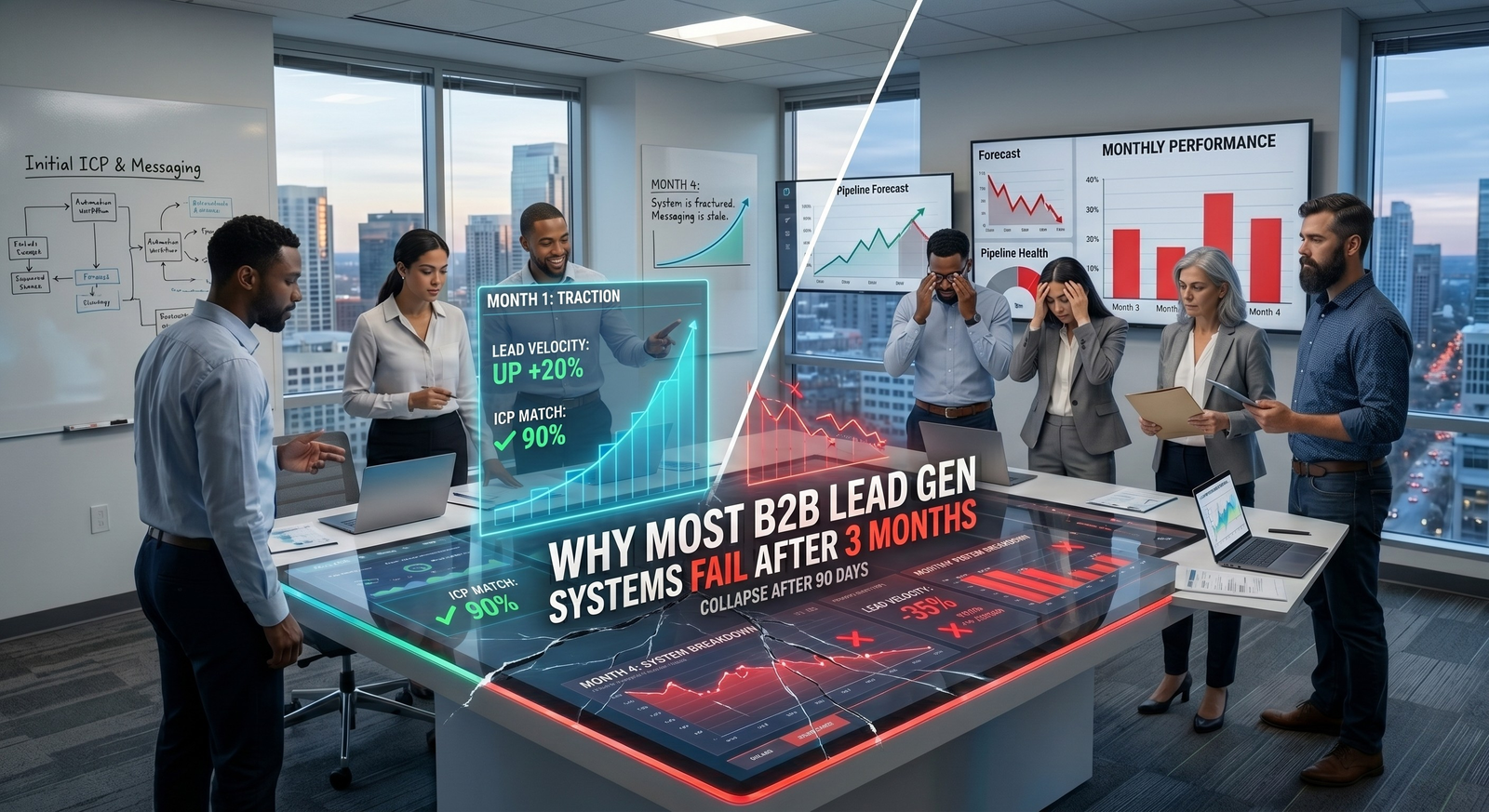
Why Most B2B Lead Generation Systems Fail After 3 Months
Most b2b lead generation systems don’t fail because the strategy is wrong.
They fail because the system was never designed to last.
What often starts as an exciting new acquisition engine quickly turns into inconsistent results, declining performance, and eventually, complete breakdown after just a few months.
The issue is not effort. It is structure.
In this article, we’ll break down why most systems collapse after 90 days and what separates short-lived setups from sustainable revenue engines.
The Reality Behind Short-Lived B2B Lead Generation Systems
Why many B2B lead generation strategies lose effectiveness over time
Most systems start strong because early activity benefits from novelty, urgency, and low competition within the new setup.
But over time:
- Response rates decline
- Target audiences become saturated
- Messaging loses impact
The gap between setup and sustainable execution
Teams often focus heavily on launching campaigns but neglect ongoing optimization.
This creates a gap between:
- Initial execution
- Long-term maintenance
And that gap is where performance drops.
Why early wins don’t translate into long-term success
Early success is often misleading. It comes from:
- Untested audiences
- Fresh messaging
- Temporary attention spikes
Without systems, those wins fade quickly.
The illusion of scalability in early-stage systems
Early traction often creates false confidence.
What looks scalable is usually:
- Manual effort disguised as a system
- Unstable processes
- Non-repeatable results
Lack of Scalable Lead Generation Systems
Why most teams fail to build scalable lead generation systems
Scalability requires structure, not activity. Most teams never move beyond tactical execution.
Over-reliance on short-term tactics instead of repeatable processes
Common issue:
- Running campaigns instead of building systems
- Chasing short-term wins instead of compounding results
Failure to systemize acquisition workflows
Without systems:
- Lead flow is inconsistent
- Execution depends on individuals
- Growth cannot be repeated reliably
Breaking when volume increases beyond manual capacity
When outreach scales, manual systems collapse:
- Response handling slows
- Personalization breaks
- Lead quality drops
Weak Foundations in Data-Driven Lead Generation
Poor data-driven lead generation leads to inconsistent results
Without data, decisions are based on assumptions instead of performance.
Inaccurate targeting and broken segmentation
Common problems include:
- Misaligned ICP definitions
- Broad targeting lists
- Lack of behavioral segmentation
Lack of feedback loops for optimization
Many teams fail to ask:
- What is working?
- What is converting?
- What should be removed?
Why data quality determines long-term performance
Poor data leads to:
- Wasted outreach
- Low conversion rates
- Unstable pipeline generation
Over-Reliance on Single Acquisition Channels
Fragility of isolated outbound lead generation campaigns
Outbound alone often breaks due to:
- Email fatigue
- Domain saturation
- Declining response rates
Limitations of standalone inbound lead generation methods
Inbound alone suffers from:
- Slow ramp-up time
- High dependency on content volume
- Inconsistent traffic quality
Why multi-channel balance is essential for stability
Stable systems combine:
- Outbound
- Inbound
- Paid distribution
- ABM strategies
Channel fatigue and diminishing returns over time
Every channel eventually declines without optimization and diversification.
Poorly Structured Sales Funnel Lead Generation
Broken sales funnel lead generation systems
Funnels fail when stages are not clearly defined or aligned.
Weak alignment between top, middle, and bottom funnel stages
Common breakdown:
- Marketing attracts leads
- Sales cannot convert them
- No alignment on qualification
Why leads drop off before conversion
Drop-offs happen due to:
- Slow follow-up
- Poor nurturing
- Weak qualification processes
Lack of optimization across funnel transitions
Each stage must be continuously refined to improve flow.
Failure to Generate High-Quality B2B Leads Consistently
Decline in high-quality B2B leads over time
As systems scale, quality often decreases due to weaker targeting.
Misaligned targeting and poor qualification processes
Without clear criteria:
- Low-intent leads enter pipelines
- Sales cycles become inefficient
Quantity over quality in early campaign stages
Many teams prioritize volume, which leads to poor downstream performance.
Why qualification systems break under pressure
When volume increases, weak qualification systems cannot keep up.
Weak Account-Based Marketing (ABM) Execution
Poorly structured account-based marketing (ABM) lead generation
ABM fails when it lacks structure and focus.
Lack of account prioritization and focus
Common issue:
- Too many accounts
- No clear tiering system
- No prioritization model
Ineffective coordination between sales and marketing
Without alignment:
- Messaging becomes inconsistent
- Outreach lacks coherence
Why ABM requires long-term consistency to succeed
ABM is not a short-term tactic. It requires sustained execution.
Outbound Lead Generation Campaign Fatigue
Why outbound lead generation campaigns lose performance quickly
Outbound performance declines due to repetition and saturation.
Messaging fatigue and overused templates
Prospects quickly recognize:
- Generic sequences
- Repetitive messaging
- Lack of originality
Lack of personalization at scale
When personalization is not scalable:
- Efficiency drops
- Engagement declines
Declining response rates over time
Without iteration, outbound performance steadily decreases.
Weak Prospecting Strategies That Don’t Scale
Ineffective prospecting strategies for B2B companies
Manual prospecting is difficult to sustain long-term.
Manual processes that cannot scale beyond early traction
Early wins often rely on:
- Founder-led outreach
- Small datasets
- High manual effort
Lack of segmentation and prioritization
Without segmentation:
- Efforts are wasted
- High-value accounts are missed
Over-reliance on short-term prospect lists
Static lists quickly become outdated and ineffective.
Failure in Lead Nurturing Strategies
Broken lead nurturing strategies in B2B pipelines
Many leads are lost due to lack of follow-up.
Ignoring long sales cycles and delayed buying behavior
B2B buyers often take months to convert.
Lack of structured follow-up systems
Without nurturing:
- Leads go cold
- Opportunities are lost
Leads going cold due to inconsistent engagement
Inconsistent communication kills pipeline momentum.
Pipeline Generation Breakdowns in Sales Teams
Unstable pipeline generation for sales teams
Unpredictable pipelines lead to unstable revenue.
Lack of coordination between marketing and SDRs
Misalignment causes:
- Poor lead handoffs
- Duplicate efforts
Poor visibility into pipeline health
Without data visibility, forecasting becomes unreliable.
Failure to maintain consistent deal flow
Systems must generate steady, not sporadic, pipeline.
Lack of Conversion-Focused Optimization
Weak conversion-focused lead generation strategies
Many systems focus on acquisition but ignore conversion efficiency.
No iteration or performance optimization
Without optimization:
- Performance stagnates
- ROI declines
Failure to improve messaging and targeting over time
Messaging must evolve based on real feedback.
Ignoring conversion bottlenecks in the system
Small bottlenecks compound into major revenue loss.
Missing B2B Demand Generation Strategy
Weak or absent B2B demand generation tactics
Without demand generation, pipelines rely solely on active buyers.
Over-focus on immediate leads instead of long-term demand
Short-term thinking leads to unstable pipelines.
Failure to build market awareness
If buyers don’t know you, they won’t convert quickly.
Why demand generation stabilizes long-term performance
Demand generation creates:
- Brand awareness
- Warm audiences
- Lower acquisition friction
Why Most Systems Collapse After 90 Days
Lack of optimization cycles and continuous improvement
Systems fail when they are not iterated regularly.
No alignment between strategy, execution, and data
Disconnected systems cannot scale effectively.
Burnout of tactics without strategic evolution
Tactics lose effectiveness without evolution.
The importance of building systems, not campaigns
Campaigns end. Systems compound over time.
How to Build Lead Generation Systems That Last
Designing sustainable B2B lead generation strategies
Sustainable systems require:
- Clear structure
- Consistent execution
- Continuous improvement
Combining inbound, outbound, and ABM into one system
Integrated systems outperform isolated channels.
Using data to continuously improve performance
Data should guide:
- Targeting
- Messaging
- Channel allocation
Building scalable, long-term revenue engines
The goal is not short-term wins but predictable growth.
Final Thoughts
Most b2b lead generation systems fail because they are built for launch, not longevity.
They rely on tactics instead of systems, and activity instead of structure.
Sustainable growth comes from:
- Multi-channel balance
- Strong data foundations
- Continuous optimization
- Clear alignment across teams
The difference between systems that fail and systems that scale is simple:
One is built for speed.
The other is built for endurance.
Find what you’re reading informative so far? Then why not read more by visiting our blog? We keep you up-to-date every week with how-to guides and strategies to B2B lead generation every single week! Click here to get started!