

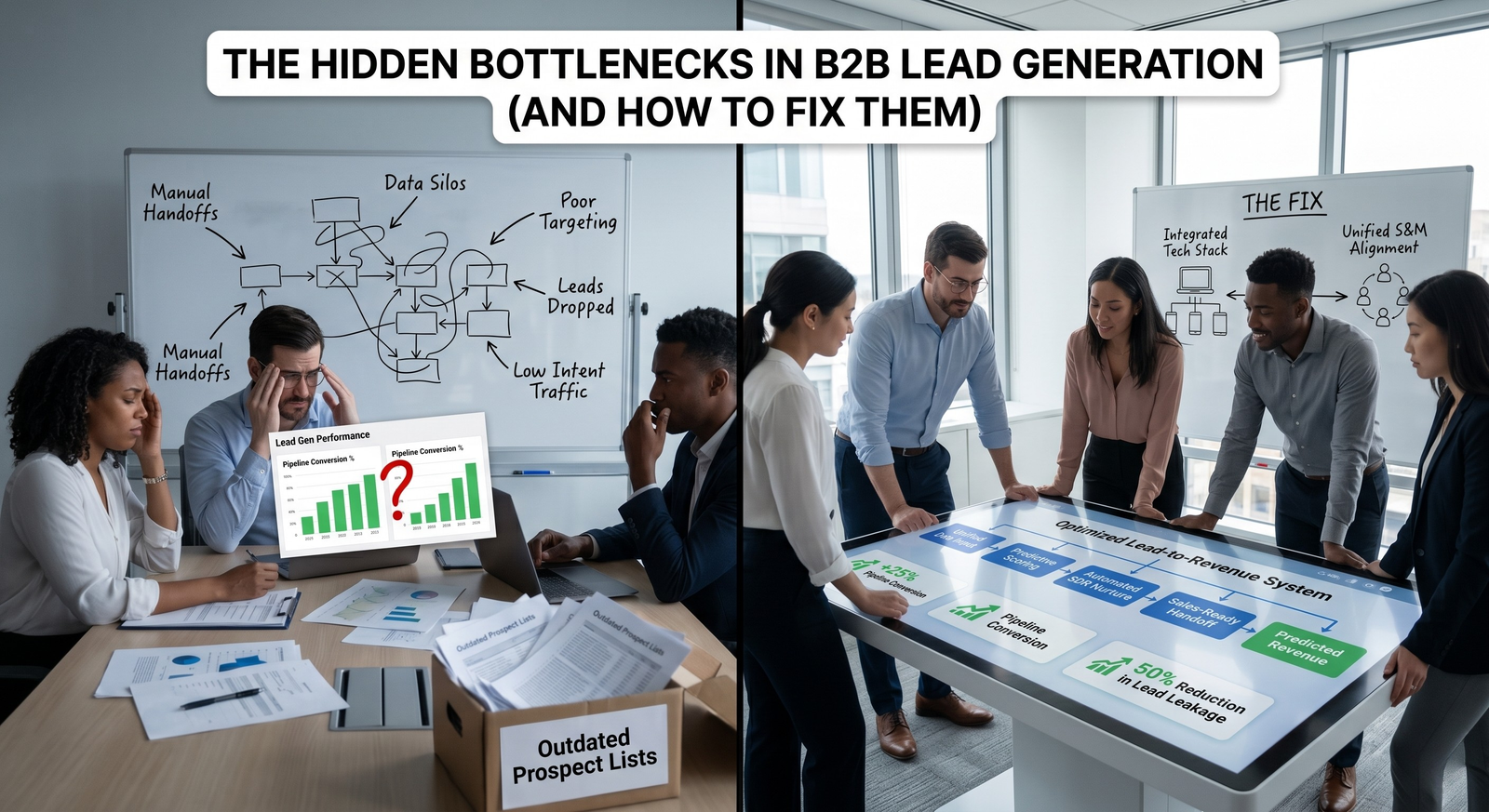
The Hidden Bottlenecks in B2B Lead Generation (And How to Fix Them)
B2B lead generation often appears to be working on the surface while quietly failing underneath.
Campaigns run, leads come in, dashboards look healthy, yet revenue remains inconsistent and pipeline quality fluctuates. This disconnect is not random. It is usually caused by hidden bottlenecks that compound over time inside the system.
The real issue is not lack of activity. It is friction inside the system that prevents consistent performance.
In this article, we will break down the most common hidden bottlenecks in b2b lead generation and how to fix them so your pipeline becomes more predictable, scalable, and conversion focused.
Why B2B Lead Generation Breaks Down Behind the Scenes
Common failures in modern B2B lead generation strategies
Most systems fail quietly due to structural weaknesses rather than obvious mistakes.
Common issues include:
• Weak targeting definitions
• Inconsistent messaging across channels
• Poor follow up processes
• Lack of alignment between marketing and sales
These issues do not stop lead generation completely. Instead, they slowly reduce efficiency until performance declines.
Why performance looks good on the surface but fails in execution
Dashboards often show positive signals such as impressions, clicks, and form fills. However, these metrics do not always translate into revenue.
The gap happens because:
• Engagement does not equal intent
• Leads are not properly qualified
• Sales readiness is misjudged
The hidden friction points in scalable acquisition systems
Hidden friction usually exists in:
• Data flow between tools
• Lead qualification steps
• Handovers between teams
These small inefficiencies are often ignored until scale exposes them.
How small inefficiencies compound into major pipeline issues
Even a small drop in conversion rate at each stage can lead to major revenue loss downstream. Over time, this creates unstable pipeline performance and unpredictable growth.
Weak Foundations in Scalable Lead Generation Systems
Why most teams struggle to build scalable lead generation systems
Scalability requires structure, not just activity. Many teams operate reactively instead of systemically.
Over reliance on manual processes and disconnected tools
When systems depend on manual work, performance becomes inconsistent. Common problems include:
• Manual list building
• Manual outreach tracking
• Fragmented reporting across platforms
Lack of repeatable workflows across acquisition channels
Without repeatable workflows, every campaign feels like a new experiment instead of a predictable engine.
The absence of system wide optimization loops
High performing systems continuously improve. Most systems fail because they do not have feedback loops to identify what is working and what is not.
Data Bottlenecks in Data Driven Lead Generation
Why data driven lead generation breaks without clean inputs
Data driven systems are only as strong as the data they rely on. Poor inputs lead to poor decisions.
Poor segmentation and targeting accuracy
When segmentation is unclear:
• Messaging becomes generic
• Conversion rates drop
• High intent prospects are missed
Incomplete or outdated CRM data
Outdated data leads to wasted effort, including:
• Contacting irrelevant accounts
• Targeting inactive leads
• Misaligned outreach timing
How bad data leads to wasted outreach and low conversion
Poor data quality creates inefficiency at every stage of b2b lead generation, from prospecting to closing.
Funnel Friction in Sales Funnel Lead Generation
Breakdowns in sales funnel lead generation stages
Funnels often break because stages are not clearly defined or properly managed.
Lead leakage between marketing and sales handoffs
One of the biggest leaks occurs during handoff, where:
• Marketing passes leads too early
• Sales rejects unqualified leads
• Follow up is inconsistent
Misalignment between funnel stages and buyer intent
Not all leads move linearly. Many systems fail to account for varying buyer readiness.
Why conversion drops happen mid funnel
Conversion drops often occur due to:
• Lack of nurturing
• Slow response times
• Weak qualification criteria
Outbound Lead Generation Campaign Bottlenecks
Inefficiencies in outbound lead generation campaigns
Outbound systems often degrade over time when not optimized.
Poor targeting and list quality issues
Bad lists lead to:
• Low response rates
• High bounce rates
• Wasted outreach effort
Messaging fatigue and low engagement rates
Repeated use of generic messaging reduces engagement over time.
Lack of personalization at scale
Without personalization, outreach becomes irrelevant, leading to declining performance.
Inbound Lead Generation Method Gaps
Weak inbound lead generation methods and inconsistent traffic quality
Inbound systems often struggle with inconsistent lead quality.
Content that fails to attract high intent prospects
Not all content attracts buyers. Many assets generate traffic but not revenue.
Search engine optimization and distribution gaps in demand capture
Even strong content fails without proper distribution and visibility.
Why inbound alone cannot sustain pipeline growth
Inbound is powerful but unpredictable without complementary outbound and account based strategies.
Problems in Qualified Lead Generation for Businesses
Inconsistent qualified lead generation for businesses
Many systems fail to define what a qualified lead actually is.
Misaligned qualification criteria across teams
Marketing and sales often use different definitions, creating friction.
Over prioritizing volume over intent
High volume does not guarantee high quality.
Lack of structured lead scoring systems
Without scoring systems, prioritization becomes subjective.
Why High Quality B2B Leads Are Hard to Sustain
Declining high quality b2b leads due to weak targeting
Poor targeting leads to inconsistent lead quality over time.
Poor ideal customer profile definition and segmentation issues
Without clear ideal customer profiles, outreach becomes unfocused.
Lack of behavioral insights in lead selection
Behavioral data helps identify real buying intent, which is often missing.
How to fix quality degradation in pipelines
Improve targeting by combining:
• Firmographic data
• Behavioral signals
• Engagement history
Account Based Marketing Execution Bottlenecks
Weak account based marketing lead generation execution
Account based marketing fails when it is not structured properly.
Lack of coordination between sales and marketing teams
Misalignment leads to inconsistent messaging and poor account coverage.
Poor account prioritization strategies
Without prioritization, resources are spread too thin across accounts.
Why account based marketing fails without intent and data alignment
ABM requires accurate timing and behavioral insight to succeed.
Prospecting Strategy Inefficiencies
Ineffective prospecting strategies for B2B companies
Many prospecting efforts are still manual and outdated.
Over reliance on outdated or static prospect lists
Static lists quickly become irrelevant in dynamic markets.
Lack of intent based targeting in outreach
Without intent signals, outreach is often poorly timed.
Manual prospecting that does not scale
Manual systems break when volume increases.
Lead Nurturing Strategy Gaps in B2B
Weak lead nurturing strategies in B2B pipelines
Many leads are lost due to lack of follow up.
Ignoring long decision making cycles
B2B buyers often need extended engagement before converting.
Lack of structured follow up sequences
Without structure, leads fall through the cracks.
Leads going cold due to poor engagement timing
Poor timing leads to lost opportunities even when interest exists.
Pipeline Generation Problems in Sales Teams
Broken pipeline generation for sales teams systems
Pipeline instability often comes from weak systems, not weak performance.
Lack of visibility into pipeline health and flow
Without visibility, forecasting becomes unreliable.
Misalignment between SDRs, marketing, and account executives
Team misalignment reduces efficiency and conversion rates.
Inconsistent deal progression tracking
Without tracking consistency, deals stall unnoticed.
Multi Channel B2B Marketing Misalignment
Challenges in multi channel b2b marketing strategies
Multi channel systems often operate in silos.
Inconsistent messaging across channels
Different messages across platforms confuse buyers.
Lack of unified campaign tracking
Without unified tracking, performance cannot be properly measured.
Channel overlap causing inefficiencies
Overlapping efforts lead to wasted spend and duplicated work.
Conversion Focused Lead Generation Gaps
Weak conversion focused lead generation practices
Many systems focus too much on acquisition and not enough on conversion.
Lack of optimization across conversion stages
Without optimization, bottlenecks remain hidden.
Failure to test and refine messaging
Messaging must evolve based on performance feedback.
Ignoring conversion bottlenecks in reporting
Focusing only on top of funnel metrics hides real problems.
How to Fix Hidden Bottlenecks in B2B Lead Generation
Strengthening systems through b2b demand generation tactics
Demand generation helps stabilize pipeline flow by creating awareness before intent.
Aligning inbound, outbound, and account based marketing strategies
Integration improves consistency and reduces fragmentation.
Using data to continuously optimize performance
Data should guide:
• Targeting decisions
• Messaging improvements
• Channel allocation
Building truly scalable end to end lead generation systems
A complete system requires alignment across every stage of the funnel.
The Future of B2B Lead Generation Optimization
Why visibility and alignment will define future performance
The future belongs to systems that can unify data, teams, and processes.
The role of automation in removing bottlenecks
Automation reduces manual friction and improves speed.
Moving from fragmented systems to unified revenue engines
Disconnected tools will be replaced by integrated revenue systems.
Building predictable growth through continuous optimization
Continuous improvement is the foundation of long term success.
Final Thoughts
Most b2b lead generation systems do not fail suddenly. They fail slowly due to hidden bottlenecks that accumulate over time.
The solution is not more tools or more activity. It is clarity, alignment, and structure.
When teams fix data issues, align their funnel, and build repeatable systems, lead generation becomes predictable instead of chaotic.
The difference between failure and scale is not effort.
It is visibility into what is really breaking inside the system.
Find what you’re reading informative so far? Then why not read more by visiting our blog? We keep you up-to-date every week with how-to guides and strategies to B2B lead generation every single week! Click here to get started!