

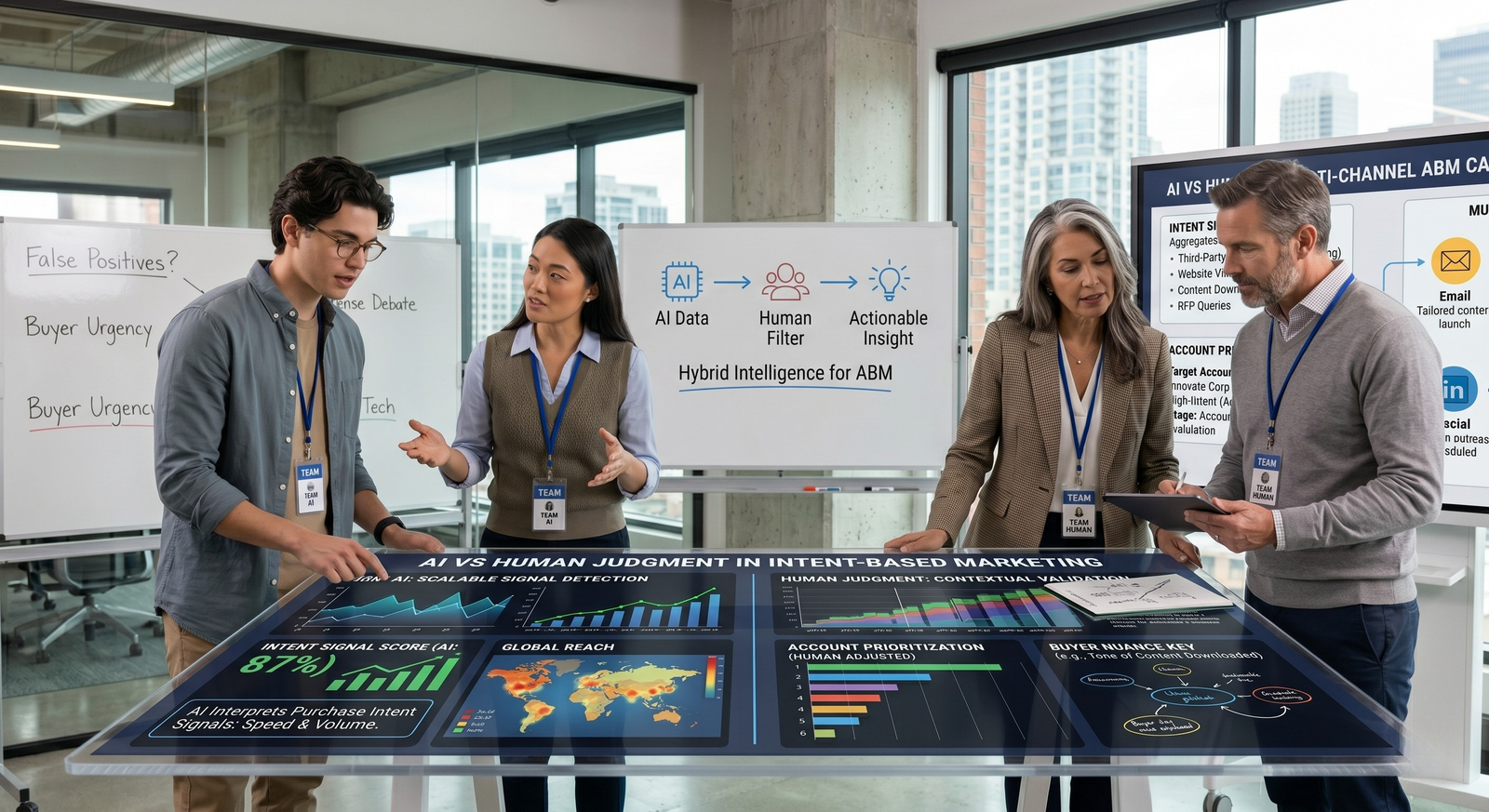
AI vs Human Judgment in Intent-Based Marketing
The rise of intent-based marketing has transformed how B2B companies identify, prioritize, and engage buyers. What once relied heavily on human intuition and static targeting is now increasingly powered by AI systems that analyze behavioral signals at scale.
But as automation becomes more advanced, a critical question emerges:
Should intent-driven decisions be led by AI, or should human judgment still guide the process?
The answer isn’t binary. In modern go-to-market teams, success depends on understanding where AI excels—and where human interpretation still outperforms machines.
This tension between speed and context is now one of the defining challenges in B2B growth strategy.
The Core Debate in Modern Intent-Based Marketing
Understanding the modern intent-based marketing definition
Intent-based marketing is the practice of using behavioral data—such as content engagement, search behavior, and cross-channel activity—to identify accounts actively researching solutions.
It moves marketing from demographic targeting to behavioral intelligence.
Why decision-making in B2B sales is becoming more data-driven
B2B buyers leave behind digital signals long before speaking to sales. As a result, companies increasingly rely on data systems to detect patterns that indicate buying intent.
This has made decision-making faster, but also more dependent on interpretation models.
The tension between automation and human intuition in marketing
AI can process massive volumes of intent signals, but it lacks context.
Humans can interpret nuance, but struggle to scale.
This creates a natural tension between efficiency and understanding in modern marketing systems.
How AI is reshaping competitive advantage in outbound strategy
Companies using AI-driven intent systems can identify in-market accounts earlier, prioritize outreach faster, and personalize messaging at scale—creating a significant advantage in crowded markets.
What AI Brings to Intent-Based Marketing
Using B2B buyer intent data for large-scale analysis
AI excels at processing large datasets across thousands of accounts, identifying patterns that would be impossible to detect manually.
How AI interprets purchase intent signals across channels
Machine learning models analyze engagement across ads, websites, search behavior, and third-party platforms to detect purchase intent signals.
The role of real-time buyer behavior tracking in predictive systems
Real-time tracking allows AI to continuously update account scores based on live engagement, improving responsiveness in outreach strategies.
Leveraging intent data platforms for faster decision-making
Intent platforms enable automated prioritization, ensuring that high-potential accounts are immediately surfaced for sales and marketing action.
Where Human Judgment Still Matters Most
Why context matters beyond intent signal analysis for lead qualification
Not all engagement signals indicate real buying intent. Humans are needed to interpret context—such as timing, industry dynamics, and account history.
Human interpretation of nuanced buyer signals
A spike in engagement might signal interest—or internal research for unrelated reasons. Human judgment helps differentiate between signal and noise.
Adjusting messaging beyond algorithmic recommendations
AI can suggest messaging themes, but humans refine tone, positioning, and empathy based on real buyer psychology.
Balancing behavioral targeting in B2B marketing with real-world insight
Effective targeting requires combining data insights with market awareness, competitive positioning, and deal-level understanding.
Early Purchase Intent Detection: AI Speed vs Human Context
How AI improves early purchase intent detection
AI systems can detect early-stage research behavior across multiple channels, surfacing accounts before they enter traditional sales pipelines.
Human validation of account intent monitoring outputs
Sales teams validate whether detected signals represent real opportunities or false positives.
Combining automation with experience in identifying real opportunities
The strongest systems combine AI detection with human review to ensure accuracy in prioritization.
Reducing false positives in high-intent prospect identification
Human oversight helps reduce wasted outreach by filtering accounts that show surface-level but non-actionable engagement.
High-Intent Prospect Identification: Who Decides Better?
AI-driven high-intent prospect identification at scale
AI can rank thousands of accounts based on engagement depth, frequency, and behavioral consistency.
Human refinement of intent-based targeting decisions
Humans refine these lists by adding strategic context such as deal size, relationship history, or competitive landscape.
Using account intent monitoring alongside sales expertise
Sales teams use intent data as input—not final judgment—to prioritize outreach.
Improving prioritization with hybrid intelligence models
The most effective systems combine machine scoring with human override mechanisms for precision targeting.
Timing Outbound Campaigns: Algorithm vs Experience
AI-powered predictive marketing strategies for outreach timing
AI predicts optimal outreach timing based on historical engagement patterns and behavioral trends.
Human judgment in interpreting buying urgency
Humans assess urgency based on external signals like funding, leadership changes, or strategic initiatives.
Aligning campaigns with real buyer readiness signals
Timing improves when AI signals are matched with real-world business context.
Why timing outbound campaigns impacts conversion outcomes
Even small improvements in timing can significantly increase engagement and conversion rates in ABM and outbound campaigns.
AI in Intent-Driven Lead Generation vs Human Strategy
Scaling intent-driven lead generation with AI systems
AI enables teams to scale lead generation by automatically identifying and scoring thousands of potential accounts.
Human-led refinement of targeting in-market buyers
Humans refine targeting strategies to ensure alignment with revenue goals and ICP fit.
Improving efficiency while preserving message relevance
AI improves speed, but human input ensures messaging remains relevant and context-aware.
Reducing noise in automated prospecting pipelines
Human oversight filters out irrelevant or low-quality signals, improving pipeline quality.
Account-Based Marketing (ABM): Data vs Decision-Making
Enhancing data-driven account-based marketing (ABM) with AI insights
AI enhances ABM by identifying which target accounts are actively in-market.
Human oversight in strategic account prioritization
Strategic accounts often require human judgment due to long-term value, complexity, or relationship factors.
Aligning sales and marketing through intent data
Shared intent insights improve alignment between teams by creating a unified view of account readiness.
Balancing automation with strategic account judgment
The best ABM programs balance automated prioritization with human strategic decision-making.
Personalized Outreach Using Buyer Intent: Machine vs Human Touch
AI-generated personalized outreach using buyer intent
AI can generate messaging based on behavioral triggers such as content consumption or product interest.
Human refinement for tone, empathy, and relevance
Humans refine messaging to ensure it feels natural, relevant, and aligned with brand voice.
Avoiding overly automated or generic messaging
Over-automation risks creating generic outreach that reduces trust and engagement.
Increasing engagement through hybrid personalization strategies
Combining AI insights with human editing creates outreach that is both scalable and authentic.
Buyer Signals: Interpreting Data vs Understanding Context
AI detection of buyer signals across channels
AI identifies signals such as repeat website visits, ad engagement, and content consumption patterns.
Human interpretation of intent signal meaning
Humans interpret what those signals mean within broader business context and buying dynamics.
Combining structured data with qualitative insight
The strongest systems combine quantitative data with qualitative interpretation.
Improving qualification accuracy through dual evaluation
Dual evaluation reduces misclassification and improves lead quality.
Does AI Help Shorten Sales Cycles or Just Speed Processes?
How AI improves qualification speed through automation
AI accelerates lead qualification by instantly scoring and prioritizing accounts.
Human influence on deal progression and trust-building
Human interaction remains essential for building trust, navigating objections, and closing deals.
Why shortening sales cycles requires both logic and context
Speed alone does not shorten cycles—relevance and timing do.
Balancing efficiency with relationship-driven selling
The best outcomes come from combining automated efficiency with human relationship-building.
The Competitive Advantage of Hybrid Intelligence
Why neither AI nor humans are sufficient alone
AI lacks context. Humans lack scale. Neither is sufficient independently.
Combining predictive systems with experienced judgment
Hybrid systems allow AI to surface opportunities while humans validate and prioritize them.
Creating a scalable yet human-centered intent strategy
This balance enables scalable marketing without losing personalization or strategic nuance.
The future of intent-based marketing is collaborative intelligence
The future is not AI vs human—it is AI with human judgment, working together to interpret intent and drive better decisions.
Final Thoughts
Intent-based marketing is no longer just a technology challenge—it is a decision-making framework challenge.
AI has fundamentally changed the speed and scale at which we can identify buyer intent. But human judgment remains essential for interpreting meaning, context, and opportunity.
The most successful teams will not choose between AI and humans.
They will design systems where both work together.
AI will surface the signals. Humans will interpret them. And together, they will turn intent into revenue with far greater precision than either could achieve alone.
Find what you’re reading informative so far? Then why not read more by visiting our blog? We keep you up-to-date every week with how-to guides and strategies to B2B lead generation every single week! Click here to get started!