

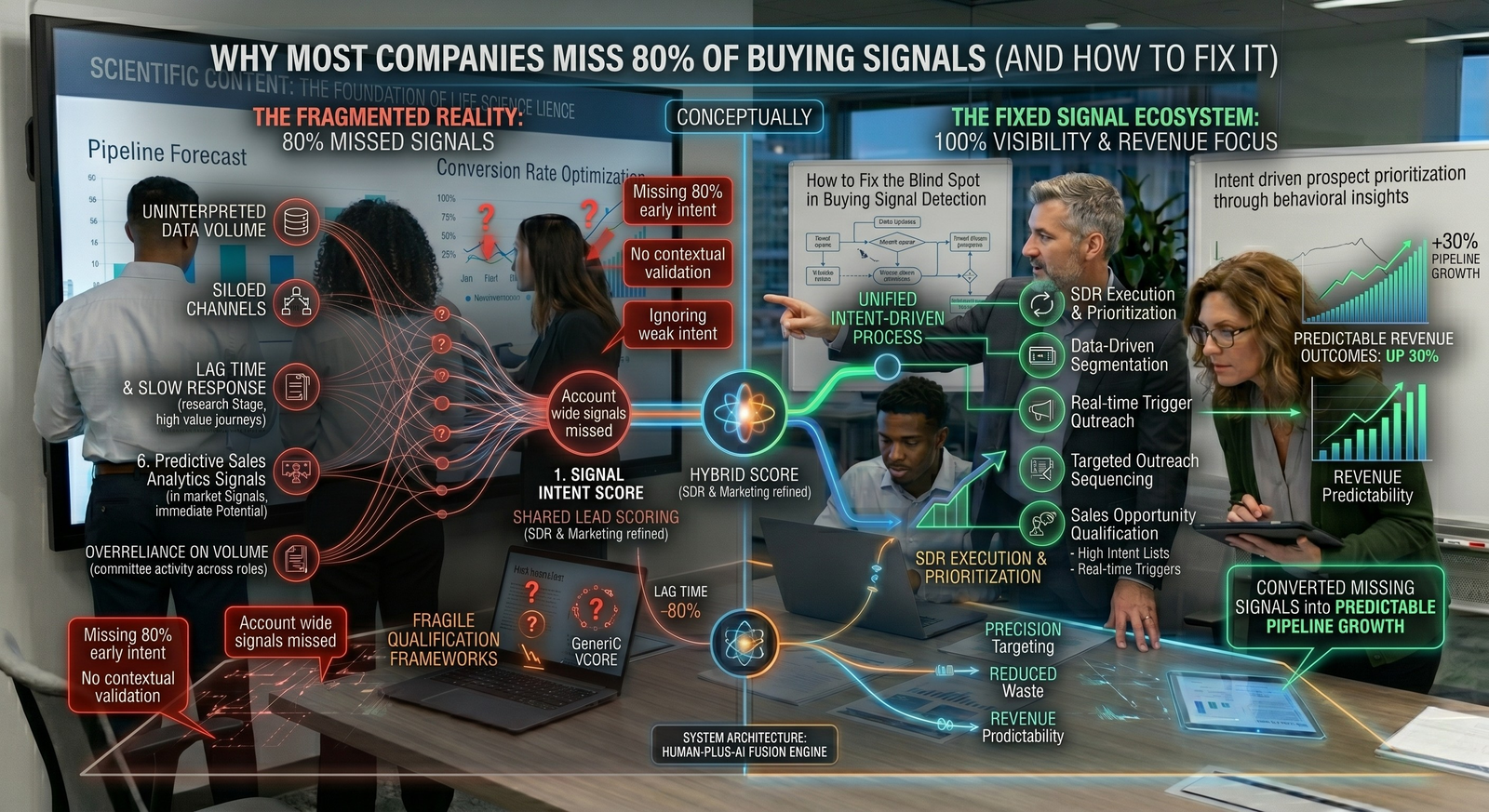
Why Most Companies Miss 80% of Buying Signals (And How to Fix It)
In modern B2B sales, data is everywhere, but clarity is rare. Most teams are surrounded by engagement metrics, CRM updates, website analytics, and email interactions, yet still struggle to accurately identify buying signals that indicate real purchase intent.
The problem is not a lack of information. It is a lack of interpretation, timing, and system design. Companies often track activity but fail to convert it into meaningful insight about readiness to buy.
Understanding how to properly identify buying signals is now one of the most important competitive advantages in sales. The difference between missed opportunities and high performing pipelines often comes down to how well teams can recognize intent hidden inside fragmented data.
Why Buying Signal Detection Fails in Most B2B Sales Teams
Most sales teams do not fail because they lack data. They fail because the data is not structured or interpreted correctly.
How buying signal detection in B2B sales breaks down in real workflows
In many organizations, signals are scattered across tools like CRM systems, email platforms, and website analytics dashboards. Each system tells a partial story, but no single system shows the full buyer journey. As a result, signals remain isolated instead of being connected into meaningful patterns.
Overreliance on volume instead of behavioral insight
A common issue is focusing on lead volume rather than behavioral depth. Teams often prioritize how many leads are generated instead of how strongly those leads are showing intent. This creates a pipeline filled with activity but lacking real buying readiness.
Lack of timing and context in interpreting signals
A website visit means very little without context. Was it the first visit or the fifth? Did it follow a product demo email or a cold ad click? Without timing context, even strong signals lose meaning.
Why most teams see data but not intent
Most organizations are tracking actions, not motivations. They know what users did but not why they did it. This gap is where most buying signals are missed.
Sales Intent Signals Identification Gaps in Modern Pipelines
How sales intent signals identification is often incomplete or inconsistent
Different teams define intent differently. Marketing may consider a webinar signup as intent, while sales ignores it unless there is direct outreach engagement. This inconsistency leads to missed opportunities.
Missing early stage research signals from prospects
Many buyers begin their journey long before they ever contact sales. They read articles, compare solutions, and revisit pricing pages. These early signals are often overlooked because they do not immediately indicate purchase readiness.
Poor alignment between marketing and sales data
When marketing and sales systems are not aligned, intent signals are not passed effectively. Marketing sees engagement, but sales sees cold leads. This disconnect weakens the entire pipeline.
The cost of ignoring weak intent indicators
Weak signals, when combined, often form strong intent patterns. Ignoring them means losing visibility into early stage buyers who are not yet ready but are actively researching.
B2B Buyer Behavior Tracking Blind Spots
How B2B buyer behavior tracking fails across channels
Buyers rarely stay in one channel. They move between email, LinkedIn, websites, and third party content platforms. When tracking is limited to isolated channels, behavior becomes fragmented.
Fragmented data across platforms and tools
Each platform captures only part of the journey. Without integration, teams cannot see the full progression of interest across touchpoints.
Ignoring multi touch engagement journeys
A single interaction rarely leads to a sale. Buyers require multiple touches before making decisions. Many systems fail to recognize cumulative engagement as a signal of intent.
Missing patterns in repeated buyer activity
Repeat visits and recurring engagement often indicate strong interest. However, without pattern recognition systems, these behaviors are treated as random noise.
Purchase Intent Indicators That Go Undetected
How purchase intent indicators are often overlooked
Signals such as pricing page visits, case study downloads, or comparison searches are strong indicators of intent, yet they are often not prioritized.
Misinterpreting early interest as low value activity
Early stage engagement is often dismissed as curiosity. In reality, it may represent the beginning of a structured buying process.
Failure to act on subtle buying signals
Subtle behaviors, like returning to the same product page multiple times, often go unnoticed or unacted upon.
Lost opportunities from weak interpretation
When subtle signals are ignored, competitors often engage first, resulting in lost deals before qualification even begins.
High Intent Prospect Recognition Problems in Sales Teams
How high-intent prospect recognition breaks down operationally
Even when high intent is detected, many teams lack a system to prioritize and act on it quickly.
Confusing engagement with true purchase readiness
Not all engagement equals intent. A prospect reading a blog post is not the same as one requesting a demo, but both are often treated equally.
Lack of prioritization frameworks
Without clear scoring models, teams struggle to separate high value prospects from general interest traffic.
Missing high value opportunities in the pipeline
As a result, high intent accounts are often buried under lower priority leads.
Account Based Buying Signals That Are Overlooked
How account-based buying signals get lost across stakeholders
In enterprise sales, decisions involve multiple stakeholders. Signals from individual users are often not connected at the account level.
Failure to track group level engagement
When multiple people from the same organization show interest independently, this often goes unnoticed as a collective buying signal.
Ignoring buying committee activity
Buying decisions are made by committees, not individuals. Missing this dynamic leads to incomplete opportunity visibility.
Missing account wide intent patterns
Without aggregation, companies fail to detect when an entire organization is actively evaluating a solution.
Lead Scoring Based on Behavior That Misfires
How lead scoring based on behavior becomes inaccurate
Poorly designed scoring models assign incorrect weights to engagement actions, leading to misleading prioritization.
Overweighting low value actions
Actions like email opens or single page visits are often overvalued compared to high intent behaviors.
Underutilizing intent driven signals
Strong indicators such as pricing engagement or repeated product comparison are often underweighted.
Poor alignment between scoring and revenue outcomes
When scoring does not reflect real buying behavior, sales teams waste time on low quality leads.
Real Time Buyer Intent Data Not Fully Utilized
How real-time buyer intent data is often underused
Even when real time data is available, many teams fail to act on it quickly enough.
Slow response to in market activity
Delayed outreach reduces the effectiveness of strong intent signals.
Lack of systems for real time action
Without automation or alerts, signals remain passive instead of actionable.
Missing competitive opportunities due to delay
Speed matters. If one company acts immediately while another delays, the opportunity is often lost.
Sales Opportunity Qualification Signals That Are Ignored
How sales opportunity qualification signals are misinterpreted
Qualification signals are often treated as subjective rather than data driven.
Weak validation of real pipeline opportunities
Without consistent criteria, pipeline quality becomes unreliable.
Confusing engagement with qualified interest
Engagement alone does not equal qualification, yet this mistake is common.
Inconsistent qualification frameworks
Different reps often apply different standards, reducing pipeline accuracy.
Website Engagement Tracking for Leads That Goes Unused
How website engagement tracking for leads is often disconnected from sales
Marketing tracks behavior, but sales often lacks visibility into it.
Ignoring high intent page behavior
Pages like pricing, integrations, or case studies often indicate strong intent but are underutilized.
Failing to act on repeat visits
Repeated visits are one of the strongest buying signals, yet often ignored.
Lack of integration with CRM systems
Without integration, behavioral insights never reach the sales team in time.
Email Engagement Signals in Sales That Are Misread
How email engagement signals in sales are often misinterpreted
Open rates alone are not reliable indicators of intent.
Treating opens as intent without context
An open does not mean interest. It may simply indicate exposure.
Missing reply based buying signals
Replies, especially with questions or objections, are significantly stronger intent indicators.
Poor follow up timing based on engagement
Delayed responses reduce conversion probability even when intent is present.
Content Consumption Patterns for Buyers That Are Overlooked
How content consumption patterns for buyers reveal hidden intent
Content journeys often show progression toward purchase readiness.
Ignoring deep research behavior
Long form content engagement is a strong indicator of serious evaluation.
Failing to map content journeys
Without journey mapping, patterns of increasing intent remain invisible.
Missing early buying stage signals
Early research content often signals the start of a structured buying process.
Predictive Sales Analytics Signals That Are Not Leveraged
How predictive sales analytics signals are underutilized
Many companies collect predictive insights but fail to operationalize them.
Lack of adoption in sales workflows
Insights remain in dashboards instead of guiding outreach.
Poor integration with outbound systems
Without integration, predictive signals do not influence real time decisions.
Missing future high value opportunities
Predictive models often identify future buyers before competitors notice them.
In Market Account Detection That Fails in Practice
How in-market account detection misses active buyers
Accounts actively researching solutions are often not flagged correctly.
Weak identification of purchase ready accounts
Without strong detection systems, high intent accounts go unnoticed.
Failure to act before competitors
Timing delays allow competitors to engage first.
Lack of real time prioritization systems
Static lists prevent dynamic prioritization of active buyers.
Intent Driven Prospect Prioritization That Is Not Implemented
How intent-driven prospect prioritization is missing in many teams
Most teams still rely on static lists instead of dynamic intent systems.
Reliance on static lead lists instead of dynamic signals
Outdated lists reduce relevance and efficiency.
Poor prioritization logic in outbound
Without intent weighting, outreach becomes random.
Lost efficiency in pipeline generation
Effort is wasted on low probability accounts.
How to Fix the Blind Spot in Buying Signal Detection
The solution is not more data, but better structure.
Centralizing all intent and behavioral data
Unifying systems allows teams to see complete buyer journeys.
Building real time signal based workflows
Automation ensures signals trigger immediate action instead of passive reporting.
Aligning sales and marketing around shared intent definitions
A unified definition of intent eliminates confusion and improves prioritization.
Turning missed signals into predictable pipeline growth
When buying signals are properly identified and operationalized, they become a reliable engine for revenue growth rather than hidden opportunities.
Final Thoughts
Most companies do not lose deals because they lack demand. They lose deals because they fail to properly identify buying signals buried within their existing data. The difference between high performing and underperforming sales teams is not access to information, but the ability to interpret intent accurately and act on it quickly.
Fixing this blind spot does not require more tools. It requires better alignment, better timing, and better systems for turning behavior into action.
Find what you’re reading informative so far? Then why not read more by visiting our blog? We keep you up-to-date every week with how-to guides and strategies to B2B lead generation every single week! Click here to get started!