

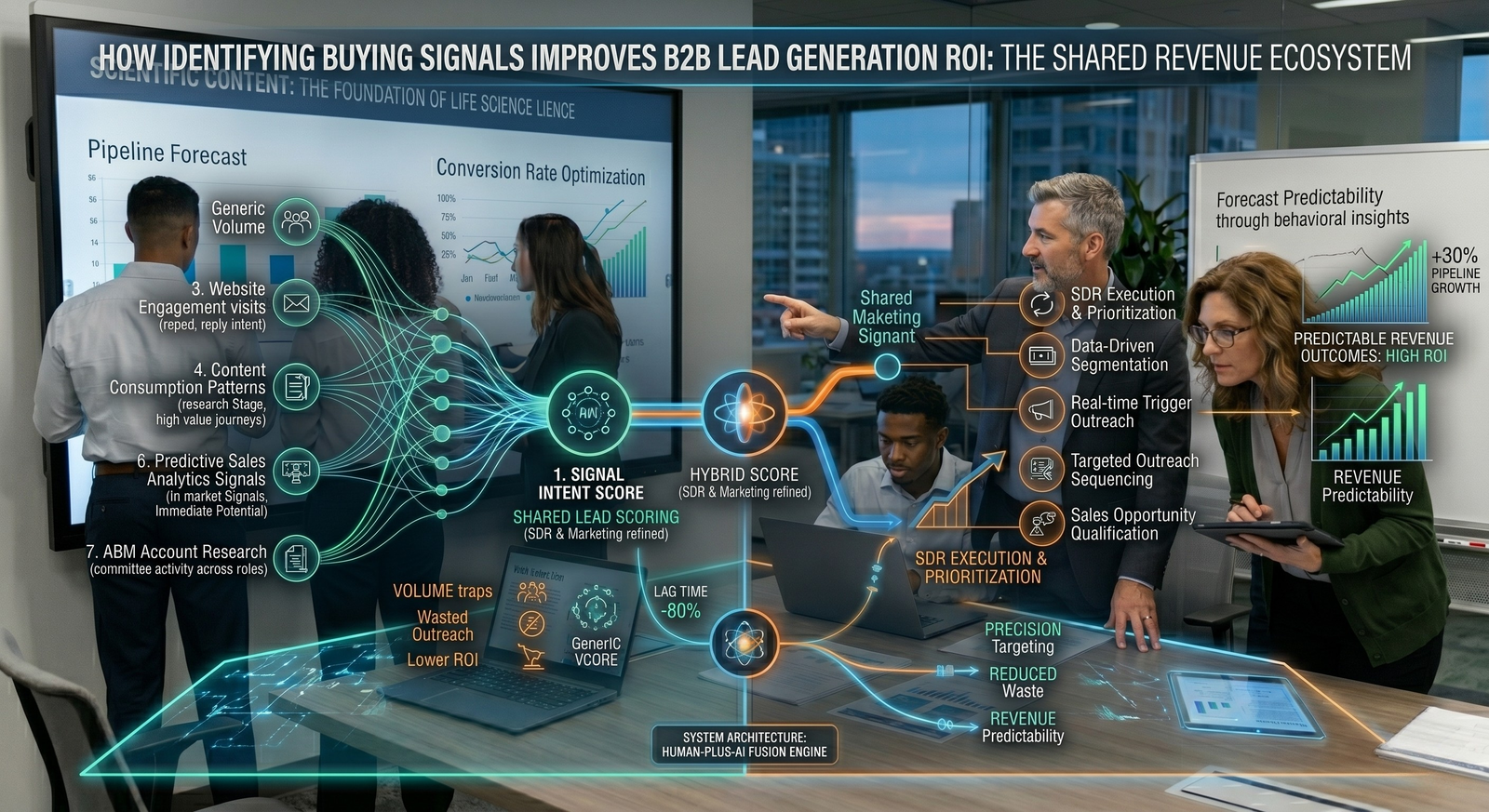
How Identifying Buying Signals Improves B2B Lead Generation ROI
In modern B2B lead generation, efficiency matters just as much as volume. Companies are realizing that success is not about generating more leads, but about generating the right leads at the right time. This is where the ability to identify buying signals becomes a critical driver of return on investment.
Buying signals reveal which prospects are actively engaging, researching solutions, or moving closer to a purchase decision. When these signals are used correctly, they allow sales and marketing teams to focus their efforts where conversion is most likely, reducing waste and increasing revenue impact.
Why Buying Signal Detection Directly Impacts Lead Generation ROI
How buying signal detection in B2B sales improves efficiency and reduces waste
Buying signal detection in B2B sales improves ROI by eliminating guesswork. Instead of reaching out to every lead, teams can prioritize prospects who show real engagement. This reduces wasted outreach and ensures resources are allocated to higher value opportunities.
Shifting from volume based outreach to signal based targeting
Traditional lead generation focuses on volume. Signal based targeting shifts the focus toward behavior and intent, ensuring outreach is guided by actual buyer activity rather than static lists.
Why timing and relevance increase conversion rates
Even strong messaging fails if delivered at the wrong time. Buying signals help align outreach with moments of active interest, which significantly increases response and conversion rates.
The link between intent and revenue performance
Intent driven engagement leads to faster sales cycles and higher deal quality, both of which directly improve ROI across the entire funnel.
Sales Intent Signals Identification for Higher Quality Leads
How sales intent signals identification improves targeting accuracy
Sales intent signals identification helps teams distinguish between casual interest and real buying intent. This leads to more accurate targeting and better lead quality.
Filtering low value leads before they enter the pipeline
By identifying weak signals early, companies can prevent low quality leads from consuming sales resources or inflating pipeline numbers.
Using behavioral cues to prioritize outreach
Actions like repeat website visits or content downloads indicate stronger interest and should be prioritized in outreach sequences.
Increasing ROI through better qualification
Better qualification ensures that only high potential leads move forward, improving overall conversion efficiency.
B2B Buyer Behavior Tracking and ROI Optimization
How B2B buyer behavior tracking reveals high value opportunities
Buyer behavior tracking provides visibility into how prospects interact across digital channels, helping identify high value opportunities early.
Identifying patterns that lead to conversion
Certain behaviors, such as repeated engagement with pricing or solution pages, often correlate strongly with eventual purchase decisions.
Tracking multi channel engagement for better insights
Combining website, email, and content engagement gives a more complete picture of buyer intent.
Reducing wasted effort through behavior analysis
Behavior analysis helps eliminate unqualified leads from sales focus, improving operational efficiency.
Purchase Intent Indicators That Drive Revenue Efficiency
How purchase intent indicators signal buying readiness
Purchase intent indicators highlight when prospects are moving closer to making a decision, such as requesting demos or reviewing product comparisons.
Prioritizing accounts with strong intent signals
High intent accounts should always be prioritized because they have a higher likelihood of converting in the short term.
Distinguishing interest from purchase readiness
Not all engagement equals readiness to buy. Proper interpretation of intent signals is essential to avoid misaligned outreach.
Improving ROI through smarter targeting
Targeting based on intent reduces wasted outreach and improves conversion efficiency across campaigns.
High Intent Prospect Recognition for Better Conversion Rates
How high-intent prospect recognition increases pipeline efficiency
Recognizing high intent prospects ensures that sales teams focus on the most promising opportunities, improving pipeline quality.
Focusing on accounts most likely to convert
This focus leads to higher close rates because outreach aligns with actual buyer behavior.
Eliminating low intent prospects from outreach
Filtering out low intent prospects reduces noise and allows teams to operate more efficiently.
Maximizing revenue from limited sales resources
With better prioritization, even small teams can generate significant revenue from high quality leads.
Account Based Buying Signals and Enterprise ROI
How account-based buying signals improve enterprise targeting
Account based signals reveal when multiple stakeholders within an organization are actively engaging with content or solutions.
Identifying buying committees in motion
When different roles within the same company engage simultaneously, it signals strong enterprise level intent.
Increasing deal size through account focus
Focusing on entire accounts rather than individuals often leads to larger deal sizes and higher ROI.
Improving ROI in complex B2B sales cycles
Account based targeting reduces inefficiency in long and complex enterprise sales cycles.
Lead Scoring Based on Behavior for Smarter Prioritization
How lead scoring based on behavior improves qualification accuracy
Behavior based scoring assigns value to specific actions, improving lead qualification accuracy.
Assigning value to high intent actions
Actions like pricing page visits or demo requests are weighted higher than general browsing activity.
Combining demographic and behavioral data
Blending firmographic fit with behavioral signals creates a more reliable scoring model.
Automating lead prioritization for ROI efficiency
Automation ensures that high quality leads are surfaced instantly for sales engagement.
Real Time Buyer Intent Data for Faster Conversions
How real-time buyer intent data increases speed to opportunity
Real time intent data allows teams to respond immediately when buying behavior is detected.
Acting immediately on in market behavior
In market signals indicate active evaluation, which is the best time for outreach.
Reducing lag between interest and outreach
Faster response times significantly improve conversion rates and ROI.
Improving ROI through faster engagement
Engaging early in the buying journey increases the likelihood of winning the deal.
Sales Opportunity Qualification Signals and Revenue Accuracy
How sales opportunity qualification signals improve pipeline quality
Qualification signals help distinguish real opportunities from weak or unqualified leads.
Separating real opportunities from weak leads
This prevents inflated pipelines and improves forecasting accuracy.
Validating intent through multiple data points
Using multiple signals ensures that opportunities are based on consistent behavior patterns.
Increasing forecast reliability and ROI
Better qualification leads to more accurate revenue forecasting and improved ROI measurement.
Website Engagement Tracking for Leads and ROI Growth
How website engagement tracking for leads identifies buying interest
Website tracking provides direct insight into what prospects are actively exploring.
High intent pages that indicate readiness
Pages like pricing, product features, and case studies often signal strong buying intent.
Repeat visits as conversion predictors
Multiple visits to key pages are a strong indicator of decision stage activity.
Turning web activity into revenue opportunities
Website behavior can be directly used to trigger sales outreach.
Email Engagement Signals in Sales for ROI Optimization
How email engagement signals in sales reflect buyer intent
Email engagement shows how prospects interact with outbound messaging.
Open, click, and reply patterns as conversion indicators
Replies and link clicks indicate stronger intent than passive opens.
Identifying hot leads through email behavior
High engagement emails often indicate immediate interest.
Improving ROI with better follow up timing
Timely follow ups based on engagement significantly increase conversions.
Content Consumption Patterns for Buyers and Revenue Insights
How content consumption patterns for buyers reveal intent strength
Content behavior shows where prospects are in their buying journey.
Mapping content journeys to purchase likelihood
Progression from educational to comparison content often signals increasing intent.
Identifying high value engagement sequences
Certain content sequences strongly correlate with eventual conversions.
Using content data to increase conversion ROI
Content insights help tailor messaging and improve engagement outcomes.
Predictive Sales Analytics Signals for ROI Forecasting
How predictive sales analytics signals improve revenue forecasting
Predictive models use behavioral and historical data to estimate conversion likelihood.
Identifying accounts most likely to convert
These models highlight high probability accounts for prioritization.
Combining historical and behavioral insights
Blending data sources improves predictive accuracy.
Prioritizing high ROI opportunities
Sales teams can focus on opportunities with the highest expected return.
In Market Account Detection for Revenue Efficiency
How in-market account detection reduces wasted outreach
In market detection helps eliminate cold accounts from targeting.
Identifying active buyers early
These accounts are already researching solutions and are closer to purchase.
Avoiding low intent accounts in campaigns
Filtering improves efficiency and reduces wasted effort.
Improving ROI through precise targeting
Targeting active buyers increases conversion rates significantly.
Intent Driven Prospect Prioritization for Maximum ROI
How intent-driven prospect prioritization improves sales focus
Prioritization ensures sales teams focus only on high probability opportunities.
Building high ROI prospect lists from signals
Signal based lists outperform traditional static databases.
Reducing inefficiency in sales workflows
Less time is wasted on unqualified leads.
Aligning outreach with highest conversion potential
Messaging becomes more relevant and effective.
How Buying Signals Transform Overall Lead Generation ROI
Combining multiple signals for better decision making
Using multiple signals together provides a more accurate view of buyer intent.
Improving conversion rates across the funnel
Signal driven strategies consistently increase conversion rates.
Reducing acquisition costs through smarter targeting
Better targeting reduces wasted spend and improves efficiency.
Turning intent intelligence into predictable revenue growth
Over time, buying signals create a repeatable system for generating predictable pipeline and revenue.
Final Thoughts
The ability to identify buying signals is one of the most powerful levers in modern B2B lead generation. It shifts the focus from volume to precision, ensuring that every outreach effort is aligned with real buyer intent.
When applied consistently, buying signals not only improve conversion rates but also reduce acquisition costs and increase overall ROI. In competitive markets, this intelligence becomes the foundation of scalable and predictable revenue growth.