

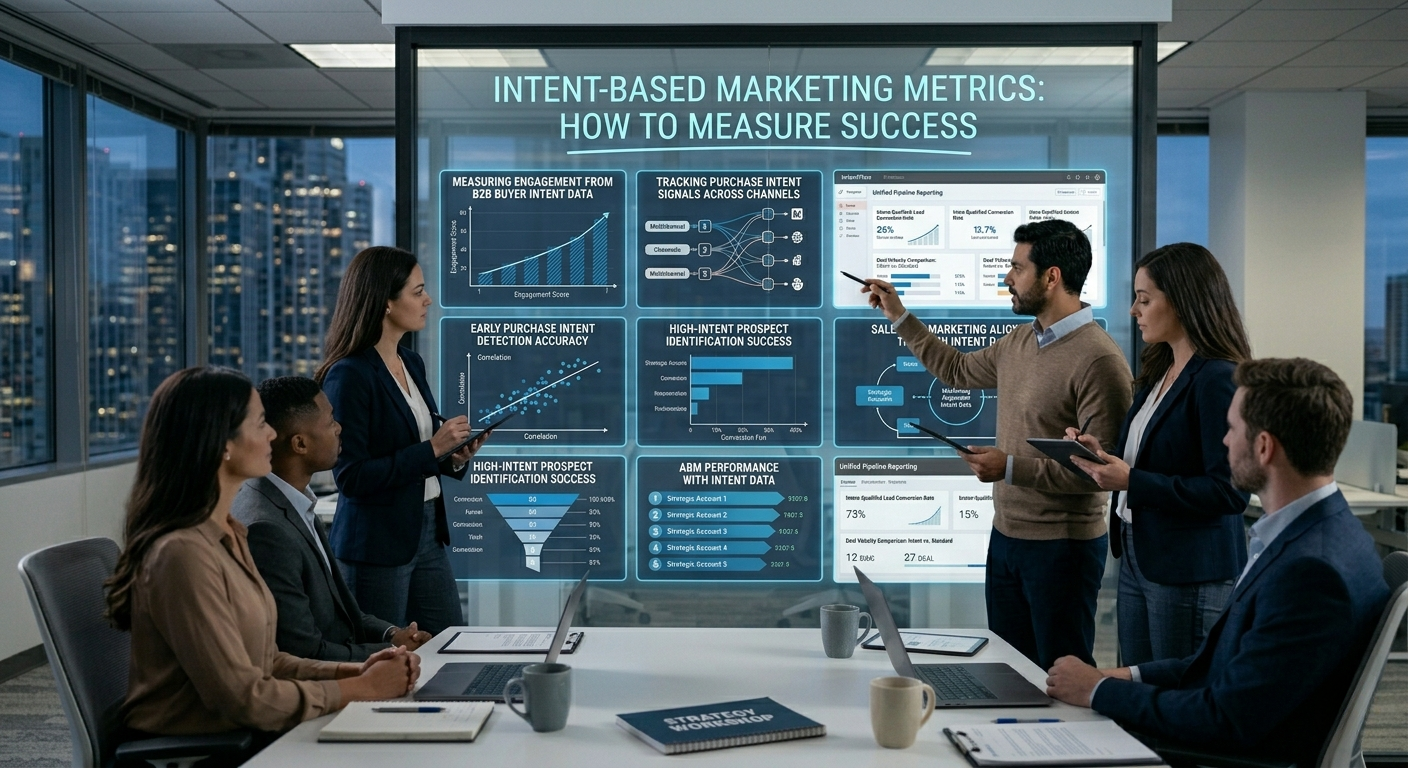
Intent-Based Marketing Metrics: How to Measure Success
As more B2B companies adopt intent based marketing, the focus is shifting from simply generating leads to understanding buyer readiness and purchase behavior. Traditional demand generation often relies on broad targeting, high outreach volume, and surface-level engagement metrics. However, modern revenue teams need deeper visibility into which accounts are actively researching solutions and moving toward a buying decision.
This is where intent data changes the game.
Intent based marketing allows sales and marketing teams to identify behavioral signals that indicate real buying interest. But collecting intent data alone is not enough. Companies also need a reliable way to measure whether their intent strategies are actually improving pipeline quality, conversion rates, and sales efficiency.
Understanding the right metrics is essential for turning buyer intelligence into predictable revenue growth.
Why Measuring Intent-Based Marketing Matters
Understanding the intent-based marketing definition from a performance perspective
At its core, intent based marketing focuses on identifying buyer behavior that signals active interest in a product or solution. This includes content consumption, keyword research, product comparisons, webinar participation, and other forms of digital engagement.
From a measurement standpoint, intent based marketing is not simply about collecting more data. It is about using behavioral insights to improve targeting, timing, personalization, and sales prioritization.
Why traditional lead generation metrics are no longer enough
Traditional metrics such as impressions, clicks, and raw lead volume often fail to reveal actual buying readiness. A large number of leads may look impressive on paper, but if those prospects are not actively researching solutions, sales teams waste time pursuing low quality opportunities.
Modern B2B teams increasingly prioritize metrics such as:
- Buying intent strength
- Engagement depth
- Sales readiness
- Account activity trends
- Pipeline contribution
These metrics provide a much clearer picture of revenue potential.
The connection between buyer signals and revenue outcomes
Strong buyer signals often correlate with faster sales cycles, higher conversion rates, and improved deal velocity. Measuring how these signals influence revenue outcomes helps organizations understand which activities truly impact pipeline generation.
How intent measurement creates long-term competitive advantage
Companies that measure buyer intent effectively can engage prospects earlier than competitors. This creates a significant advantage in crowded B2B markets where timing and relevance heavily influence deal outcomes.
The Core Metrics Every Intent-Based Marketing Strategy Should Track
Measuring engagement from B2B buyer intent data
One of the most important metrics in intent based marketing is engagement quality. Instead of tracking simple website visits, companies should measure deeper interactions such as:
- Time spent on high-intent pages
- Repeat visits from target accounts
- Engagement with pricing or product content
- Webinar attendance and follow-up activity
These actions reveal stronger buying interest than surface-level interactions.
Tracking purchase intent signals across channels
Intent signals appear across multiple channels including websites, review platforms, LinkedIn activity, email engagement, and third-party content consumption. Tracking cross-channel behavior creates a more complete view of buyer intent.
Evaluating lead quality instead of lead volume
High quality leads generate meaningful conversations and move through the pipeline faster. Measuring lead quality helps teams avoid overvaluing quantity-based metrics.
Monitoring conversion trends throughout the buyer journey
Intent based marketing should improve conversion rates at every stage of the funnel. Teams should monitor:
- Lead-to-meeting conversion
- Meeting-to-opportunity conversion
- Opportunity-to-close rates
- Pipeline velocity
These metrics reveal whether intent signals are improving sales performance.
Measuring Buyer Signals and Engagement Quality
Identifying the most valuable buyer signals
Not all buyer signals carry equal weight. Reading a single blog article is far less significant than comparing vendors or downloading technical documentation.
High value buyer signals often include:
- Pricing page visits
- Product demo requests
- Competitor comparison research
- Case study engagement
- Technical resource downloads
Using real-time buyer behavior tracking to monitor intent activity
Real-time buyer behavior tracking allows teams to identify sudden spikes in account activity. This helps SDRs and sales reps engage prospects while interest levels are high.
Measuring engagement depth instead of surface-level interactions
Surface metrics like opens and clicks rarely tell the full story. Teams should evaluate engagement depth by analyzing content paths, session frequency, and behavioral consistency across multiple touchpoints.
Tracking content consumption and research behavior patterns
Intent measurement becomes more powerful when organizations identify recurring research patterns tied to purchase readiness. This helps improve forecasting and qualification accuracy.
Early Purchase Intent Detection Metrics
How to measure early purchase intent detection accuracy
Early purchase intent detection focuses on identifying buying behavior before prospects actively request sales conversations. Measuring accuracy requires tracking whether early signals eventually convert into pipeline opportunities.
Monitoring research spikes and account engagement surges
Sudden increases in research activity often indicate emerging buying interest. Tracking these spikes allows teams to prioritize accounts more effectively.
Using account intent monitoring to identify buying readiness
Account intent monitoring helps organizations measure how engagement changes over time. Increasing activity levels across multiple stakeholders often signal growing buying readiness.
Evaluating how early engagement impacts pipeline performance
Sales teams that engage buyers early typically gain stronger positioning in competitive deals. Measuring this impact helps validate intent-driven outreach strategies.
Metrics for High-Intent Prospect Identification
Measuring success in high-intent prospect identification
Effective high-intent prospect identification should lead to better pipeline quality and improved conversion rates. Companies should compare performance between intent-qualified accounts and traditionally sourced leads.
Comparing intent-qualified accounts against traditional prospect lists
Intent-qualified accounts often outperform generic prospect lists in terms of engagement, reply rates, and sales velocity.
Evaluating outreach efficiency through intent scoring models
Intent scoring models help teams prioritize accounts based on behavioral intensity. Measuring outreach efficiency reveals whether scoring systems are improving productivity.
Reducing wasted outreach with stronger prioritization systems
One major benefit of intent based marketing is reducing wasted outreach toward low-intent accounts. Measuring SDR efficiency and response quality helps validate this improvement.
Measuring the Effectiveness of Timing Outbound Campaigns
Why timing outbound campaigns affects response rates
Outreach timing plays a major role in campaign success. Engaging prospects during active research periods often leads to significantly higher response rates.
Measuring outreach engagement during active buying windows
Companies should analyze engagement performance based on buyer activity timing rather than simply measuring overall campaign volume.
Using predictive marketing strategies to optimize timing
Predictive marketing strategies use historical and behavioral data to identify ideal outreach windows. Measuring timing accuracy helps refine campaign planning.
Comparing conversion rates based on outreach timing accuracy
Intent-driven outreach typically performs better because messaging aligns with active buyer interest. Comparing conversion rates helps quantify this advantage.
Measuring Personalized Outreach Using Buyer Intent
Tracking engagement from personalized outreach using buyer intent
Intent data allows companies to personalize outreach around actual buyer research behavior instead of generic demographic assumptions.
Measuring reply quality and conversation relevance
High quality conversations matter more than high response volume. Teams should evaluate whether personalization leads to meaningful engagement.
Evaluating messaging performance across buyer segments
Different buyer personas respond to different messaging styles. Measuring segment-level engagement helps optimize outreach relevance.
Using behavioral targeting in B2B marketing to improve engagement
Behavioral targeting helps companies align messaging with buyer interests, increasing personalization effectiveness and engagement quality.
Intent Signal Analysis for Lead Qualification Metrics
Measuring intent signal analysis for lead qualification effectiveness
Intent signal analysis improves qualification accuracy by identifying accounts showing genuine buying interest.
Tracking sales-ready lead conversion rates
Sales-ready lead conversion rates provide one of the clearest indicators of qualification quality.
Comparing intent-qualified leads against standard MQLs
Intent-qualified leads often outperform traditional MQLs because they reflect real behavioral engagement rather than static demographic criteria.
Improving pipeline quality through behavioral scoring metrics
Behavioral scoring models help sales teams prioritize opportunities with the highest probability of conversion.
Measuring ABM Performance With Intent Data
Tracking success in data-driven account-based marketing (ABM)
Intent data strengthens ABM by identifying accounts actively researching relevant solutions.
Measuring account engagement across buying committees
Modern B2B deals involve multiple stakeholders. Measuring engagement across committees provides a more accurate picture of account readiness.
Evaluating account progression through the sales funnel
Tracking account movement across funnel stages helps teams understand whether intent signals are accelerating deal progression.
Monitoring strategic account activity using intent insights
Ongoing intent monitoring allows sales and marketing teams to maintain visibility into evolving account behavior.
How Intent Data Helps Shorten Sales Cycles
Measuring the relationship between intent signals and deal velocity
High-intent accounts often move through the funnel faster because outreach aligns with active buyer demand.
Tracking faster qualification and engagement timelines
Intent data reduces qualification delays by helping teams identify serious buyers earlier.
Evaluating how intent-driven outreach impacts sales efficiency
Sales efficiency improves when reps focus on accounts already showing purchase interest.
Why intent-informed campaigns help shorten sales cycles
Relevant outreach, better timing, and stronger personalization all contribute to shorter sales cycles.
Measuring Sales and Marketing Alignment Through Intent Data
Evaluating sales and marketing alignment through intent data
Intent based marketing encourages closer collaboration between sales and marketing teams around shared buyer insights.
Tracking shared account prioritization effectiveness
Shared prioritization frameworks help ensure both teams focus on the same high-value accounts.
Measuring collaboration between marketing and outbound teams
Organizations should evaluate how effectively teams coordinate campaigns, outreach timing, and account engagement strategies.
Building unified reporting systems around buyer intent
Unified reporting improves visibility into pipeline performance and campaign contribution.
The Role of Intent Data Platforms in Reporting and Analytics
How intent data platforms support performance measurement
Intent data platforms centralize behavioral insights and simplify performance tracking.
Integrating intent analytics into CRM and RevOps dashboards
Integrating intent data into CRM systems helps sales teams access buyer intelligence directly within existing workflows.
Automating reporting for account-level engagement trends
Automated reporting improves visibility into emerging opportunities and changing buyer behavior.
Building scalable intent measurement systems
Scalable reporting systems help organizations standardize measurement across campaigns and teams.
Common Mistakes When Measuring Intent-Based Marketing Success
Overvaluing clicks and impressions instead of buyer readiness
Surface engagement metrics rarely indicate true buying intent.
Ignoring context behind buyer behavior data
Buyer behavior must be interpreted within the broader context of account activity and sales readiness.
Failing to connect intent metrics to revenue outcomes
Intent measurement should always connect back to pipeline contribution and revenue impact.
Measuring activity instead of actual pipeline impact
Activity alone does not guarantee sales success. Revenue-focused measurement creates stronger alignment.
Building a Scalable Intent-Based Marketing Measurement Framework
Aligning KPIs with intent-driven lead generation goals
Organizations should align KPIs around pipeline quality, engagement depth, and sales efficiency.
Creating dashboards around buyer behavior and engagement trends
Effective dashboards provide visibility into account activity, intent surges, and conversion performance.
Combining predictive insights with sales performance metrics
Combining behavioral insights with sales metrics improves forecasting accuracy and prioritization.
The future of intent measurement in B2B growth strategies
As AI and predictive analytics continue evolving, intent measurement will become even more sophisticated and central to revenue operations.
Final Thoughts
Intent based marketing is transforming how B2B organizations identify, prioritize, and engage potential buyers. However, the true value of intent data only becomes clear when companies measure its impact effectively. Tracking engagement quality, buying signals, outreach timing, pipeline influence, and sales efficiency provides a much deeper understanding of performance than traditional lead generation metrics alone.
Companies that build strong intent measurement frameworks gain a major advantage in competitive markets. They can engage buyers earlier, personalize outreach more effectively, improve qualification accuracy, and shorten sales cycles. As buyer behavior becomes increasingly digital and data-driven, organizations that master intent measurement will be better positioned to create scalable, predictable pipeline growth.
Find what you’re reading informative so far? Then why not read more by visiting our blog? We keep you up-to-date every week with how-to guides and strategies to B2B lead generation every single week! Click here to get started!