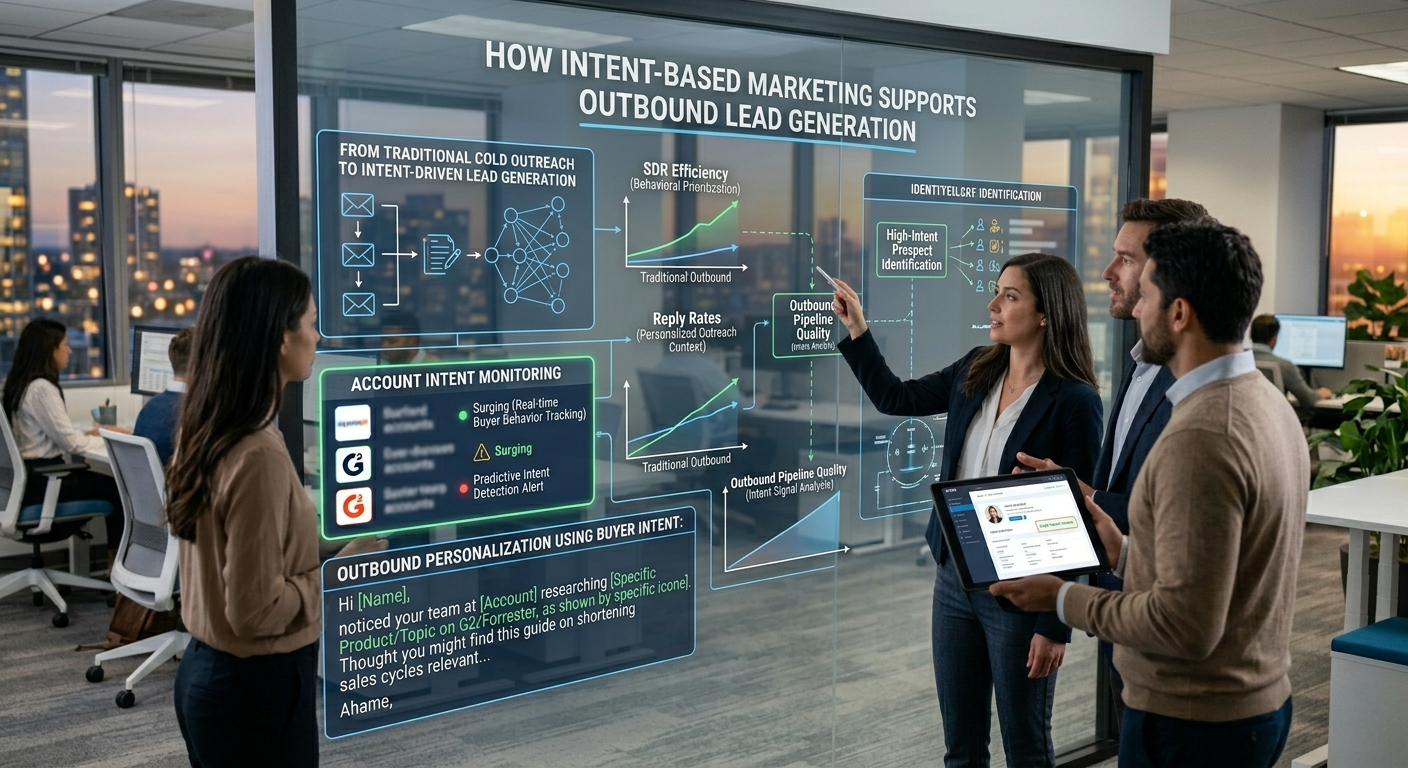
How Intent-Based Marketing Supports Outbound Lead Generation
Outbound lead generation has changed significantly over the past few years. Traditional cold outreach methods that relied heavily on broad prospect lists and high email volume are becoming less effective in modern B2B environments. Buyers are more informed, competition is stronger, and decision makers expect personalized outreach that aligns with their actual business needs and timing.
This shift has increased the importance of intent based marketing.
Instead of relying on assumptions, intent based marketing helps sales teams identify accounts actively researching solutions before direct conversations begin. By analyzing buyer behavior, engagement patterns, and research activity, outbound teams can improve targeting, personalize outreach, and prioritize the right opportunities at the right time.
For modern SDR and outbound teams, intent data is no longer just an advantage. It is becoming a core part of scalable pipeline generation.
Why Outbound Lead Generation Needs to Evolve
The limitations of traditional cold outreach strategies
Traditional outbound strategies often focus on activity volume rather than buyer readiness. SDRs may contact hundreds of prospects each week without knowing whether those companies are actively evaluating solutions.
This creates several problems:
- Low response rates
- Poor conversion efficiency
- Wasted outreach effort
- Longer sales cycles
- Higher acquisition costs
Modern buyers expect outreach that feels relevant and timely, not generic.
Understanding the modern intent-based marketing definition
Intent based marketing refers to the process of using behavioral data and buyer signals to identify companies actively researching products or services. These signals help outbound teams understand which prospects are showing genuine interest before direct engagement happens.
Rather than guessing who might be interested, sales teams can prioritize accounts demonstrating active buying behavior.
Why outbound teams need better timing and targeting
Even strong messaging struggles when outreach timing is wrong. Buyers who are not actively researching solutions are far less likely to engage in meaningful conversations.
Intent data improves both timing and targeting by helping SDRs focus on accounts currently showing purchase intent signals.
How intent data creates a competitive advantage in outbound sales
The earlier a sales team identifies active demand, the greater the chance of entering the buying process before competitors. Intent data gives outbound teams visibility into emerging opportunities that would otherwise remain hidden.
What Intent Data Reveals About Buyers
Understanding B2B buyer intent data and buyer research behavior
B2B buyer intent data captures digital activities that suggest a company may be exploring a solution category. This includes behaviors such as:
- Reading product-related content
- Visiting comparison pages
- Downloading technical resources
- Engaging with competitor research
- Attending webinars or events
These actions reveal where buyers are in their research process.
The role of purchase intent signals in outbound prospecting
Purchase intent signals help SDRs determine whether a prospect is likely entering an active buying cycle. Instead of relying purely on firmographics, outbound teams gain visibility into real-time interest levels.
Using buyer signals to uncover active demand
Buyer signals provide insight into accounts that are actively researching solutions but have not yet reached out directly. This creates opportunities for proactive outbound engagement.
Leveraging real-time buyer behavior tracking for smarter outreach
Real-time buyer behavior tracking allows teams to monitor shifts in account activity. Sudden spikes in engagement often indicate growing purchase intent and should trigger outbound action quickly.
Intent-Driven Lead Generation vs Traditional Prospecting
How intent-driven lead generation improves outreach precision
Traditional prospecting often treats all accounts equally. Intent-driven lead generation prioritizes companies based on actual buyer behavior.
This improves:
- Outreach relevance
- SDR efficiency
- Meeting quality
- Pipeline accuracy
The difference between static lists and intent-qualified accounts
Static prospect lists quickly become outdated because they lack behavioral context. Intent-qualified accounts continuously evolve based on live engagement activity.
Why intent-based outbound focuses on relevance over volume
Modern outbound success depends less on sending more messages and more on delivering relevant outreach to buyers already showing interest.
Comparing conversion quality between traditional and intent-driven outreach
Intent-based outbound campaigns typically generate stronger conversations because outreach aligns with active buyer interest and timing.
Early Purchase Intent Detection in Outbound Sales
Why early purchase intent detection matters in competitive markets
The earlier a sales team identifies buyer interest, the greater the opportunity to shape the buying process before competitors engage.
Using account intent monitoring to identify research activity early
Account intent monitoring helps outbound teams identify research spikes across target accounts. This visibility allows SDRs to prioritize outreach more strategically.
Engaging buyers before competitors enter the conversation
Many deals are influenced long before formal evaluations begin. Early engagement creates stronger positioning and trust.
Building proactive outbound workflows around buyer behavior
Modern outbound workflows increasingly rely on behavioral triggers instead of static prospecting schedules.
High-Intent Prospect Identification for SDR Teams
Techniques for high-intent prospect identification
Effective high-intent prospect identification combines multiple factors, including:
- Research frequency
- Content engagement depth
- Topic relevance
- Stakeholder activity
- Historical buying patterns
Applying behavioral targeting in B2B marketing to outbound campaigns
Behavioral targeting allows outbound teams to tailor campaigns around actual buyer interests instead of assumptions.
Prioritizing outreach toward accounts showing active buying intent
Prioritization helps SDRs focus their effort on accounts with the highest conversion probability.
Reducing wasted prospecting effort with smarter qualification
Intent data reduces time spent chasing low-intent accounts, improving productivity and outbound efficiency.
Timing Outbound Campaigns Around Buyer Signals
Why timing outbound campaigns impacts reply and conversion rates
Even highly personalized outreach performs poorly if buyers are not actively evaluating solutions. Timing is often the difference between ignored outreach and meaningful engagement.
Using predictive marketing strategies to improve outreach timing
Predictive marketing strategies analyze behavioral patterns to determine optimal outreach windows.
Aligning cold email and call sequences with buying behavior
Outbound teams can trigger campaigns based on real research activity instead of arbitrary schedules.
Increasing engagement by reaching prospects at the right moment
Relevance increases significantly when outreach aligns with buyer urgency and active demand.
Personalized Outreach Using Buyer Intent
Building personalized outreach using buyer intent insights
Intent data enables SDRs to personalize messaging around actual buyer interests, pain points, and research activity.
Creating context-aware messaging for outbound campaigns
Context-aware outreach feels more relevant because it reflects what buyers are already exploring.
For example, messaging can reference:
- Industry trends
- Product categories being researched
- Relevant business challenges
- Competitor comparisons
Moving beyond surface-level personalization tactics
Modern personalization goes beyond adding a prospect’s name or company. Buyers expect outreach that demonstrates genuine understanding.
Increasing response quality through relevance-driven outreach
Better personalization improves conversation quality, not just response rates.
Intent Signal Analysis for Better Lead Qualification
Applying intent signal analysis for lead qualification
Intent signal analysis helps outbound teams identify which accounts are most likely to convert into pipeline opportunities.
Distinguishing high-interest buyers from passive researchers
Not all engagement signals indicate buying readiness. Teams must evaluate engagement depth and consistency.
Improving SDR efficiency through behavior-based prioritization
Behavior-based prioritization allows SDRs to focus on opportunities with stronger conversion potential.
Strengthening outbound pipeline quality with intent scoring
Intent scoring models improve qualification consistency across outbound teams.
Combining Intent Data With Account-Based Marketing (ABM)
Strengthening data-driven account-based marketing (ABM) with intent signals
Intent signals strengthen ABM by identifying which strategic accounts are actively researching solutions.
Coordinating outbound outreach around account-level engagement
Outbound campaigns become more effective when aligned with account-wide activity patterns.
Prioritizing strategic accounts showing active research behavior
ABM programs benefit significantly from intent-based prioritization.
Aligning ABM and outbound workflows for better conversions
Coordinated workflows improve consistency across sales and marketing engagement.
Using Intent Data Platforms in Outbound Workflows
How intent data platforms support modern outbound teams
Intent data platforms centralize buyer intelligence and simplify account prioritization.
Integrating intent insights into CRM and sales engagement tools
Integrating intent data directly into outbound systems improves workflow efficiency.
Automating alerts for surging accounts and buyer activity
Automated alerts help SDRs react quickly to emerging opportunities.
Scaling outbound prospecting through intent intelligence
Intent intelligence enables outbound teams to scale personalization without sacrificing relevance.
Sales and Marketing Alignment Through Intent Data
Improving sales and marketing alignment through intent data
Shared buyer insights create stronger collaboration between sales and marketing teams.
Creating shared outbound targeting frameworks
Alignment improves when both teams prioritize the same high-intent accounts.
Aligning SDR campaigns with marketing engagement signals
Marketing engagement data helps SDRs understand account readiness more accurately.
Building unified revenue operations around buyer intent
Intent data supports a more connected revenue generation process across departments.
How Intent-Based Marketing Helps Shorten Sales Cycles
Reaching buyers earlier in the research process
Early engagement increases the likelihood of influencing buyer decisions before competitors.
Improving qualification speed through intent insights
Intent signals help sales teams identify sales-ready opportunities faster.
Increasing conversion efficiency with better timing and relevance
Relevant outreach reduces friction and improves buyer engagement quality.
Why intent-informed outreach helps shorten sales cycles
Sales cycles become shorter when conversations begin with buyers already demonstrating active interest.
Building a Sustainable Outbound Strategy With Intent Data
Moving from reactive outreach to predictive prospecting
Intent based marketing allows outbound teams to anticipate demand instead of reacting after opportunities appear publicly.
Creating scalable outbound systems powered by buyer intelligence
Buyer intelligence creates repeatable prospecting systems that improve efficiency over time.
Combining human outreach with intent-driven insights
Technology improves targeting, but strong outbound results still depend on human communication and relationship-building.
The future of outbound lead generation is intent-based and behavior-driven
Modern outbound success will increasingly depend on behavioral intelligence, personalization, timing, and predictive engagement.
Final Thoughts
Outbound lead generation is evolving rapidly as buyer expectations and competitive pressures continue increasing. Traditional prospecting methods that rely heavily on volume and static targeting are becoming less effective in complex B2B sales environments. Intent based marketing offers a smarter approach by helping outbound teams identify active buyers earlier, prioritize outreach more accurately, and personalize conversations around real buyer behavior.
By combining buyer signals, intent data, predictive insights, and personalized engagement, organizations can create more efficient outbound systems that generate higher quality pipeline opportunities. Companies that adopt intent-driven outbound strategies are better positioned to improve SDR productivity, shorten sales cycles, and build sustainable competitive advantages in increasingly crowded markets.
Find what you’re reading informative so far? Then why not read more by visiting our blog? We keep you up-to-date every week with how-to guides and strategies to B2B lead generation every single week! Click here to get started!