

How to Use Behavioral Signals to Improve B2B Lead Generation Results
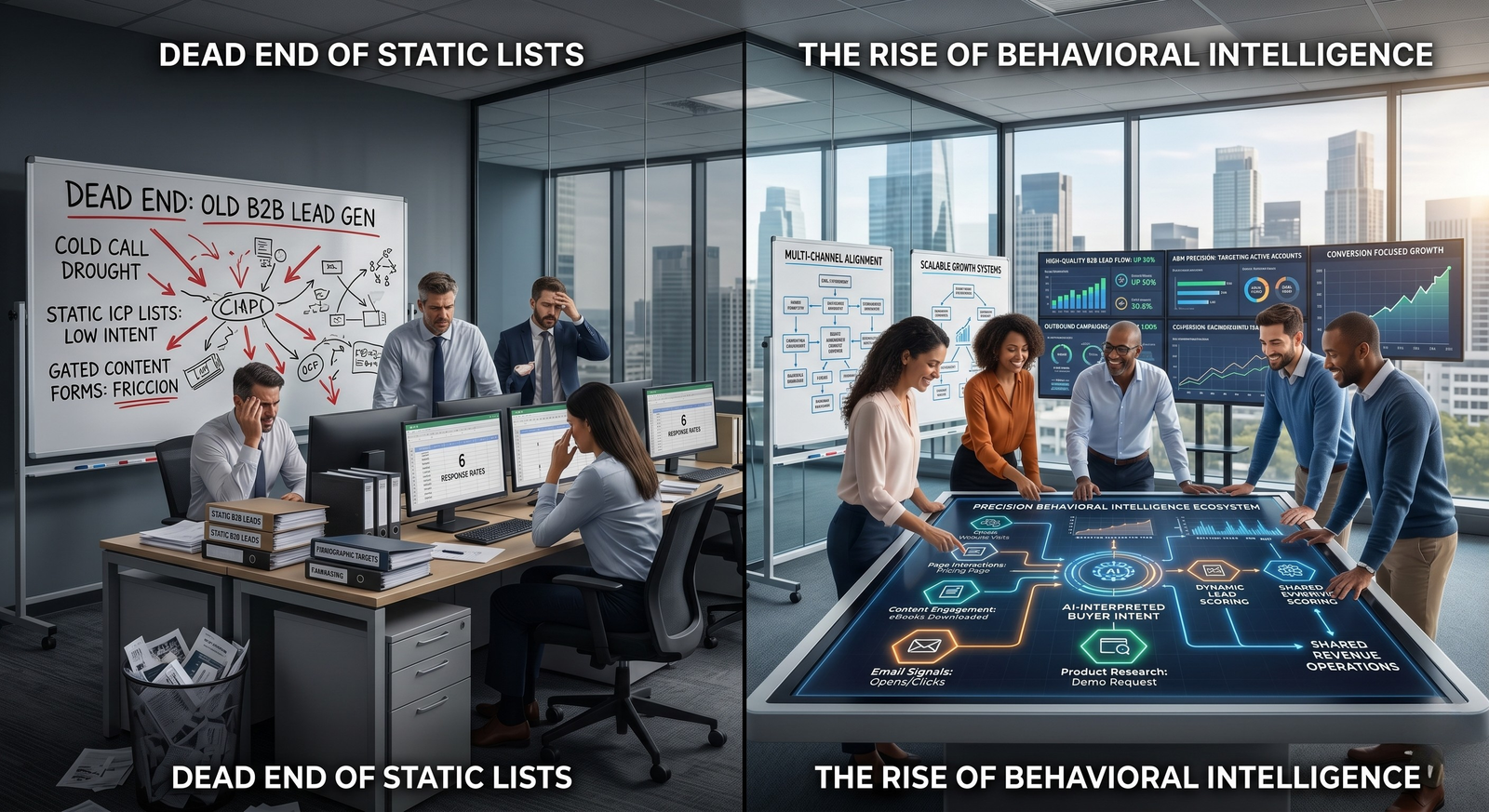
Modern B2B lead generation is no longer about who fits your ICP on paper. It is about who is actively showing intent through behavior.
Clicks, page visits, content engagement, email interactions, and product research patterns now reveal more about buying readiness than static firmographic data ever could.
The shift is clear. Companies that understand and act on behavioral signals are consistently outperforming those still relying on traditional targeting methods.
In this article, we’ll break down how behavioral intelligence transforms b2b lead generation and how to apply it across your entire revenue system.
Why Behavioral Signals Are Changing Modern B2B Lead Generation
The evolution of B2B lead generation strategies toward behavior-first targeting
B2B marketing has shifted from identity-based targeting to behavior-based targeting.
Instead of asking “who is this company,” teams now ask:
- What are they doing right now
- How often are they engaging
- What signals show buying intent
Why traditional targeting methods miss high-intent buyers
Static targeting misses buyers because it ignores real-time activity.
For example:
- A low-ICP company actively researching your solution may be highly valuable
- A perfect ICP account with no engagement may not be ready to buy
Understanding how buyer behavior shapes conversion outcomes
Behavior is one of the strongest predictors of conversion because it reflects:
- urgency
- interest level
- decision stage
The shift from static lists to dynamic intent-driven systems
Modern systems no longer rely on fixed lists. They adapt based on behavior such as:
- repeated visits
- content depth engagement
- multi-channel interaction
What Behavioral Signals Reveal About B2B Buyers
How behavioral data improves qualified lead generation for businesses
Behavioral signals help teams identify which leads are actually worth pursuing by filtering out noise and highlighting real engagement.
Key digital actions that indicate purchase readiness
High-intent behaviors include:
- Multiple website visits within a short period
- Pricing or demo page views
- Repeat content engagement
- Webinar or product page interactions
Differentiating curiosity from buying intent
Not all engagement equals intent.
For example:
- Curiosity = single blog visit
- Intent = repeated visits + product research + email engagement
Turning engagement patterns into actionable insights
When behavior is tracked consistently, it becomes possible to:
- prioritize accounts
- trigger outreach
- personalize messaging
Using Behavioral Data to Strengthen Data-Driven Lead Generation
Improving data-driven lead generation with real-time insights
Behavioral data adds a real-time layer to data-driven lead generation, improving timing and accuracy.
Combining behavioral signals with CRM and intent data
The strongest systems integrate:
- CRM records
- behavioral analytics
- third-party intent signals
This creates a complete view of the buyer journey.
Reducing guesswork in targeting and outreach
Instead of guessing who to contact, teams can rely on:
- engagement frequency
- content interest
- interaction depth
Increasing accuracy in lead prioritization
Behavioral scoring helps rank leads based on real activity, not assumptions.
Behavioral Targeting in B2B Demand Generation
Enhancing B2B demand generation tactics with behavioral insights
Behavior helps refine demand generation by showing what topics and content actually resonate.
Aligning messaging with observed buyer actions
Messaging becomes more relevant when based on behavior such as:
- downloaded content
- viewed product pages
- attended webinars
Identifying content engagement patterns across channels
Behavioral tracking reveals:
- which channels drive interest
- which content converts attention into intent
Improving awareness-to-conversion pathways
By understanding behavior, teams can guide prospects more effectively through the funnel.
How Behavioral Signals Improve Sales Funnel Lead Generation
Optimizing sales funnel lead generation with engagement data
Funnels become more predictable when behavior is used to guide progression.
Tracking movement between funnel stages using behavior
Examples include:
- awareness → blog engagement
- consideration → product research
- decision → pricing page visits
Identifying drop-off points and friction in the funnel
Behavioral data highlights where users disengage, helping improve funnel design.
Improving conversion flow through behavioral insights
Fixing friction points increases overall conversion rates.
High-Quality B2B Leads Through Behavioral Intelligence
Generating high-quality B2B leads using engagement signals
Behavioral intelligence ensures only active, engaged prospects are prioritized.
Filtering low-intent activity from real buying behavior
This helps remove:
- passive visitors
- irrelevant traffic
- one-time clicks
Improving lead scoring accuracy with behavioral indicators
Behavior improves scoring by adding context to engagement levels.
Increasing conversion rates through better qualification
Better qualification leads directly to higher close rates.
Account-Based Marketing (ABM) Powered by Behavioral Signals
Strengthening account-based marketing (ABM) lead generation with behavior tracking
ABM becomes more powerful when based on real engagement data rather than static account lists.
Monitoring account-level engagement across stakeholders
Behavioral signals often come from multiple stakeholders within the same company.
Prioritizing accounts showing active research behavior
Accounts with repeated engagement should always be prioritized.
Improving ABM precision with real-time insights
Real-time behavior allows teams to adjust campaigns dynamically.
Outbound Lead Generation Campaigns Driven by Behavior
Improving outbound lead generation campaigns with intent signals
Outbound becomes more effective when based on active behavior rather than cold lists.
Timing outreach based on engagement activity
Reaching out when a prospect is already engaging increases response rates.
Increasing response rates with behavior-based messaging
Messaging becomes more relevant when aligned with observed actions.
Reducing wasted outreach through smarter targeting
Behavior ensures teams contact only accounts showing interest.
Inbound Lead Generation Methods Enhanced by Behavioral Data
Optimizing inbound lead generation methods using engagement tracking
Behavior reveals what inbound content actually drives qualified interest.
Understanding content consumption patterns
Teams can identify:
- top-performing topics
- high-engagement content types
Converting anonymous traffic into qualified leads
Behavioral tools help identify and score anonymous visitors based on activity.
Aligning inbound content with buyer behavior
Content strategies improve when aligned with real engagement patterns.
Lead Nurturing Strategies in B2B Using Behavioral Signals
Strengthening lead nurturing strategies in B2B with behavioral triggers
Nurturing becomes more effective when triggered by behavior.
Personalizing follow-ups based on engagement history
Follow-ups can reflect:
- pages visited
- content consumed
- level of engagement
Automating nurturing workflows using behavior thresholds
Automation ensures timely engagement at scale.
Improving long-cycle engagement with relevant messaging
Behavior-based nurturing keeps leads warm over long decision cycles.
Pipeline Generation for Sales Teams Through Behavioral Insights
Improving pipeline generation for sales teams with behavioral scoring
Behavior improves pipeline predictability by prioritizing high-intent leads.
Prioritizing opportunities based on engagement intensity
More engagement equals higher priority.
Aligning SDR efforts with real buyer activity
SDRs can focus only on accounts actively engaging.
Increasing pipeline predictability through behavior tracking
Behavior creates more reliable forecasting signals.
Prospecting Strategies for B2B Companies Using Behavioral Signals
Enhancing prospecting strategies for B2B companies with intent behavior
Behavioral signals modernize prospecting by adding context to outreach.
Identifying accounts actively researching solutions
These accounts are far more likely to convert.
Moving beyond static prospect lists
Lists become dynamic based on real-time activity.
Increasing outreach relevance with behavioral segmentation
Segmentation ensures messaging matches intent level.
Multi-Channel B2B Marketing Strategies Powered by Behavior
Strengthening multi-channel B2B marketing strategies with unified signals
Behavioral data unifies performance across channels.
Aligning email, ads, and sales outreach using behavior data
All channels respond to the same engagement signals.
Ensuring consistent messaging across touchpoints
Consistency improves trust and conversion rates.
Improving engagement through coordinated timing
Timing outreach based on behavior increases impact.
Conversion-Focused Lead Generation Using Behavioral Intelligence
Shifting toward conversion-focused lead generation models
Behavior allows teams to focus on conversion readiness, not just lead volume.
Prioritizing actions that signal buying readiness
High-priority actions include:
- demo requests
- pricing page visits
- repeat engagement
Improving messaging based on user behavior
Messaging becomes more relevant and contextual.
Increasing ROI through precision targeting
Better targeting leads to higher return on investment.
Building Scalable Lead Generation Systems with Behavioral Data
Designing scalable lead generation systems powered by behavioral insights
Behavior enables systems to scale without losing precision.
Automating segmentation and prioritization workflows
Automation ensures real-time response to behavioral changes.
Integrating behavior signals into CRM systems
This creates a unified view of the customer journey.
Creating repeatable, data-backed growth systems
Behavior-driven systems are more consistent and scalable.
The Future of Behavioral-Driven B2B Lead Generation
Why behavioral intelligence will define next-generation B2B lead generation strategies
The future of b2b lead generation will be defined by real-time behavior, not static data.
The role of AI in interpreting buyer behavior at scale
AI will analyze massive behavioral datasets to detect intent patterns faster.
Moving toward fully adaptive, real-time marketing systems
Systems will adjust messaging and targeting dynamically based on behavior.
Building revenue engines based on continuous behavioral feedback
Future systems will constantly learn and optimize from engagement signals.
Final Thoughts
Behavioral signals are transforming b2b lead generation from a static process into a dynamic, real-time system.
Instead of guessing who might be interested, teams can now see who is actively engaging, what they care about, and when they are ready to buy.
The companies that win will not be those with the biggest lists.
They will be the ones that understand behavior best—and act on it fastest.
Find what you’re reading informative so far? Then why not read more by visiting our blog? We keep you up-to-date every week with how-to guides and strategies to B2B lead generation every single week! Click here to get started!