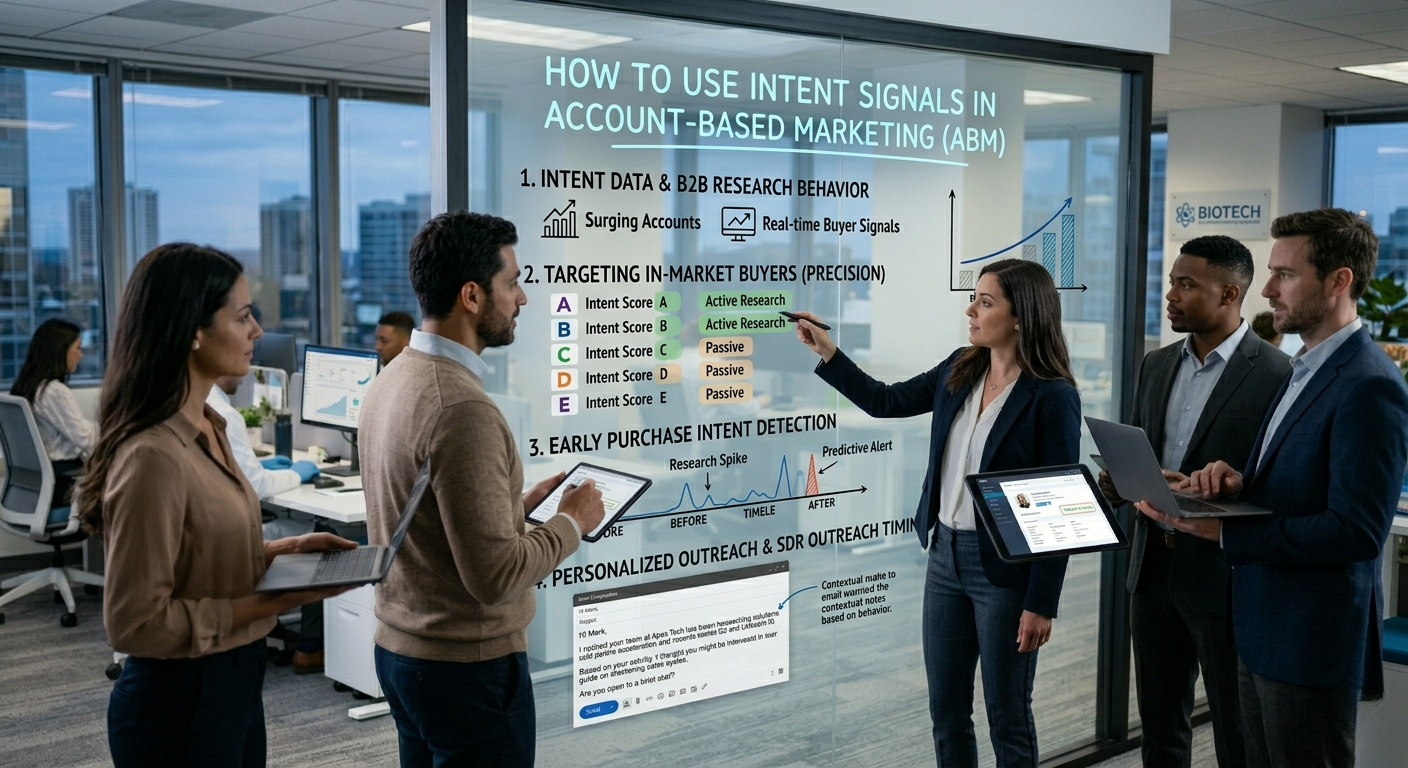
How to Use Intent Signals in Account-Based Marketing (ABM)
Account Based Marketing has evolved significantly over the last few years. Traditional ABM strategies once focused heavily on firmographic targeting, static account lists, and broad personalization. While these methods still have value, modern B2B sales environments demand more precision. Companies can no longer rely solely on assumptions about which accounts may be interested in their solutions.
This is where intent based marketing becomes a major competitive advantage.
Intent signals help sales and marketing teams identify which target accounts are actively researching solutions, engaging with relevant topics, and demonstrating buying readiness. Instead of treating every account equally, businesses can prioritize outreach based on real buyer behavior.
In this guide, we will explore how intent signals improve ABM execution, strengthen account prioritization, and help revenue teams generate more qualified pipeline opportunities.
Why Intent Signals Are Transforming Modern ABM
Understanding the intent-based marketing definition in B2B sales
Intent based marketing refers to the use of behavioral data and buyer activity signals to identify organizations actively researching products, services, or solutions.
These signals may include:
• Website engagement
• Content consumption
• Topic research behavior
• Webinar participation
• Product comparison activity
• Search intent patterns
The goal is to align outreach with actual buyer readiness instead of relying only on static account criteria.
Why traditional ABM struggles without buyer intent visibility
Traditional ABM often relies on predefined target account lists built around company size, industry, or revenue. While these factors help identify potential fit, they do not indicate whether an account is actively interested right now.
Without buyer intent visibility, sales teams may spend months engaging accounts that are not currently evaluating solutions.
How intent data creates a competitive advantage in account targeting
Intent data provides visibility into account activity before competitors recognize demand. This allows companies to initiate conversations earlier in the buying journey.
Early engagement often creates stronger positioning, higher response rates, and increased influence over buying decisions.
The evolution toward data-driven account-based marketing (ABM)
Modern ABM is becoming increasingly data-driven. Revenue teams now combine firmographic targeting with behavioral insights to improve prioritization and personalization.
This shift allows companies to focus on accounts with both strong fit and active buying intent.
What Intent Signals Actually Reveal About Accounts
Understanding B2B buyer intent data and digital research behavior
B2B buyer intent data reveals how organizations interact with content, technologies, and industry topics online.
For example, repeated engagement with cybersecurity articles or CRM integration documentation may indicate growing buying interest in those areas.
Intent signals provide context around what accounts are researching and how urgently they may be evaluating solutions.
The role of purchase intent signals in identifying buying readiness
Purchase intent signals help distinguish casual interest from genuine evaluation behavior.
Strong buying indicators often include:
• Multiple stakeholder engagement
• Increased topic research frequency
• Visits to pricing or integration pages
• Product comparison activity
• Demo-related content engagement
These behaviors help identify accounts moving closer toward purchase decisions.
Using buyer signals to uncover active demand inside target accounts
Intent signals help reveal active demand even before prospects contact vendors directly.
This gives ABM teams the opportunity to engage accounts during the early research stage instead of waiting until competitors are already involved.
How real-time buyer behavior tracking improves account prioritization
Real-time buyer behavior tracking allows teams to respond quickly when research activity increases.
Instead of relying on outdated account scoring models, companies can prioritize outreach based on live engagement signals.
Early Purchase Intent Detection in ABM Campaigns
Why early purchase intent detection matters in enterprise sales
Enterprise buying cycles are often long and competitive. The earlier a company enters the conversation, the greater its ability to shape buyer preferences and influence decision-making.
Intent data helps identify accounts before formal procurement discussions begin.
Using account intent monitoring to identify surging accounts
Account intent monitoring tracks increases in research activity across target organizations.
Sudden spikes in engagement often indicate that an account is entering an active evaluation phase.
Recognizing research spikes before competitors engage buyers
Research spikes provide early warning signs that a company may soon enter the market for a solution.
Sales teams that recognize these signals early gain a major advantage in timing and positioning.
Building proactive outreach strategies around buyer behavior
Rather than waiting for inbound inquiries, ABM teams can proactively engage accounts showing strong behavioral intent.
This creates more strategic outreach opportunities.
Identifying and Prioritizing High-Intent Accounts
Methods for high-intent prospect identification in ABM programs
High-intent prospect identification requires evaluating multiple engagement signals together rather than relying on isolated actions.
Effective indicators may include:
• Cross-channel engagement
• Multiple employee interactions
• Repeat content consumption
• Engagement acceleration over time
Combined patterns create stronger intent visibility.
Moving from static target lists to targeting in-market buyers
Traditional ABM lists often remain unchanged for months. Intent based marketing introduces dynamic prioritization based on active buying behavior.
This helps teams focus resources on accounts most likely to convert.
Applying behavioral targeting in B2B marketing for precision outreach
Behavioral targeting improves relevance by aligning outreach with actual buyer interests and research behavior.
This creates stronger engagement and more meaningful conversations.
Prioritizing accounts based on real buying activity
Not every target account deserves equal attention at all times. Intent signals help determine which accounts are currently worth prioritizing.
Timing Outbound Campaigns Around Buyer Signals
Why timing outbound campaigns impacts ABM performance
Even highly personalized outreach can fail if timing is poor.
Accounts are more responsive when outreach aligns with active research behavior and organizational urgency.
Using predictive marketing strategies to improve engagement timing
Predictive marketing strategies help identify likely buying windows based on behavioral trends and engagement patterns.
This allows outreach to happen when buyer interest is strongest.
Coordinating SDR outreach around active research behavior
SDRs can prioritize outreach toward accounts currently consuming relevant content or researching related technologies.
This increases the likelihood of meaningful engagement.
Increasing response rates through intent-informed timing
Intent-informed timing improves response rates because outreach feels relevant to current buyer priorities instead of random prospecting.
Personalized Outreach Using Buyer Intent in ABM
Building personalized outreach using buyer intent insights
Intent data allows outreach personalization based on actual account interests instead of surface-level customization.
This creates deeper relevance in communication.
Aligning messaging with account-specific buyer behavior
Different accounts research different challenges, technologies, and priorities.
Intent signals help tailor messaging around the exact topics buyers are already exploring.
Creating more relevant conversations across buying committees
ABM often involves multiple stakeholders with different priorities.
Intent data helps personalize outreach for various departments and decision-makers inside the same organization.
Moving beyond generic ABM personalization tactics
Basic personalization tokens are no longer enough. Buyers expect contextual communication that reflects real understanding of their current challenges.
Intent insights make this possible.
Using Intent Signals for Better Lead Qualification
Applying intent signal analysis for lead qualification
Intent signal analysis improves qualification accuracy by evaluating behavioral engagement instead of relying only on demographic fit.
Distinguishing high-interest accounts from passive researchers
Not every engaged account is ready to buy. Intent analysis helps distinguish active evaluation behavior from casual research activity.
Improving pipeline quality through behavioral prioritization
Behavioral prioritization helps revenue teams spend more time on accounts with stronger purchase likelihood.
This improves overall pipeline quality.
Supporting more efficient intent-driven lead generation
Smarter qualification reduces wasted outreach and improves SDR productivity.
Leveraging Intent Data Platforms for ABM Execution
How intent data platforms support ABM teams
Intent data platforms aggregate buyer activity signals from multiple digital sources.
These platforms help identify emerging demand across target accounts.
Integrating intent signals into CRM and sales workflows
CRM integration ensures that intent data becomes actionable inside daily sales workflows.
This improves operational efficiency and outreach coordination.
Automating alerts for account-level research activity
Automated alerts notify teams when accounts demonstrate significant increases in engagement or research behavior.
This supports faster response times.
Scaling account prioritization through intent intelligence
Technology allows companies to scale ABM prioritization without relying entirely on manual research.
Aligning Sales and Marketing Through Intent Data
Improving sales and marketing alignment through intent data
Intent data creates shared visibility into buyer activity across both teams.
This improves collaboration and campaign coordination.
Creating shared account prioritization frameworks
Sales and marketing teams can align around common qualification standards and engagement priorities.
Coordinating campaigns around live buyer behavior insights
Behavioral insights help both teams coordinate messaging and outreach around current buyer activity.
Building unified ABM execution across teams
Unified execution creates more consistent buyer experiences and stronger campaign effectiveness.
How Intent-Driven ABM Helps Shorten Sales Cycles
Engaging accounts earlier in the buying journey
Earlier engagement increases the opportunity to influence buyer evaluation criteria.
Reducing delays caused by mistimed outreach
Intent data helps teams avoid outreach that occurs too early or too late in the buying process.
Accelerating conversion through more relevant engagement
Relevant outreach reduces friction and improves buyer responsiveness.
Why intent-informed ABM helps shorten sales cycles
Intent-informed engagement creates faster movement through the pipeline because conversations start with stronger contextual relevance.
Building a Long-Term Competitive Advantage With Intent-Based ABM
Turning buyer intelligence into scalable pipeline growth
Buyer intelligence allows organizations to scale pipeline generation more efficiently and strategically.
Creating repeatable systems for account prioritization
Intent data helps build repeatable frameworks for identifying and engaging the right accounts at the right time.
Combining intent data with strategic relationship-building
Technology improves targeting, but relationship-building remains essential in enterprise sales.
Intent insights simply make relationship development more effective.
The future of ABM is intent-driven, predictive, and behavior-based
The future of ABM will center around predictive targeting, real-time buyer intelligence, and behavior-driven personalization.
Companies that adopt intent based marketing strategies early will gain stronger competitive positioning and more scalable growth opportunities.
Final Thoughts
Intent based marketing is transforming the way companies execute account-based marketing strategies. Traditional ABM methods often struggle because they rely heavily on static targeting and assumptions rather than live buyer behavior. Intent signals solve this problem by helping teams identify active demand, prioritize high-intent accounts, and personalize outreach based on real research activity.
As B2B buying environments become increasingly competitive, companies that align timing, relevance, and behavioral insight will outperform organizations still relying on broad prospecting methods. Intent-driven ABM allows sales and marketing teams to engage accounts earlier, improve qualification accuracy, shorten sales cycles, and build stronger pipeline growth over time.
Find what you’re reading informative so far? Then why not read more by visiting our blog? We keep you up-to-date every week with how-to guides and strategies to B2B lead generation every single week! Click here to get started!