The Real Cost of a Low-Quality B2B Lead Generation
In b2b lead generation, most teams focus heavily on increasing volume. More leads, more campaigns, more traffic. On the surface, this feels like progress. The dashboards look healthier, the funnel looks fuller, and marketing reports stronger numbers.
But underneath those metrics, many companies are quietly losing money.
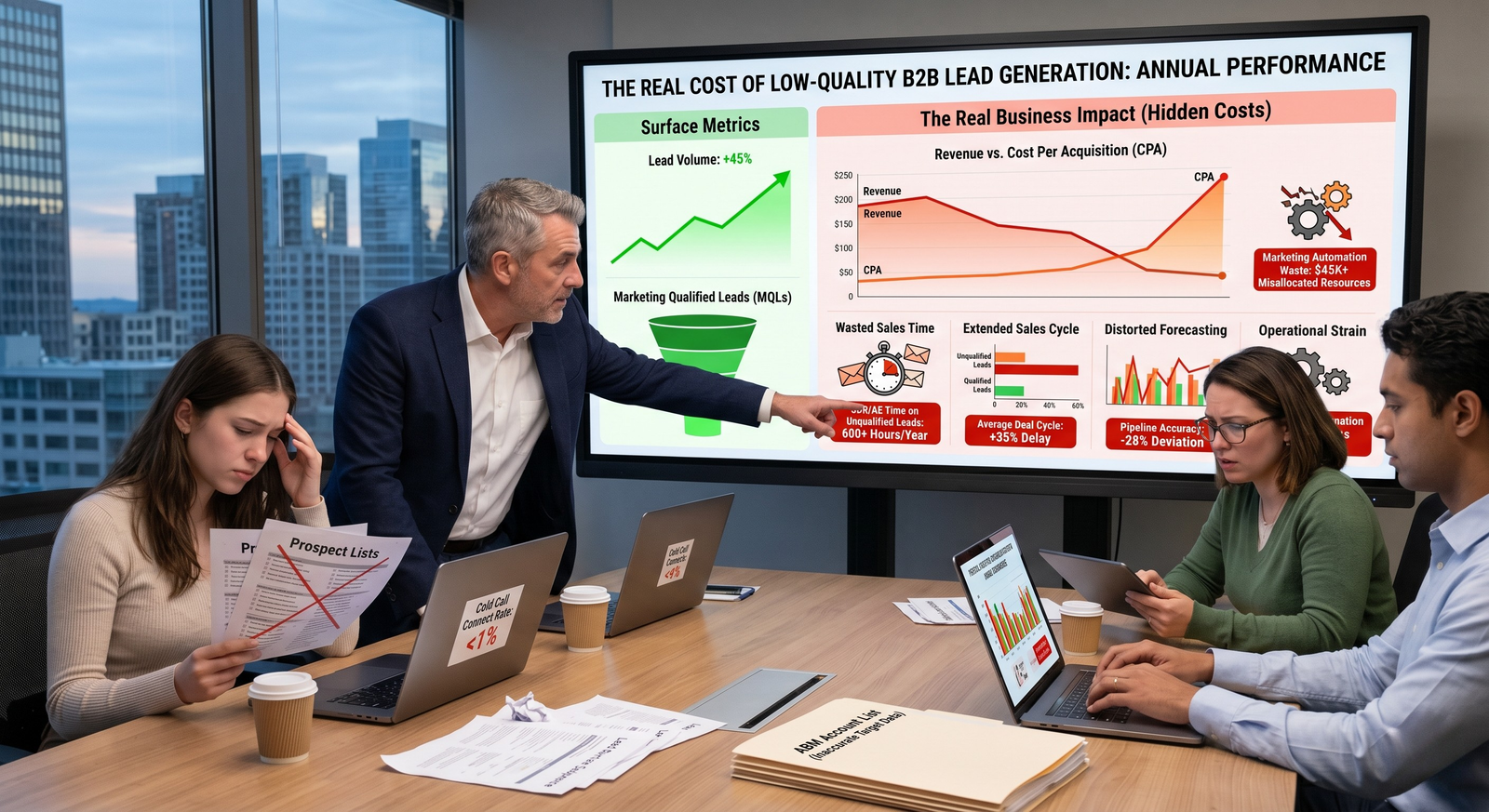
Low quality leads do not just fail to convert. They actively increase costs, waste sales time, distort forecasting, and slow down revenue growth. The real problem is not lack of leads. It is the hidden cost of the wrong leads entering the system.
This article breaks down the real business impact of poor lead quality and why improving qualification is one of the fastest ways to improve revenue efficiency.
Why Lead Quality Matters More Than Volume in B2B Lead Generation
How weak B2B lead generation strategies inflate hidden costs
Weak b2b lead generation strategies often prioritize reach over relevance. This leads to large pipelines filled with unqualified contacts who were never likely to buy.
The hidden cost appears later in the funnel when sales teams invest time in deals that will never close.
The difference between activity and revenue impact
Many teams confuse engagement with revenue potential. A download, click, or signup may indicate interest, but not intent to purchase.
Without proper qualification, activity metrics create a false sense of success.
Why low quality leads distort pipeline expectations
When low quality leads enter the pipeline, forecast accuracy declines. Leaders expect revenue that never materializes, leading to poor planning and missed targets.
The compounding cost of bad targeting decisions
Bad targeting does not just affect one campaign. It compounds over time by filling CRM systems with irrelevant data, reducing future targeting precision and increasing long term acquisition costs.
What Defines a Low Quality vs High Quality B2B Lead
Characteristics of high quality B2B leads vs poor fit prospects
High quality leads typically show clear intent, match the ideal customer profile, and have a defined business need. Low quality leads lack one or more of these factors and often disengage early.
Misalignment between ICP and actual buyer behavior
One of the most common issues in b2b lead generation is an unclear ideal customer profile. When ICP definitions are too broad, irrelevant leads enter the funnel.
Why qualification breakdown happens early in the funnel
If qualification is delayed until later stages, resources are already wasted. Early filtering is essential to prevent poor leads from progressing.
The importance of clear qualification standards
Without standardized qualification criteria, sales and marketing teams interpret lead quality differently, leading to friction and inefficiency.
The Hidden Cost in Qualified Lead Generation for Businesses
Why qualified lead generation for businesses breaks down with poor inputs
Even strong systems for qualified lead generation for businesses fail when initial targeting is weak. Garbage in, garbage out applies directly to lead quality.
Sales time wasted on non buyers and unfit accounts
Sales teams spend valuable hours chasing prospects who were never in a buying cycle. This reduces time available for real opportunities.
Opportunity cost of ignoring better fit prospects
Every hour spent on a bad lead is an hour not spent on a high potential account. This opportunity cost directly impacts revenue.
Increased cost per acquisition due to inefficiency
Low conversion rates increase the cost per acquisition because more effort is required to close fewer deals.
Sales Funnel Lead Generation Leakage Caused by Bad Leads
How sales funnel lead generation is disrupted by low quality leads
Poor quality leads enter the funnel and distort every stage of sales funnel lead generation, making conversion rates unreliable.
Drop off rates increase at every funnel stage
Unqualified leads tend to exit the funnel early, increasing drop off rates and weakening performance metrics.
Misleading conversion metrics from unqualified traffic
High traffic volumes can mask poor performance if conversion quality is not measured properly.
Fixing funnel inefficiencies caused by poor targeting
Improving targeting at the top of the funnel reduces leakage and increases downstream conversion efficiency.
Outbound Lead Generation Campaign Waste and Inefficiency
The cost of ineffective outbound lead generation campaigns
Ineffective outbound lead generation campaigns waste resources by targeting broad or irrelevant audiences.
Poor targeting leading to low response rates
When messaging is not aligned with prospect needs, response rates drop significantly.
Wasted SDR effort and reduced morale
Sales development representatives spend time on cold outreach with little return, which impacts morale and productivity.
How bad lists damage deliverability and reputation
Poor data quality leads to high bounce rates and spam complaints, which can harm sender reputation over time.
Inbound Lead Generation Methods That Attract the Wrong Audience
Why inbound lead generation methods can still produce low quality leads
Even strong inbound lead generation methods attract unqualified traffic if content is too broad or misaligned with buyer intent.
Content mismatch with buyer intent
Educational or general content may attract readers who are not in a purchasing mindset.
Traffic vs conversion quality gap
High website traffic does not guarantee high quality leads. The gap between traffic and conversions must be measured carefully.
Improving inbound filtering and qualification
Using progressive forms, gated content strategies, and lead scoring helps filter low intent visitors early.
Account Based Marketing Lead Generation Waste from Poor Targeting
How account based marketing lead generation fails with inaccurate data
Even account based marketing lead generation fails when account lists are outdated or incorrectly prioritized.
Misaligned account selection and wasted effort
Targeting the wrong accounts leads to wasted personalization and outreach effort.
Lack of engagement from non buying accounts
If accounts are not in market, engagement remains low despite high effort.
Improving ABM precision with better intent signals
Using intent data and firmographic filters improves targeting accuracy significantly.
Lead Nurturing Strategies in B2B and Wasted Resources
Inefficiency in lead nurturing strategies in B2B for low quality leads
Strong lead nurturing strategies in B2B cannot fix fundamentally unqualified leads, which leads to wasted automation effort.
Long nurturing cycles with no conversion outcome
Low quality leads often remain in nurturing flows for months without progressing.
Misallocation of marketing automation resources
Automation tools are used inefficiently when they are focused on the wrong audience segments.
The importance of early stage qualification
Early filtering ensures nurturing efforts are reserved for leads with real potential.
Pipeline Generation for Sales Teams and False Confidence
How pipeline generation for sales teams gets inflated by bad leads
Weak pipeline generation for sales teams often includes unqualified deals that inflate pipeline value without real revenue impact.
Unreliable forecasting caused by poor qualification
Forecasts become inaccurate when pipeline quality is not controlled.
Time wasted on non converting opportunities
Sales teams invest time in deals that were never realistically going to close.
Cleaning pipeline data for accuracy and predictability
Regular pipeline hygiene improves forecasting accuracy and decision making.
Prospecting Strategies for B2B Companies and Targeting Errors
Inefficient prospecting strategies for B2B companies
Poor prospecting strategies for B2B companies often rely on outdated lists or overly broad segmentation.
Poor segmentation and ICP misalignment
Without clear segmentation, outreach becomes irrelevant and ineffective.
Outdated or irrelevant prospect lists
Old data leads to wasted outreach and low engagement rates.
Improving targeting precision through better data
Updated databases and intent based targeting significantly improve prospecting outcomes.
Conversion Focused Lead Generation and Cost Efficiency
Why conversion focused lead generation reduces waste
Conversion focused lead generation prioritizes qualified opportunities over raw volume, reducing waste across the funnel.
Improving ROI by filtering early stage leads
Early qualification improves return on investment by preventing low quality leads from entering the pipeline.
Better messaging alignment increases conversion rates
When messaging matches intent, conversion rates improve significantly.
Reducing cost per opportunity through quality focus
Higher conversion efficiency lowers overall acquisition cost.
Data Driven Lead Generation and Quality Control
Using data driven lead generation to prevent low quality leads
Data driven lead generation helps identify which sources produce high converting leads.
Identifying patterns of unqualified behavior
Behavioral tracking reveals signals that indicate low purchase intent.
Improving targeting with analytics and feedback loops
Continuous feedback from sales improves targeting over time.
Continuous optimization of lead sources
Non performing channels can be reduced or eliminated based on data.
Multi Channel B2B Marketing Strategies and Amplified Waste
How multi channel B2B marketing strategies multiply inefficiencies
Without coordination, multi channel B2B marketing strategies can amplify poor targeting across channels.
Inconsistent messaging attracting irrelevant audiences
Different messaging across platforms confuses prospects and attracts unqualified leads.
Difficulty tracking lead quality across channels
Without proper attribution, it becomes difficult to identify quality sources.
Aligning channels to improve lead integrity
Consistent targeting and messaging improve overall lead quality.
Scalable Lead Generation Systems and Quality Trade Offs
Why scalable lead generation systems often sacrifice quality
Many scalable lead generation systems prioritize automation over qualification.
Automation without qualification creates waste at scale
Automated systems that lack filtering produce large volumes of low value leads.
The importance of built in filtering mechanisms
Lead scoring and qualification rules are essential to maintain quality.
Designing systems that scale quality not just volume
True scalability comes from improving efficiency, not just increasing output.
The True Business Impact of Low Quality Leads
Lost revenue and extended sales cycles
Low quality leads delay deals and reduce close rates.
Increased operational and sales costs
More time and resources are required to manage unqualified leads.
Lower morale in sales teams
Repeated exposure to poor leads reduces motivation and productivity.
Why fixing lead quality improves every downstream metric
Improving lead quality strengthens conversion rates, forecasting accuracy, and revenue growth.
How to Reduce the Cost of Low Quality Leads
Strengthening B2B demand generation tactics with better targeting
Better targeting improves overall efficiency in b2b lead generation.
Improving ICP definition and qualification rules
A clear ICP ensures only relevant leads enter the funnel.
Aligning sales and marketing on lead standards
Shared definitions of lead quality reduce friction and improve performance.
Building systems that prioritize quality over quantity
The most effective systems are designed to filter early and optimize for revenue outcomes.
Final Thoughts
The real cost of low quality leads is not always visible in marketing dashboards. It appears in wasted sales effort, inaccurate forecasts, longer sales cycles, and reduced revenue efficiency.
Improving b2b lead generation is not about generating more leads. It is about generating the right leads. When companies shift their focus from volume to quality, every part of the revenue engine becomes more efficient, predictable, and scalable.
Find what you’re reading informative so far? Then why not read more by visiting our blog? We keep you up-to-date every week with how-to guides and strategies to B2B lead generation every single week! Click here to get started!