

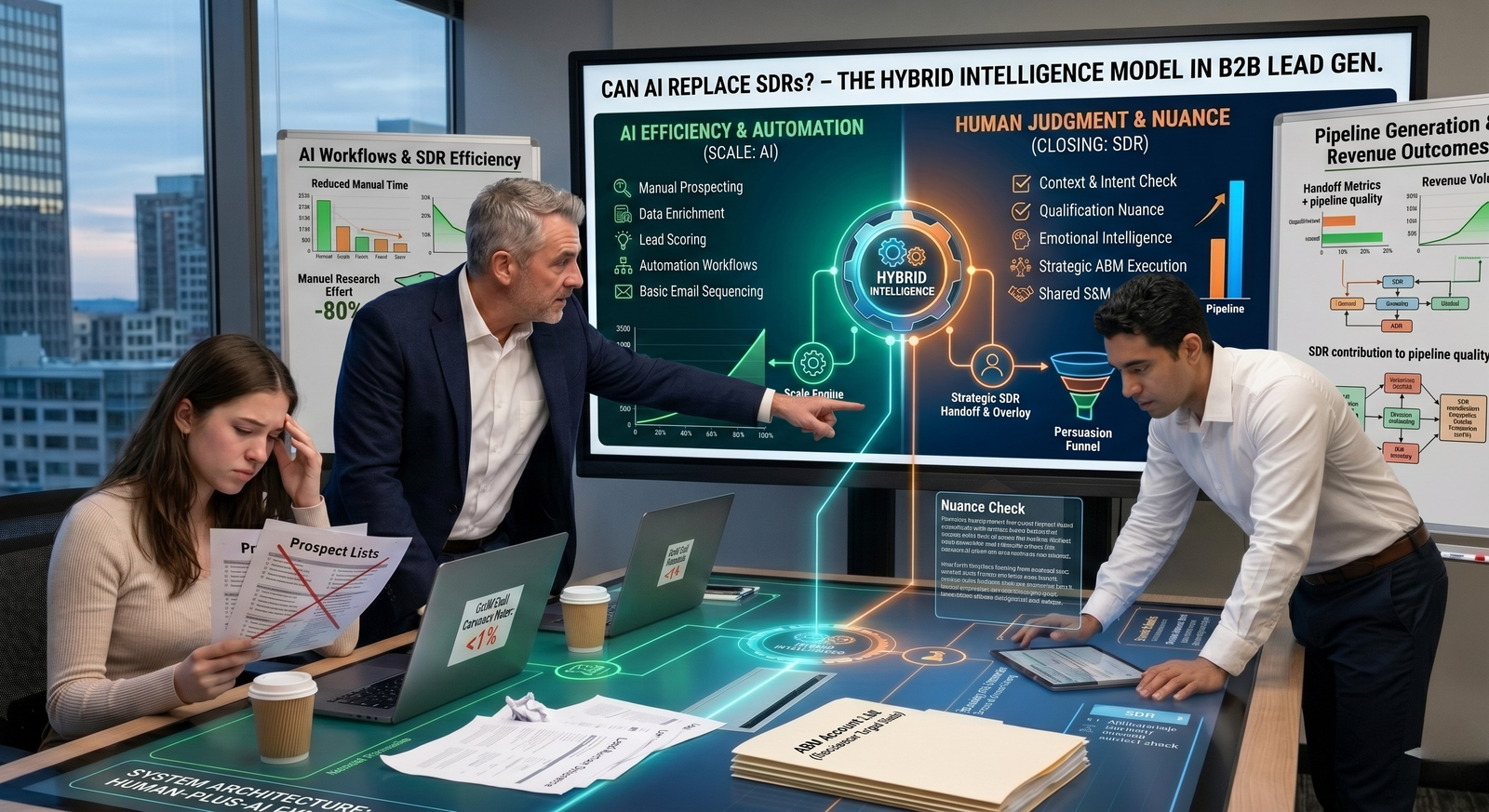
Can AI Replace SDRs in B2B Lead Generation?
In b2b lead generation, artificial intelligence is no longer a future concept. It is already embedded in prospecting tools, email automation platforms, lead scoring systems, and outreach workflows. As a result, many companies are asking a critical question. Can AI fully replace Sales Development Representatives, or SDRs?
The answer is not as simple as replacement or no replacement. Instead, it is about understanding how AI is reshaping the SDR role, where automation creates efficiency, and where human judgment still drives revenue outcomes.
This article breaks down the evolving relationship between AI and SDRs across modern B2B sales systems.
The Debate Behind AI and SDR Roles in Modern B2B Lead Generation
How B2B lead generation strategies are being reshaped by AI
AI is transforming b2b lead generation by automating repetitive tasks such as list building, prospect research, and initial outreach. This shift allows teams to scale faster while reducing manual workload.
Why SDR roles are under pressure from automation
Many traditional SDR tasks such as cold emailing, data entry, and basic prospecting can now be done by AI tools. This puts pressure on SDR roles to evolve beyond execution.
The shift from manual prospecting to AI-assisted workflows
Instead of manually searching for prospects, SDRs now rely on AI systems that generate lead lists, identify intent signals, and prioritize accounts automatically.
What “replacement” really means in practice
In reality, “replacement” rarely means full elimination. It usually means task automation. SDRs are not disappearing, but their responsibilities are shifting toward higher value activities.
What SDRs Actually Do in Qualified Lead Generation for Businesses
The role of SDRs in qualified lead generation for businesses
In qualified lead generation for businesses, SDRs act as filters between raw leads and sales opportunities. They ensure that only relevant prospects move into the pipeline.
Human responsibilities that go beyond automation
SDRs do more than send emails. They interpret context, adapt messaging, and understand subtle buying signals that AI systems may miss.
Relationship building and contextual understanding
Human SDRs can build rapport through conversation, adjust tone dynamically, and respond to objections in real time.
Why qualification still requires human judgment
Even with advanced scoring systems, final qualification often depends on human interpretation of intent, urgency, and organizational fit.
Where AI Fits in B2B Demand Generation Tactics
How AI supports B2B demand generation tactics today
AI strengthens B2B demand generation tactics by improving targeting accuracy and automating repetitive marketing tasks.
Automating research, targeting, and list building
AI tools can scan large datasets, identify ideal customer profiles, and generate targeted prospect lists in seconds.
Improving efficiency in early stage outreach
Initial outreach sequences can be automated, allowing SDRs to focus on high intent leads rather than cold volume.
Limitations of AI in demand creation
AI can support demand generation, but it cannot create genuine interest where none exists. Human strategy is still required to shape messaging and positioning.
Sales Funnel Lead Generation and AI Automation
How sales funnel lead generation is impacted by AI tools
AI is changing sales funnel lead generation by automating entry points such as lead capture, scoring, and routing.
Automating top of funnel activities vs closing stages
AI performs well at the top of the funnel but struggles with deeper engagement stages where trust and persuasion are required.
Where AI performs well in the funnel
It excels at identifying leads, segmenting audiences, and prioritizing accounts based on behavior.
Where human SDRs remain critical
Human SDRs are still essential in middle and bottom funnel stages where objections, negotiation, and relationship building occur.
High Quality B2B Leads Still Depend on Human Input
Why high quality B2B leads require human refinement
Even with AI filtering, high quality B2B leads often require human review to ensure relevance and accuracy.
AI generated lists vs real buyer context
AI can identify patterns, but it may miss contextual factors such as internal decision dynamics or budget timing.
The importance of nuance in qualification
Nuance such as urgency, political structure, and buying readiness is difficult for AI to fully interpret.
Avoiding false positives in automated targeting
Over reliance on automation can lead to false positives, where leads appear qualified but lack real intent.
Account Based Marketing and AI Collaboration
Enhancing account based marketing lead generation with AI
AI improves account based marketing lead generation by analyzing account data and identifying high potential targets.
How AI improves account research and personalization
AI can summarize company insights, track funding signals, and suggest personalized outreach angles.
Why strategic ABM still needs human oversight
Strategy, prioritization, and messaging alignment still require human decision making.
Combining AI insights with SDR execution
The strongest ABM programs combine AI driven insights with SDR driven outreach and engagement.
Outbound Lead Generation Campaigns AI vs SDR Execution
Automating outbound lead generation campaigns with AI tools
AI can automate large parts of outbound lead generation campaigns, including email sequencing and follow ups.
Scaling outreach vs maintaining personalization
While AI enables scale, personalization often suffers if not carefully managed.
Response rate differences between AI and human outreach
Human written messages typically achieve higher response rates due to better contextual awareness and tone.
Hybrid outbound models for better performance
The most effective systems combine AI for scale and SDRs for personalization and conversion.
Inbound Lead Generation Methods and AI Support
How inbound lead generation methods benefit from AI
Inbound lead generation methods are enhanced by AI through smarter routing, scoring, and segmentation.
Automated lead scoring and routing systems
AI can instantly assign scores to inbound leads based on behavior and engagement patterns.
AI driven segmentation and personalization
Content and messaging can be adapted dynamically based on user profiles and intent.
SDR role in converting inbound interest
SDRs still play a key role in converting inbound leads into qualified opportunities through direct engagement.
Lead Nurturing Strategies in B2B with AI Assistance
Using AI to enhance lead nurturing strategies in B2B
AI improves lead nurturing strategies in B2B by automating follow up sequences and engagement flows.
Automated follow ups and engagement workflows
Drip campaigns and email sequences can be personalized and triggered automatically.
Where human touch is still necessary
Complex deals still require human interaction to build trust and answer specific concerns.
Avoiding over automation in nurturing sequences
Too much automation can make communication feel generic and reduce engagement quality.
Pipeline Generation for Sales Teams in an AI Era
Impact of AI on pipeline generation for sales teams
AI accelerates pipeline generation for sales teams by identifying and prioritizing opportunities faster.
Faster pipeline creation through automation
Lead identification and qualification can now happen in real time using AI systems.
SDR contribution to pipeline quality
SDRs ensure that pipeline entries are not just fast, but also accurate and meaningful.
Balancing speed with accuracy
Speed without qualification leads to inflated pipelines that do not convert.
Prospecting Strategies for B2B Companies AI vs Human SDRs
Evolution of prospecting strategies for B2B companies
Prospecting strategies for B2B companies are shifting from manual research to AI assisted workflows.
AI for research and list building vs human targeting intuition
AI handles data processing while humans provide intuition and strategic targeting decisions.
Identifying intent signals at scale
AI can detect buying signals across digital behavior patterns.
Why hybrid prospecting models dominate
The best results come from combining machine efficiency with human judgment.
Conversion Focused Lead Generation and AI Limitations
Can AI improve conversion focused lead generation
AI can improve targeting efficiency in conversion focused lead generation, but it cannot fully control conversion outcomes.
Where AI fails to influence conversion decisions
AI cannot replace trust building, negotiation, or emotional persuasion.
Importance of emotional intelligence in sales
Human SDRs understand emotions, urgency, and hesitation in ways machines cannot.
Human persuasion vs automated messaging
Automated messaging lacks adaptability in real conversations.
Data Driven Lead Generation Powered by AI
Strengthening data driven lead generation with machine learning
Data driven lead generation becomes more powerful with machine learning models that analyze patterns at scale.
Predictive scoring and prioritization models
AI predicts which leads are most likely to convert based on behavioral signals.
Reducing manual research effort
Automation reduces time spent on repetitive research tasks.
Ensuring data quality and accuracy
Human oversight is still required to validate data accuracy and relevance.
Multi Channel B2B Marketing Strategies in an AI World
Optimizing multi channel B2B marketing strategies with AI
Multi channel B2B marketing strategies benefit from AI through automated coordination and sequencing.
Automated sequencing across platforms
AI can manage outreach across email, LinkedIn, and other channels simultaneously.
Maintaining message consistency at scale
Automation ensures consistent messaging across all touchpoints.
SDR role in cross channel engagement
SDRs ensure conversations remain personalized and responsive across channels.
Scalable Lead Generation Systems with AI and SDR Collaboration
Building scalable lead generation systems using AI
AI enables scalable lead generation systems by removing repetitive manual tasks.
Where automation replaces manual repetition
Tasks like list building, data enrichment, and follow ups are easily automated.
Why SDRs still anchor revenue outcomes
SDRs are still responsible for converting opportunities into revenue.
Designing human plus AI hybrid systems
The most effective systems combine automation for scale with humans for conversion.
So Can AI Replace SDRs? The Real Answer
What AI can fully automate today
AI can automate research, list building, scoring, sequencing, and basic outreach.
What still requires human SDR expertise
Relationship building, complex qualification, objection handling, and closing conversations still require humans.
Why hybrid models outperform full automation
Hybrid models consistently outperform because they combine efficiency with emotional intelligence.
The future of SDR roles in B2B lead generation strategies
SDRs are not disappearing. They are evolving into higher value roles focused on strategy, qualification, and conversion within b2b lead generation systems.
Final Thoughts
AI is transforming how companies approach b2b lead generation, but it is not replacing SDRs entirely. Instead, it is reshaping their role.
The future belongs to hybrid systems where AI handles scale and speed, while SDRs handle judgment, relationships, and conversion. Companies that combine both effectively will outperform those relying solely on automation or manual effort alone.
Find what you’re reading informative so far? Then why not read more by visiting our blog? We keep you up-to-date every week with how-to guides and strategies to B2B lead generation every single week! Click here to get started!