
Should You Build an In-House B2B Lead Generation Team or Outsource It?
One of the biggest decisions in b2b lead generation is whether to build an in-house team or outsource the function entirely.
This choice affects more than just cost. It shapes how fast you grow, how consistent your pipeline becomes, and how closely your messaging aligns with your buyers.
There is no universal right answer. The right model depends on your stage, resources, and how complex your sales motion is. This article breaks down both approaches so you can make a more informed decision.
The Core Decision Behind B2B Lead Generation Strategy Structure
How companies evaluate B2B lead generation strategies when choosing build vs buy
Most companies evaluate this decision based on:
• Budget availability
• Speed to market
• Internal expertise
• Pipeline expectations
The reality is that each option solves a different problem.
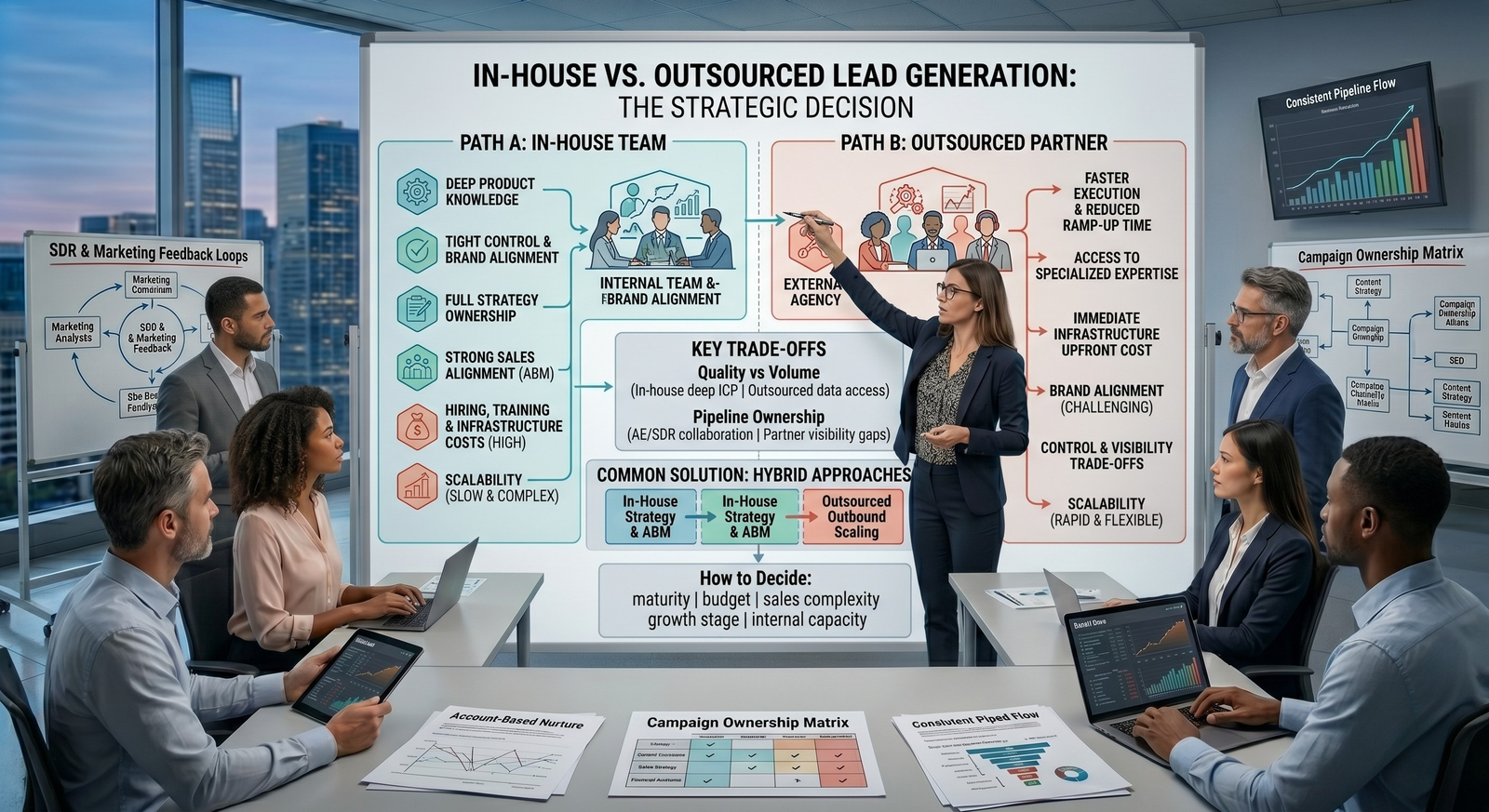
The trade-off between control, cost, and scalability
You are always balancing three variables:
• Control over messaging and targeting
• Cost efficiency
• Ability to scale quickly
You rarely optimize all three at once.
Why this decision directly impacts revenue performance
Your b2b lead generation structure determines:
• Lead quality
• Sales velocity
• Conversion rates
A weak setup leads to inconsistent revenue flow.
Aligning structure with growth stage and sales complexity
Early-stage companies often need speed. Mature companies need control and predictability. Your structure should reflect that.
When In-House Teams Work Best for Qualified Lead Generation
Building internal qualified lead generation for businesses capabilities
In-house teams work best when you need deep alignment between marketing, product, and sales.
Advantages of full control over targeting and messaging
Key benefits include:
• Full ownership of messaging
• Direct feedback loops with sales
• Faster iteration on ICP targeting
Deep product knowledge and stronger sales alignment
Internal teams understand:
• Product nuances
• Customer pain points
• Competitive positioning
This improves messaging accuracy.
Challenges in hiring, training, and scaling internal teams
However, in-house teams require:
• Time to hire
• Continuous training
• Strong leadership
• Tooling and infrastructure investment
Scaling can be slow and expensive.
When Outsourcing Lead Generation Becomes the Better Option
Using external partners for B2B demand generation tactics
Outsourcing is often used for:
• Cold outreach
• Appointment setting
• List building
Faster execution and reduced ramp-up time
External teams bring:
• Ready-to-go systems
• Existing talent
• Faster launch timelines
Access to specialized expertise and infrastructure
Agencies often have:
• Proven outbound frameworks
• Deliverability systems
• Multi-client experience
Limitations in control and brand alignment
The downside:
• Less control over messaging
• Potential misalignment with brand tone
• Limited product depth
Sales Funnel Lead Generation and Ownership Models
How sales funnel lead generation is managed internally vs externally
In-house teams usually own full funnel visibility. Outsourced teams typically focus on top-of-funnel activity.
Where outsourcing typically fits in the funnel
Outsourcing is most common in:
• Prospecting
• Outreach
• Appointment setting
Ensuring consistency across funnel stages
Without alignment, leads often feel disconnected between stages.
Avoiding fragmentation in lead handoffs
Clear documentation and qualification rules prevent pipeline breakdowns.
Quality Differences in High-Quality B2B Leads
Comparing high-quality B2B leads from in-house vs outsourced teams
In-house teams usually produce:
• Higher context leads
• Better ICP alignment
Outsourced teams often produce:
• Higher volume
• Faster outreach cycles
Impact of ICP understanding on lead quality
The deeper the ICP understanding, the better the conversion quality.
Data access and its effect on targeting accuracy
Internal teams often have richer:
• CRM data
• Customer insights
• Behavioral signals
Maintaining consistent qualification standards
Both models require strict qualification criteria to avoid pipeline noise.
Account-Based Marketing (ABM) and Control Requirements
Managing account-based marketing ABM lead generation internally vs externally
ABM is usually more effective in-house due to its strategic nature.
Why ABM often requires tighter internal alignment
ABM depends on:
• Sales coordination
• Strategic messaging
• Account prioritization
Risks of outsourcing strategic account targeting
Outsourcing ABM can lead to:
• Misaligned targeting
• Generic messaging
• Lower account penetration
Hybrid ABM execution models
Many companies:
• Keep strategy in-house
• Outsource execution tasks
Outbound Lead Generation Campaigns: Execution Trade-Offs
Running outbound lead generation campaigns in-house vs outsourced
In-house teams offer control. Outsourced teams offer speed.
Speed vs personalization trade-offs
Outsourced models scale faster but may lack deep personalization.
Scaling outreach without losing message quality
In-house teams tend to maintain stronger messaging consistency.
Managing deliverability and response optimization
External teams often bring stronger technical deliverability systems.
Inbound Lead Generation Methods and Content Ownership
Control over inbound lead generation methods in internal teams
Inbound is usually best handled internally due to brand sensitivity.
SEO content and brand alignment considerations
Content must reflect:
• Brand voice
• Thought leadership
• Product positioning
Outsourcing content vs keeping it in-house
Outsourcing works for production, but strategy should remain internal.
Impact on long-term demand generation
Inbound builds long-term equity, so control matters.
Lead Nurturing Strategies in B2B Across Models
Managing lead nurturing strategies in B2B internally vs externally
Nurturing requires:
• Context
• Timing
• Personalization
Importance of brand voice consistency in nurturing
Inconsistent tone can reduce trust.
Automation vs human-led follow-up strategies
Best results come from combining:
• Automated sequences
• Human SDR follow-ups
Ensuring continuity in long sales cycles
Long cycles require consistent engagement regardless of ownership model.
Pipeline Generation for Sales Teams and Ownership Clarity
How pipeline generation for sales teams differs across models
In-house teams typically own pipeline creation end-to-end.
Responsibility gaps between outsourced and internal teams
Outsourcing can create gaps in:
• Lead ownership
• Follow-up responsibility
Aligning pipeline targets with execution ownership
Clear KPIs prevent misalignment between teams.
Improving visibility into pipeline contribution
Shared dashboards improve accountability.
Prospecting Strategies for B2B Companies: Who Executes Better?
Comparing prospecting strategies for B2B companies internally vs outsourced
Prospecting effectiveness depends on:
• Data quality
• Messaging precision
• Speed of iteration
Data access and targeting precision differences
In-house teams usually have better targeting intelligence.
Speed of iteration and messaging optimization
External teams iterate faster due to specialization.
Balancing scale with personalization
The best systems combine both strengths.
Conversion-Focused Lead Generation and Accountability
Ensuring conversion-focused lead generation regardless of structure
Success is measured by:
• Meetings booked
• Pipeline created
• Revenue generated
Measuring success beyond activity metrics
Activity alone is not a success indicator.
Accountability challenges in outsourced models
External teams may optimize for volume over conversion.
Aligning incentives with revenue outcomes
KPIs must reflect real business impact.
Data-Driven Lead Generation Requirements for Both Models
Using data-driven lead generation to improve performance tracking
Both models require:
• Clean data
• Accurate reporting
• Clear attribution
Shared dashboards and reporting transparency
Visibility ensures alignment across teams.
Data ownership challenges in outsourcing
Data access can become fragmented with external vendors.
Importance of unified analytics systems
A single source of truth improves decision-making.
Multi-Channel B2B Marketing Strategies Across Teams
Managing multi-channel B2B marketing strategies in hybrid setups
Hybrid systems require coordination between:
• Email
• Ads
• Outbound
• Content
Coordination between internal and external channels
Misalignment leads to inconsistent messaging.
Avoiding message inconsistency across platforms
Brand consistency must remain centralized.
Ensuring unified customer experience
Every touchpoint should reinforce the same value proposition.
Scalable Lead Generation Systems and Long-Term Growth
Building scalable lead generation systems in-house vs outsourced
Scalability depends on:
• Systems
• Processes
• Ownership clarity
Flexibility and ramp-up speed differences
Outsourced teams scale faster initially.
Dependency risks in outsourced models
Over-reliance can create long-term risk.
Creating sustainable growth architectures
The strongest systems evolve beyond vendor dependency.
Hybrid Models: The Most Common Winning Approach
Combining in-house strategy with outsourced execution
Most successful companies use:
• Internal strategy
• External execution support
Keeping ABM and strategy internal while scaling outbound externally
This balance preserves control while improving scale.
Balancing control with scalability
Hybrid models reduce trade-offs between speed and quality.
Why hybrid systems often outperform pure models
They combine:
• Control of in-house teams
• Efficiency of outsourced teams
How to Decide What’s Right for Your Business
Evaluating maturity, budget, and sales complexity
Key factors include:
• Revenue stage
• Team size
• Sales cycle complexity
Matching B2B demand generation tactics to internal capacity
Your execution model must match your operational ability.
Choosing based on growth stage and pipeline goals
Early stage favors speed. Mature stage favors control.
Building a structure that evolves over time
The best systems adapt as your business scales.
Final Thoughts
There is no one-size-fits-all answer in b2b lead generation structure.
In-house teams offer control and alignment. Outsourcing offers speed and scalability. Hybrid models often deliver the best of both.
The right choice is not about ideology. It is about where your business is today—and what kind of revenue system you want to build tomorrow.
Find what you’re reading informative so far? Then why not read more by visiting our blog? We keep you up-to-date every week with how-to guides and strategies to B2B lead generation every single week! Click here to get started!