

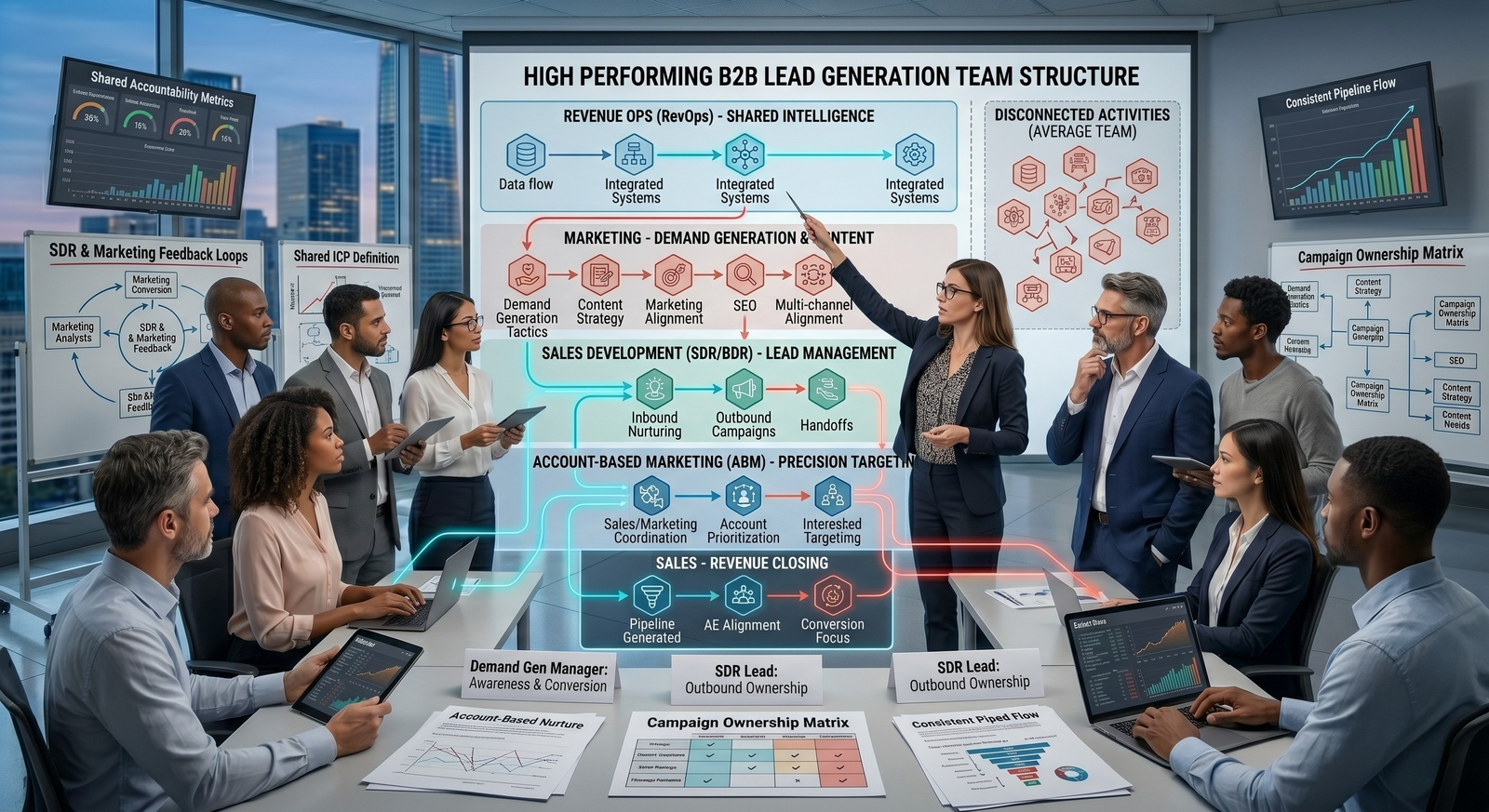
How High Performing B2B Lead Generation Teams Are Structured
Most companies struggle with b2b lead generation not because they lack tools, but because they lack structure.
When lead generation is treated as a collection of disconnected activities, results become inconsistent. When it is treated as a system with clear roles, ownership, and alignment, performance becomes predictable and scalable.
This article breaks down how high performing teams are structured, how responsibilities are distributed, and what makes their lead generation engine consistently deliver high quality pipeline.
What Defines a High Performing B2B Lead Generation Team
How top teams design effective B2B lead generation strategies
High performing teams do not rely on random execution. They build deliberate systems where every function supports revenue outcomes.
Key characteristics include:
• Clear ownership across each stage of the funnel
• Strong alignment between marketing and sales
• Data informed decision making
• Consistent feedback loops between teams
Instead of asking who is responsible for leads, they ask how leads move efficiently through the system.
Why structure matters more than individual talent
Even the best SDR or marketer cannot fix a broken system.
Structure determines:
• Lead quality
• Conversion efficiency
• Pipeline predictability
Talent matters, but structure multiplies or limits that talent.
The difference between average and elite performing teams
Average teams:
• Focus on activity volume
• Work in silos
• Lack consistent follow up processes
Elite teams:
• Focus on conversion outcomes
• Share ownership of revenue goals
• Continuously optimize based on data
Aligning structure with revenue outcomes
Every function in a high performing b2b lead generation team connects directly to revenue, not vanity metrics.
Core Functions Inside Qualified Lead Generation Teams
Roles responsible for qualified lead generation for businesses
Qualified lead generation requires coordination between multiple roles:
• Marketing teams generate demand and attract interest
• SDR teams qualify and engage prospects
• Sales teams convert opportunities into revenue
How specialization improves efficiency and output
Specialization allows each team to focus deeply on its strength:
• Marketing focuses on reach and engagement
• SDRs focus on qualification and conversations
• Sales focuses on closing deals
Aligning marketing, SDRs, and sales development functions
Alignment ensures:
• Leads are passed at the right time
• Messaging stays consistent
• No opportunity is lost in transition
Avoiding role overlap and operational confusion
Without clarity, teams often:
• Duplicate effort
• Mismanage leads
• Blame each other for poor performance
Clear boundaries eliminate friction.
Demand Generation as the Foundation of Team Structure
How B2B demand generation tactics shape team responsibilities
Demand generation is responsible for creating awareness and interest before outreach begins.
It includes:
• Content creation
• Paid campaigns
• Brand positioning
• Educational resources
Balancing awareness building and conversion activities
Strong teams balance:
• Long term awareness building
• Short term conversion focused activities
Structuring teams for long term pipeline impact
Instead of focusing only on immediate leads, demand generation builds pipeline consistency over time.
Connecting brand, content, and outbound efforts
High performing teams ensure all messaging reinforces the same value proposition across channels.
Sales Funnel Lead Generation Ownership Across Teams
How sales funnel lead generation is distributed across roles
Each stage of the funnel has clear ownership:
• Top of funnel: marketing
• Middle of funnel: SDRs
• Bottom of funnel: sales
Defining ownership for each funnel stage
Ownership clarity ensures no stage is neglected or duplicated.
Improving handoffs between marketing and sales
Effective handoffs include:
• Context about lead behavior
• Engagement history
• Intent signals
Eliminating pipeline leakage through clear accountability
When ownership is clear, fewer leads fall through the cracks.
Building a System for High Quality B2B Leads
How teams consistently generate high quality B2B leads
Consistency comes from:
• Defined ideal customer profiles
• Strong segmentation
• Behavioral targeting
Defining ICPs and qualification standards across departments
All teams must agree on:
• Who the buyer is
• What qualifies a lead
• When a lead is sales ready
Aligning scoring systems and feedback loops
Lead scoring improves when feedback flows from sales back to marketing.
Improving lead quality through shared accountability
When everyone is responsible for quality, not just volume, results improve.
Account Based Marketing and Team Alignment
Structuring account based marketing lead generation teams
Account based marketing requires close coordination between:
• Marketing
• Sales
• Revenue operations
Coordination between sales and marketing on key accounts
Teams collaborate on:
• Account targeting
• Messaging strategy
• Engagement timing
Prioritizing strategic accounts over broad targeting
Instead of chasing volume, teams focus on high value accounts.
Increasing conversion through account focused execution
Focused attention increases relevance and conversion rates.
Outbound Lead Generation Campaign Ownership
Managing outbound lead generation campaigns within SDR teams
SDRs typically own outbound execution including:
• Prospecting
• Cold outreach
• Follow ups
Structuring prospecting and outreach responsibilities
Clear processes define:
• Who to contact
• When to contact
• How to personalize messaging
Scaling personalized outreach through systems and tools
Automation supports scale, but personalization ensures relevance.
Ensuring consistency in messaging and follow ups
Consistency improves trust and response rates.
Inbound Lead Generation Methods and Marketing Teams
Ownership of inbound lead generation methods in growth teams
Marketing owns inbound channels such as:
• Search engine optimization
• Content marketing
• Webinars and events
Content and SEO responsibilities
Teams focus on attracting buyers through education and discovery.
Aligning inbound leads with sales qualification processes
Not all inbound leads are equal. Qualification ensures efficiency.
Ensuring seamless lead handoff to SDRs
Smooth transitions improve conversion rates significantly.
Lead Nurturing Strategies in B2B Organizations
How lead nurturing strategies in B2B are structured across teams
Nurturing is shared between marketing automation and SDR follow ups.
Marketing automation versus SDR responsibilities
• Marketing handles long term email sequences
• SDRs handle active engagement conversations
Multi touch engagement across buyer journeys
Buyers require multiple touchpoints before making decisions.
Improving conversion through coordinated nurturing
Coordinated nurturing builds trust and readiness over time.
Pipeline Generation for Sales Teams Structure
How pipeline generation for sales teams is organized
Pipeline creation is a shared responsibility across SDRs and AEs.
SDR, AE, and marketing collaboration models
Each team contributes:
• SDRs generate opportunities
• AEs close deals
• Marketing supports demand creation
Ensuring consistent pipeline coverage
Strong teams maintain steady pipeline flow rather than spikes.
Accountability metrics for pipeline performance
Key metrics include:
• Opportunity creation
• Conversion rates
• Revenue contribution
Prospecting Strategies for B2B Companies at Scale
Designing prospecting strategies for B2B companies within SDR teams
Prospecting is structured to maximize efficiency and relevance.
Balancing manual and automated workflows
Effective teams combine:
• Manual research for high value accounts
• Automation for scale
Prioritizing high intent accounts and leads
Intent signals guide prioritization decisions.
Improving outreach efficiency through segmentation
Segmentation increases relevance and response rates.
Conversion Focused Lead Generation Teams
Building conversion focused lead generation into team KPIs
Teams are measured on:
• Conversion rates
• Pipeline quality
• Revenue impact
Aligning messaging, timing, and qualification standards
Alignment ensures leads receive the right message at the right time.
Optimizing conversion rates across funnel stages
Each stage is continuously improved through data analysis.
Focusing teams on revenue outcomes, not just activity
Activity without conversion is not success.
Data Driven Lead Generation as a Core Operating Model
How data driven lead generation shapes modern team structure
Data informs:
• Targeting
• Messaging
• Prioritization
Shared dashboards and performance visibility
All teams access the same performance data.
Continuous optimization through feedback loops
Feedback improves accuracy over time.
Using analytics to improve targeting and efficiency
Data reduces guesswork and improves precision.
Multi Channel B2B Marketing Strategy Integration
Coordinating multi channel B2B marketing strategies across teams
Channels include:
• Email
• Social
• Paid ads
• Outbound outreach
Ensuring consistent messaging across platforms
Consistency builds brand trust.
Aligning paid, organic, and outbound efforts
Integrated strategies improve overall efficiency.
Reducing channel silos through unified planning
Unified planning avoids fragmented execution.
Scalable Lead Generation Systems Inside Teams
Building scalable lead generation systems across departments
Scalability comes from repeatable systems, not manual effort.
Automating repetitive tasks in outreach and qualification
Automation supports efficiency while freeing human effort for strategy.
Standardizing processes for predictable results
Standardization ensures consistent performance.
Creating systems that grow without adding complexity
Good systems scale without becoming harder to manage.
The Ideal Structure of a High Performing Lead Generation Engine
Combining inbound, outbound, and ABM into one system
The strongest teams unify all acquisition channels into a single engine.
Aligning sales, marketing, and RevOps under one framework
RevOps ensures alignment across the entire revenue process.
Building accountability across the entire funnel
Every stage has clear ownership and responsibility.
Designing a system that continuously improves over time
Continuous optimization turns good teams into elite teams.
Final Thoughts
High performing b2b lead generation teams are not defined by tools or tactics.
They are defined by structure, alignment, and clarity.
When every function understands its role in the revenue system, performance becomes predictable. When teams operate in silos, even strong execution fails to scale.
The difference is not effort.
It is architecture.
Find what you’re reading informative so far? Then why not read more by visiting our blog? We keep you up-to-date every week with how-to guides and strategies to B2B lead generation every single week! Click here to get started!