The Psychology Behind Why B2B Buyers Respond to Some Outreach (And Ignore Others)
Most b2b lead generation outreach doesn’t fail because of bad tools or weak lists.
It fails because it ignores how buyers actually think.
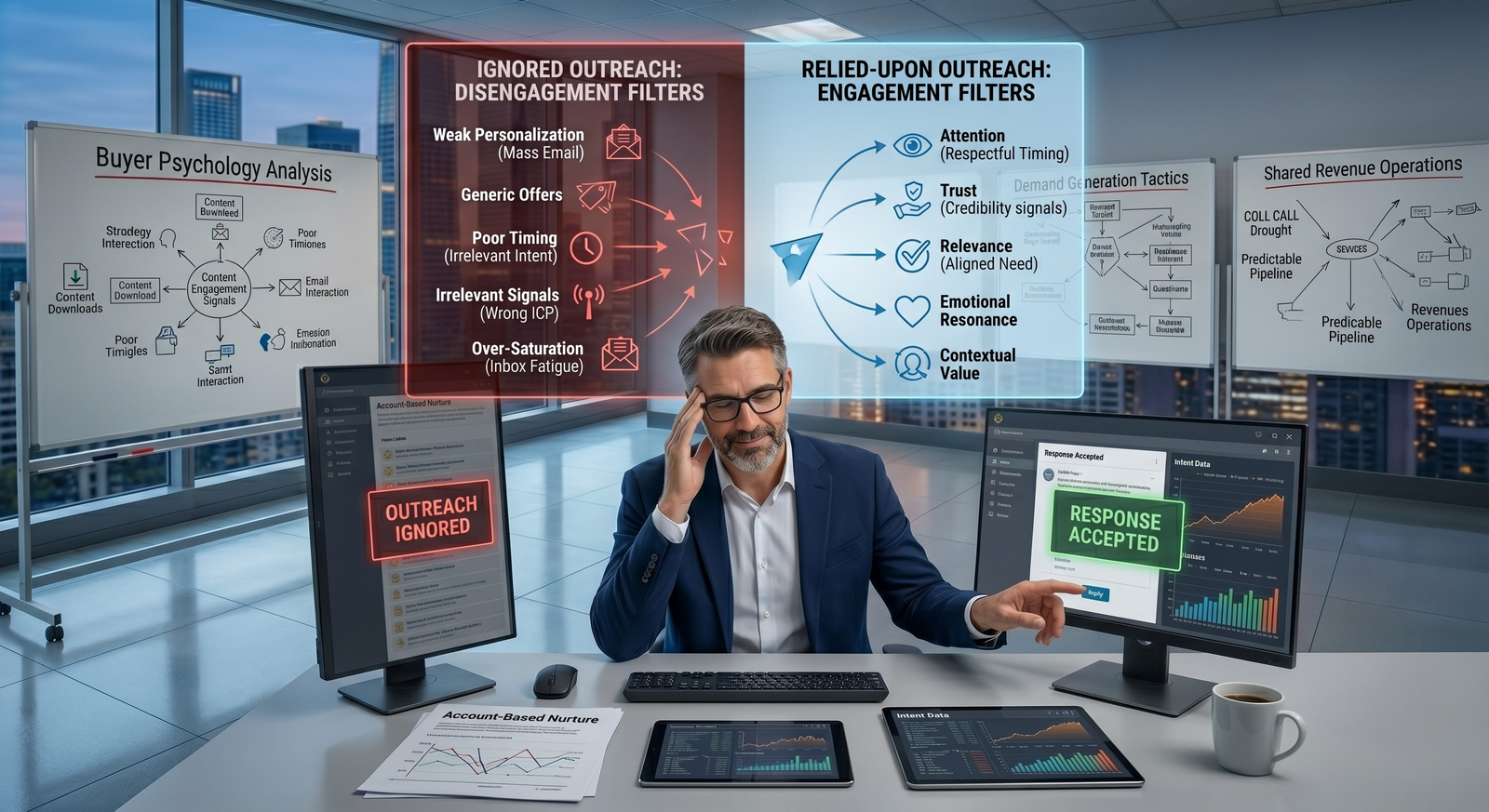
In B2B environments, decisions are not impulsive. They are filtered through attention, trust, relevance, and timing. If your message doesn’t align with these psychological filters, it gets ignored—no matter how well it’s written or how strong your offer is.
This article breaks down the psychology behind buyer response behavior and what separates outreach that gets ignored from outreach that gets replies.
Understanding Buyer Psychology in Modern B2B Lead Generation
How cognitive overload impacts B2B lead generation strategies
B2B buyers are constantly processing:
- Emails
- LinkedIn messages
- Ads
- Internal priorities
This creates cognitive overload, forcing them to ignore most outreach automatically.
Why buyers filter most outreach automatically
Buyers don’t evaluate every message. They scan and filter based on:
- Familiarity
- Relevance
- Urgency
If a message doesn’t pass this filter instantly, it’s ignored.
The role of trust, relevance, and timing in engagement
Three factors determine response:
- Trust: Do I recognize or trust this source?
- Relevance: Does this matter to me right now?
- Timing: Am I in a buying window?
Why attention is the real currency in outreach
In modern b2b lead generation, attention is more valuable than impressions. Without attention, nothing else matters.
Why Most Outreach Gets Ignored in Qualified Lead Generation
Weak personalization in qualified lead generation for businesses
Generic outreach signals lack of effort:
- “Hi [First Name]” is no longer personalization
- Surface-level references don’t create relevance
Irrelevant messaging and poor targeting signals
If messaging doesn’t align with:
- Industry
- Role
- Current challenges
It gets ignored immediately.
Over-saturation in buyer inboxes and channels
Buyers are overwhelmed. They have learned to ignore anything that feels:
- Salesy
- Generic
- Interruptive
Lack of perceived value in first contact
If the first message doesn’t offer immediate value, it gets discarded.
The Psychology of High-Quality B2B Leads and Attention
What defines high-quality B2B leads in behavioral terms
High-quality leads are not just fit—they are:
- Actively engaged
- Problem-aware
- Open to solutions
How perceived relevance drives engagement
People respond when they feel:
“This was meant for me.”
Relevance is the trigger, not volume.
Emotional triggers behind response behavior
Common psychological triggers include:
- Curiosity
- Urgency
- Risk reduction
- Opportunity gain
Why intent matters more than demographic fit
A perfect ICP with no intent is less valuable than a slightly off-fit lead showing active buying behavior.
Sales Funnel Lead Generation and Buyer Decision Triggers
How sales funnel lead generation aligns with buyer psychology
Funnels mirror psychology:
- Awareness = learning
- Consideration = comparison
- Decision = commitment
Psychological shifts between awareness, consideration, and decision
Each stage requires different messaging:
- Awareness: educate
- Consideration: differentiate
- Decision: validate
Why messaging must match funnel stage intent
Mismatch creates friction. Buyers disengage when messaging feels too advanced or too basic.
Where most outreach fails in the funnel
Most outreach fails by jumping directly to sales before trust is built.
Why Outbound Lead Generation Campaigns Fail to Connect
Common mistakes in outbound lead generation campaigns
Typical failures include:
- Generic templates
- No timing strategy
- Weak targeting
Lack of relevance and timing in cold outreach
Even good messages fail if sent at the wrong time.
Why generic messaging reduces trust instantly
Buyers associate generic messaging with:
- Low effort
- Low credibility
The importance of emotional resonance in first touch
First contact must feel human, relevant, and specific to create engagement.
Inbound Lead Generation Methods and Buyer Control Psychology
How inbound lead generation methods align with buyer autonomy
Inbound works because buyers feel in control of the journey.
Why buyers prefer self-directed discovery
Modern buyers want to:
- Research privately
- Compare options
- Avoid pressure
Trust-building through content consumption
Each content interaction builds:
- Credibility
- Familiarity
- Confidence
The psychological advantage of inbound engagement
Inbound leads convert more easily because trust is pre-established.
Account-Based Marketing (ABM) and Perceived Relevance
How account-based marketing (ABM) lead generation improves response rates
ABM increases relevance by targeting specific accounts with tailored messaging.
Psychological impact of account-specific messaging
When a buyer sees their company referenced, attention increases immediately.
Why personalization increases perceived value
Personalized outreach signals:
“This message was created for you.”
Building familiarity before outreach
Repeated exposure builds recognition, reducing resistance.
Why Multi-Channel B2B Marketing Influences Buyer Attention
Role of multi-channel B2B marketing strategies in reinforcement
Multiple touchpoints reinforce memory and trust.
Why repeated exposure builds trust over time
Familiarity reduces skepticism and increases openness.
Channel consistency and psychological familiarity
Consistent messaging across email, ads, and social builds coherence.
Avoiding cognitive fatigue across platforms
Too many inconsistent messages create confusion and disengagement.
Lead Nurturing Strategies in B2B and Trust Building
How lead nurturing strategies in B2B shape decision confidence
Nurturing builds confidence over time through education and relevance.
Gradual persuasion vs aggressive selling
Gradual persuasion respects buyer psychology. Aggressive selling creates resistance.
Psychological importance of timing and sequence
Right message, wrong time = ignored message.
Building credibility through consistent engagement
Consistency signals reliability and expertise.
Data-Driven Lead Generation and Behavioral Understanding
Using data-driven lead generation to predict response likelihood
Behavioral data helps predict who is likely to respond.
Understanding behavioral patterns behind engagement
Patterns reveal:
- Interest level
- Buying readiness
- Content preferences
Reducing guesswork in outreach targeting
Data replaces assumptions with real behavior signals.
Aligning messaging with observed buyer behavior
When messaging reflects behavior, relevance increases dramatically.
Prospecting Strategies for B2B Companies That Respect Buyer Psychology
Modern prospecting strategies for B2B companies based on intent
Modern prospecting prioritizes:
- Intent signals
- Engagement activity
- Timing
Why interruption-based outreach is becoming less effective
Interruptions feel intrusive, especially in saturated markets.
Improving relevance through segmentation and timing
Segmentation ensures the right message reaches the right buyer.
Aligning outreach with buyer readiness signals
Outreach should match where the buyer is in their journey.
Conversion-Focused Lead Generation and Decision Triggers
How conversion-focused lead generation leverages psychology
Conversion improves when messaging aligns with decision triggers.
Reducing friction in decision-making pathways
Friction slows down decisions. Simplicity speeds them up.
Using clarity and value to drive response
Clear value propositions outperform complex messaging.
Why simplicity increases conversion rates
Simple messages are easier to process and act on.
Pipeline Generation for Sales Teams and Behavioral Alignment
Improving pipeline generation for sales teams with psychology insights
Sales performance improves when aligned with buyer mindset.
Aligning SDR messaging with buyer mindset
SDRs must match tone and intent level of the buyer.
Prioritizing high-intent engagement opportunities
Focus shifts toward buyers showing real signals.
Reducing wasted outreach through behavioral filters
Behavior filters eliminate low-probability prospects.
Scalable Lead Generation Systems Built on Psychology
Designing scalable lead generation systems around buyer behavior
Scalable systems must reflect how humans actually make decisions.
Automating personalization without losing relevance
Automation should enhance, not replace, relevance.
Balancing volume with psychological precision
High volume without precision leads to wasted effort.
Creating systems that adapt to human decision-making patterns
Adaptive systems outperform static outreach models.
The Future of B2B Outreach Is Psychological Precision
Why understanding psychology will define future B2B demand generation tactics
The future belongs to teams that understand buyer behavior deeply.
AI’s role in predicting engagement behavior
AI will help identify:
- When buyers are ready
- What they care about
- How they prefer to engage
Moving from mass outreach to relevance-first communication
Generic outreach will continue to decline in effectiveness.
Building competitive advantage through behavioral intelligence
The strongest advantage will come from understanding attention, intent, and timing better than competitors.
Final Thoughts
In b2b lead generation, success is not just about reaching more people.
It’s about understanding why people respond—or don’t.
Buyers respond when outreach is:
- Relevant
- Timely
- Trust-building
- Behavior-aware
Everything else gets filtered out.
The companies that win are not the ones that send the most messages.
They are the ones that understand the psychology behind the response.
Find what you’re reading informative so far? Then why not read more by visiting our blog? We keep you up-to-date every week with how-to guides and strategies to B2B lead generation every single week! Click here to get started!