

Intent-Based Prospecting: A Decisive Alternative to Cold Lists
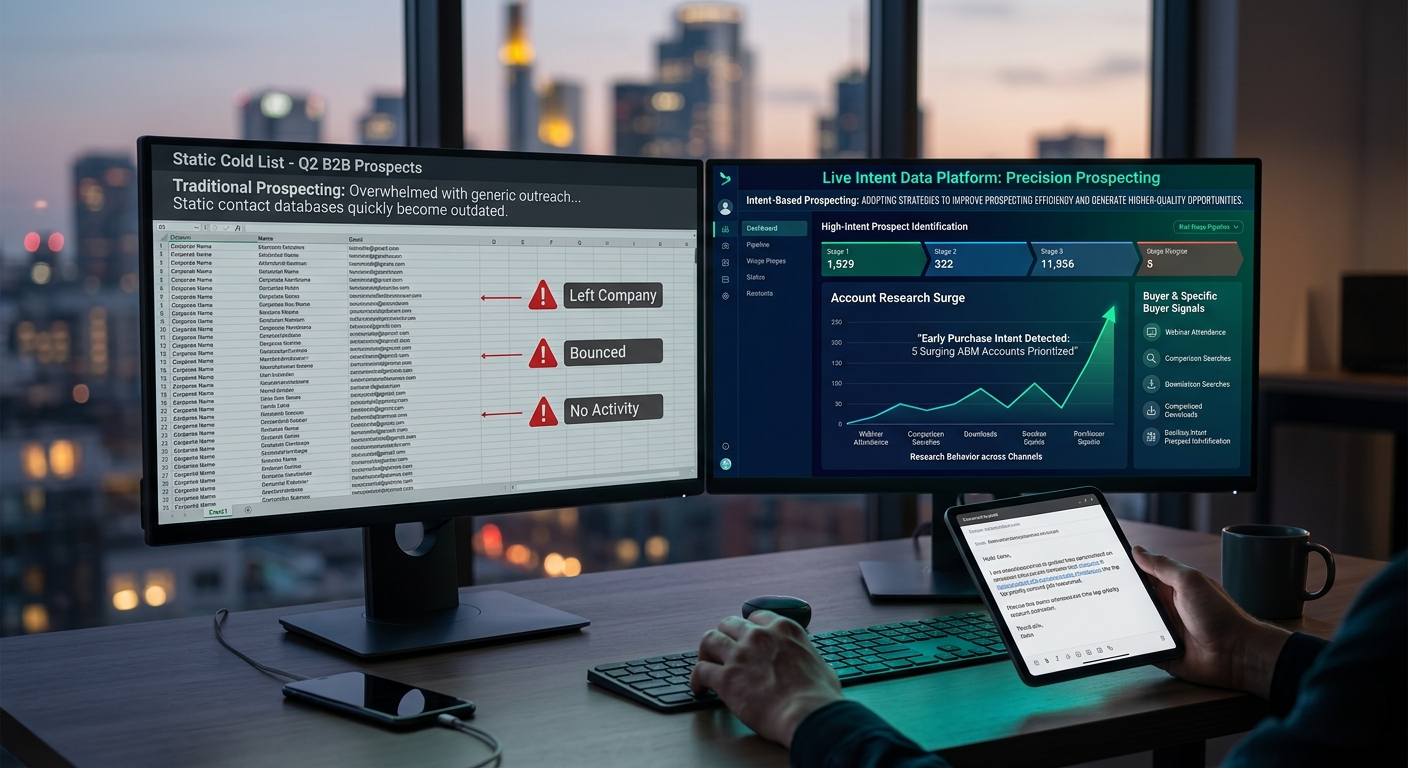
Traditional cold prospecting is becoming less effective in modern B2B sales. Buyers are overwhelmed with generic outreach, static contact databases quickly become outdated, and mass email campaigns often generate low response rates.
Today’s buyers expect relevance, timing, and personalization.
That shift is why more companies are adopting intent based marketing strategies to improve prospecting efficiency and generate higher-quality opportunities. Instead of relying on static lists filled with contacts who may have no interest in buying, intent-based prospecting focuses on identifying accounts actively researching solutions right now.
By leveraging buyer signals, behavioral data, and real-time engagement insights, businesses can engage prospects earlier, improve outreach quality, and create stronger sales conversations.
Why Traditional Cold Lists Are Losing Effectiveness
The limitations of static prospect databases
Cold lists are built around firmographic filters such as industry, company size, revenue, or job title. While this information helps define target accounts, it does not indicate actual buying intent.
A prospect may perfectly match your ideal customer profile but have no current interest in purchasing.
Static databases also become outdated quickly due to employee turnover, changing priorities, and evolving business needs.
Why volume-based prospecting creates lower-quality conversations
Many outbound teams still rely on volume-heavy outreach strategies. The assumption is simple: send enough emails and eventually someone will respond.
The problem is that buyers increasingly ignore irrelevant outreach.
Without behavioral context, sales teams often contact prospects at the wrong time with generic messaging that fails to connect.
Understanding the modern intent-based marketing definition
Intent based marketing uses behavioral insights to identify prospects actively researching products, services, or solutions.
Instead of relying solely on who a company is, intent-based strategies focus on what buyers are actually doing online.
This includes behaviors such as:
- Visiting solution pages
- Reading comparison content
- Researching competitors
- Downloading resources
- Attending webinars
- Engaging with industry topics
These actions reveal active buying interest.
The shift from mass outreach to buyer-intent targeting
Modern prospecting is moving away from broad targeting and toward precision engagement.
Companies now prioritize prospects showing signs of active demand instead of relying on large contact lists with little buying context.
What Makes Intent-Based Prospecting Different?
How B2B buyer intent data improves prospect targeting
B2B buyer intent data provides visibility into prospect behavior across digital channels.
Instead of guessing which accounts may be interested, businesses can identify organizations already researching relevant topics.
This dramatically improves targeting accuracy.
The role of purchase intent signals in identifying active buyers
Purchase intent signals help determine whether a prospect is moving through the buying journey.
Common signals include:
- Pricing page visits
- Product comparison research
- High-frequency content engagement
- Repeated website sessions
- Demo-related searches
These signals reveal stronger purchasing interest than static demographic data alone.
Why intent-driven prospecting focuses on timing and relevance
Intent-based prospecting prioritizes engaging buyers at the right moment.
Timing often determines whether outreach feels valuable or disruptive.
Using buyer signals instead of generic contact lists
Behavioral insights allow sales teams to focus on active opportunities instead of blindly contacting large lists of passive prospects.
How Buyer Signals Reveal In-Market Opportunities
Understanding digital buyer signals across channels
Modern buyers leave digital intent clues across multiple channels, including:
- Websites
- Review platforms
- Social media
- Industry forums
- Search activity
- Webinar engagement
- Content downloads
Each interaction contributes to a larger picture of buyer readiness.
Using real-time buyer behavior tracking to identify engagement patterns
Real-time tracking helps businesses monitor behavioral changes as they happen.
Sudden increases in engagement often indicate growing urgency or active evaluation.
Detecting active research behavior before outreach begins
Intent data allows teams to identify demand before prospects directly contact sales.
This creates earlier outreach opportunities.
Recognizing when prospects are entering buying cycles
Repeated engagement with solution-focused content often signals that a buyer is entering an active purchasing phase.
Early Purchase Intent Detection Creates Competitive Advantage
Why early purchase intent detection matters in outbound sales
The earlier a company identifies buying intent, the more influence it can have during the decision-making process.
Late outreach often means competing against established vendor preferences.
Using account intent monitoring to identify demand sooner
Account intent monitoring tracks engagement patterns across organizations to detect rising interest levels.
This helps sales teams prioritize accounts showing active buying behavior.
Reaching prospects before competitors recognize the opportunity
Early visibility creates a significant competitive advantage.
Companies that engage first often shape buyer perception earlier in the journey.
Turning research activity into proactive outreach campaigns
Intent-based prospecting transforms outreach from reactive selling into proactive engagement.
High-Intent Prospect Identification vs Cold List Prospecting
Improving high-intent prospect identification through behavioral data
Behavioral insights reveal which accounts are most likely to convert.
This improves prospect prioritization and outreach efficiency.
The difference between broad targeting and intent-based prioritization
Cold list prospecting prioritizes account fit.
Intent-based prospecting prioritizes account readiness.
That distinction dramatically improves conversion potential.
Applying behavioral targeting in B2B marketing for smarter outreach
Behavioral targeting focuses on real engagement patterns instead of assumptions.
This creates more relevant prospecting strategies.
Reducing wasted outreach with intent-qualified accounts
Sales teams spend less time contacting uninterested prospects and more time engaging buyers already showing demand.
Timing Outbound Campaigns Around Buyer Intent
Why timing outbound campaigns impacts response rates
Even strong messaging can fail if delivered at the wrong moment.
Buyers respond more positively when outreach aligns with active research behavior.
Using predictive marketing strategies to improve engagement timing
Predictive intent models help identify optimal outreach windows based on engagement activity.
Aligning outreach with active buyer research windows
Intent-based timing ensures outreach reaches prospects while interest and urgency are highest.
Increasing reply quality through intent-driven timing
Better timing improves both response rates and conversation quality.
Personalized Outreach Using Buyer Intent Signals
Building personalized outreach using buyer intent insights
Intent data enables outreach tailored around actual buyer interests.
This creates far more relevant communication.
Moving beyond surface-level personalization tactics
Modern personalization requires more than simply adding a prospect’s name or company.
Behavioral context matters far more.
Creating context-aware messaging based on buyer behavior
Outreach can reference:
- Research topics
- Industry challenges
- Competitor comparisons
- Product interests
- Engagement patterns
This creates stronger relevance.
Increasing engagement through relevance-driven outreach
Relevant messaging improves trust, engagement, and conversion efficiency.
Intent Signal Analysis for Better Lead Qualification
Applying intent signal analysis for lead qualification
Behavioral scoring models help identify which accounts are sales-ready.
Distinguishing active buyers from passive contacts
Not every engaged prospect intends to buy immediately.
Intent analysis helps distinguish genuine buying readiness from casual curiosity.
Improving sales efficiency through behavior-based prioritization
Sales teams can focus their efforts on higher-converting opportunities.
Supporting more effective intent-driven lead generation
Intent-based qualification strengthens overall pipeline quality.
Using Intent Data Platforms to Replace Static Prospect Lists
How intent data platforms improve outbound targeting
Intent platforms aggregate buyer signals from multiple channels to identify active demand.
Integrating buyer intent into CRM and prospecting workflows
CRM integrations allow sales teams to prioritize outreach based on live behavioral insights.
Automating alerts for surging accounts and buyer activity
Automated notifications help SDRs respond quickly to rising engagement patterns.
Scaling outbound prospecting through intent intelligence
Intent platforms make behavior-driven prospecting scalable across larger revenue teams.
How Intent-Based Prospecting Strengthens ABM Strategies
Improving data-driven account-based marketing (ABM) campaigns
Intent insights help ABM teams prioritize accounts actively researching solutions.
Prioritizing accounts actively researching solutions
Behavioral engagement improves account selection accuracy.
Coordinating outreach around account-level engagement behavior
Intent signals improve coordination between sales and marketing teams.
Combining ABM precision with intent-driven insights
This creates more focused and effective account engagement strategies.
Sales and Marketing Alignment Through Intent Data
Improving sales and marketing alignment through intent data
Intent data creates shared visibility into buyer behavior.
Building shared qualification standards around buyer signals
Both teams can prioritize opportunities using the same behavioral insights.
Coordinating campaigns using real-time engagement insights
Shared visibility improves campaign timing and consistency.
Creating unified prospect prioritization systems
Alignment improves overall pipeline generation efficiency.
How Intent-Based Prospecting Helps Shorten Sales Cycles
Reaching buyers earlier in the decision-making process
Early engagement allows businesses to shape buyer perception sooner.
Improving conversion speed through better qualification
Intent-driven qualification improves sales efficiency.
Reducing delays caused by mistimed outreach
Behavioral insights reduce wasted outreach and improve timing accuracy.
Why intent-informed prospecting helps shorten sales cycles
Sales teams spend less time pursuing low-quality leads and more time engaging active buyers.
The Future of Prospecting Is Intent-Driven
Why static lists will continue losing effectiveness
Buyers increasingly ignore generic outbound outreach.
Static lists provide little visibility into actual demand.
The evolution of predictive prospecting and buyer intelligence
Predictive technologies will continue improving buying-stage visibility and engagement timing.
Combining AI, intent data, and personalization at scale
AI-powered analysis will make intent-driven prospecting even more scalable and precise.
The future of outbound sales will focus on timing, relevance, and buyer intent
Modern B2B prospecting is shifting toward behavior-based engagement strategies that prioritize buyer readiness over outreach volume.
Final Thoughts
Intent-based prospecting is transforming how modern B2B sales teams identify and engage opportunities. Instead of relying on outdated cold lists and mass outreach strategies, businesses can now use buyer intent signals to prioritize accounts actively researching solutions.
By combining behavioral data, timing insights, and personalized outreach, intent based marketing enables sales teams to create more relevant conversations, improve qualification accuracy, shorten sales cycles, and generate higher-quality pipeline opportunities.
As buyer behavior continues evolving, companies that embrace intent-driven prospecting will gain a significant advantage over competitors still relying on traditional cold outreach methods.
Find what you’re reading informative so far? Then why not read more by visiting our blog? We keep you up-to-date every week with how-to guides and strategies to B2B lead generation every single week! Click here to get started!