

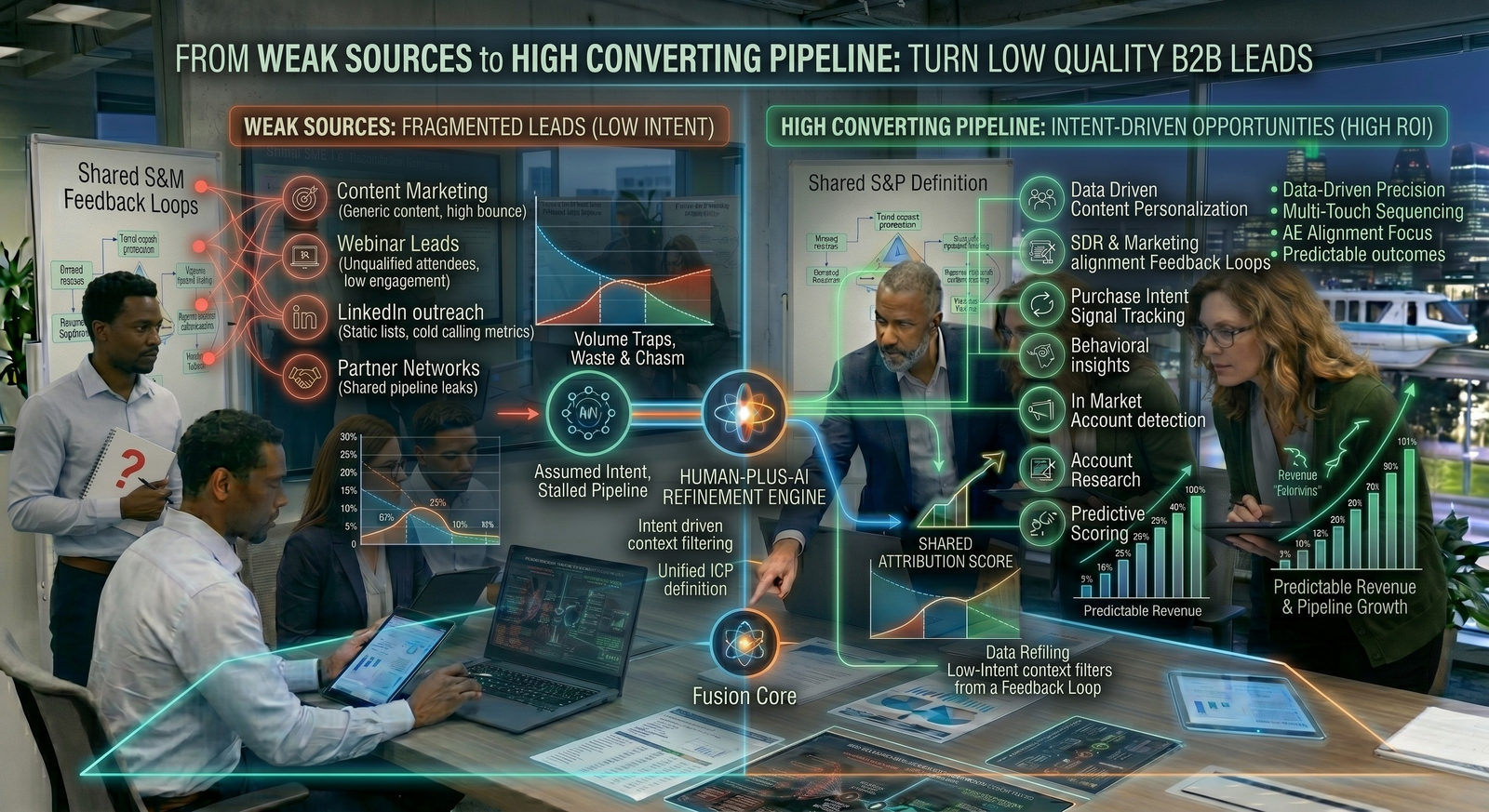
How to Turn Low Quality B2B Lead Sources into High Converting Pipelines
Not all B2B Lead Sources are created equal. Some channels consistently bring in sales ready opportunities, while others generate large volumes of contacts that never convert. The difference usually is not the channel itself, but how it is structured, targeted, and optimized.
Low quality leads are not a permanent problem. In most cases, they are a signal that your system needs better filtering, better alignment with intent, or tighter execution across channels. This article breaks down how to identify weak lead sources and turn them into high converting pipelines through practical, data driven improvements.
Understanding Why Some B2B Lead Generation Channels Underperform
How B2B lead generation channels vary in quality and intent
Different B2B lead generation channels attract different buyer mindsets. For example, SEO traffic often includes high intent researchers, while broad paid campaigns may attract less qualified audiences. Quality depends heavily on intent alignment, not just channel type.
Identifying weak sources of B2B leads in your funnel
Weak sources usually show clear patterns:
- High traffic but low conversion rates
- Many leads but few sales qualified opportunities
- Low engagement after first contact
- Long sales cycles with minimal progression
These signals suggest the channel is misaligned with buyer readiness.
Common reasons lead acquisition channels fail to convert
Most underperforming lead acquisition channels for businesses fail due to:
- Poor targeting
- Lack of qualification filters
- Generic messaging
- Weak follow up processes
The channel is rarely the real issue; execution usually is.
The gap between traffic volume and pipeline quality
More leads do not automatically mean more revenue. In fact, high volume often hides inefficiency. The goal is not more leads, but better conversion from the right leads.
Diagnosing Your Current Lead Acquisition Channels for Businesses
How lead acquisition channels for businesses lose efficiency over time
Even strong channels degrade if not optimized. Audience fatigue, outdated targeting, and shifting buyer behavior all reduce performance over time.
Auditing inbound vs outbound performance gaps
Start by comparing:
- Conversion rates by channel
- Cost per qualified lead
- Deal velocity per source
This reveals where quality drops occur.
Identifying bottlenecks in your conversion funnel
Common bottlenecks include:
- Low response rates in outbound
- Weak landing page conversion in paid campaigns
- Poor lead qualification criteria
Fixing leakage points across channels
Once identified, fix leaks by improving:
- Targeting precision
- Messaging relevance
- Lead scoring systems
- Follow up consistency
Improving Inbound Lead Sources for Higher Conversion Rates
How inbound lead sources can be optimized for intent
Not all inbound traffic is equal. Focus on optimizing inbound lead sources for high intent keywords and problem focused content.
Enhancing content marketing lead sources for better qualification
Strong content marketing lead sources should:
- Address specific pain points
- Target decision stage queries
- Include clear calls to action
Strengthening organic search lead generation with high-intent keywords
Organic search lead generation improves significantly when content is built around:
- “Best solution” queries
- Comparison searches
- Problem aware keywords
Aligning inbound traffic with buyer readiness
Match content depth with funnel stage. Educational content for awareness, solution pages for consideration, and case studies for decision stage.
Fixing Outbound Lead Sourcing Strategies for Better Results
How outbound lead sourcing strategies can be refined for quality
Outbound lead sourcing strategies should not rely on volume alone. Focus on targeting accuracy and message relevance.
Improving targeting in cold email and outreach campaigns
Better targeting includes:
- Narrow ICP definitions
- Industry and role filtering
- Behavioral intent signals
Using intent signals to filter outbound lists
Intent data helps prioritize prospects already showing interest, increasing response likelihood.
Increasing response rates through personalization
Personalized messaging based on role, pain point, or company context significantly improves engagement.
Turning LinkedIn B2B Lead Generation into a High-Conversion Channel
How LinkedIn B2B lead generation can be optimized for quality leads
LinkedIn B2B lead generation becomes more effective when focused on relevance over reach.
Refining targeting for decision maker engagement
Prioritize:
- Job seniority
- Industry relevance
- Active engagement behavior
Converting social interactions into qualified opportunities
Engagement like comments, profile visits, and post interactions often indicate early intent.
Building authority to attract higher intent prospects
Consistent posting builds trust, attracting inbound leads with stronger buying intent.
Optimizing Email Outreach Lead Generation Channels
How email outreach lead generation channels improve pipeline quality
Email works best when it is tightly targeted and behavior driven.
Better segmentation for higher conversion potential
Segment based on:
- Industry
- Company size
- Intent signals
- Buyer role
Personalization strategies that increase reply rates
Effective personalization includes:
- Pain point alignment
- Industry specific insights
- Trigger based messaging
Filtering low quality prospects before outreach
Remove poor fit leads early to improve efficiency and protect sender reputation.
Improving Event and Webinar Lead Sources for Better ROI
How event and webinar lead sources generate high intent leads
Attendees of event and webinar lead sources are already engaged and actively learning.
Capturing engagement signals during live events
Behavioral signals like questions, attendance duration, and downloads indicate strong interest.
Post-event nurturing for qualification improvement
Follow up sequences should focus on:
- Relevance recap
- Value reinforcement
- Next step conversion
Converting attendees into sales ready opportunities
Not all attendees are ready immediately, but structured nurturing converts interest into pipeline.
Fixing Paid Advertising for B2B Leads That Don’t Convert
How paid advertising for B2B leads can be optimized for quality
Paid advertising for B2B leads often fails due to broad targeting and weak landing pages.
Refining audience targeting for better intent alignment
Use:
- Retargeting lists
- Intent based segments
- Lookalike audiences from high value customers
Reducing wasted ad spend on low intent traffic
Exclude irrelevant segments and continuously refine targeting based on conversion data.
Improving landing page conversion rates
Landing pages should be focused, specific, and aligned with ad messaging.
Strengthening Account Based Marketing Lead Sources
How account-based marketing lead sources improve pipeline efficiency
Account-based marketing lead sources concentrate efforts on high value accounts instead of broad audiences.
Targeting high value accounts with intent signals
Combine firmographic data with behavioral signals to identify best-fit accounts.
Aligning marketing and sales for better conversion outcomes
Shared account lists ensure coordinated outreach and messaging.
Personalization strategies for account level engagement
Tailored messaging at the account level significantly improves engagement rates.
Enhancing Referral Based Lead Generation for Higher Quality Leads
How referral-based lead generation produces high conversion opportunities
Referral leads convert faster due to built-in trust and credibility.
Structuring referral systems for consistent quality
Implement structured referral programs instead of relying on informal introductions.
Leveraging customer advocacy for better pipeline outcomes
Happy customers are often the strongest source of high quality leads.
Tracking referral performance effectively
Measure referral conversion rates separately to understand true value.
Improving Partner and Affiliate Lead Sources
How partner and affiliate lead sources can be optimized
Partner and affiliate lead sources work best when aligned with the same ICP.
Aligning partner audiences with your ICP
Mismatched audiences lead to low quality traffic and poor conversion rates.
Improving co-marketing conversion strategies
Joint webinars, content, and campaigns improve trust and engagement.
Filtering low quality partner traffic
Continuously evaluate partner performance and remove low converting sources.
Using Data Driven Lead Sourcing Strategies to Fix Low Quality Leads
How data-driven lead sourcing strategies improve targeting accuracy
Data helps identify what actually converts, not just what generates volume.
Identifying patterns in high converting leads
Look for common traits such as:
- Industry
- Company size
- Engagement behavior
Removing low performing segments using analytics
Eliminate channels or segments that consistently underperform.
Building feedback loops for continuous optimization
Sales feedback is essential for improving lead quality over time.
Turning Weak Lead Sources into High Converting Pipelines
Aligning sales and marketing on lead quality definitions
Both teams must agree on what qualifies as a “good lead.”
Combining multiple channels for better conversion rates
Blending inbound, outbound, and ABM improves consistency and coverage.
Prioritizing intent over volume in lead generation
Intent signals matter more than raw lead numbers in modern B2B systems.
Building a scalable and predictable revenue pipeline
When optimization is consistent, even weak B2B Lead Sources can become reliable revenue drivers.
Final Thoughts
Low quality leads are rarely a permanent limitation of a channel. They are usually a reflection of weak targeting, poor filtering, or misaligned strategy. By improving intent alignment, refining targeting, and integrating data driven optimization, any B2B Lead Sources can be transformed into a high converting pipeline.
The real shift is simple: stop optimizing for volume, and start optimizing for conversion quality.
Find what you’re reading informative so far? Then why not read more by visiting our blog? We keep you up-to-date every week with how-to guides and strategies to B2B lead generation every single week! Click here to get started!