

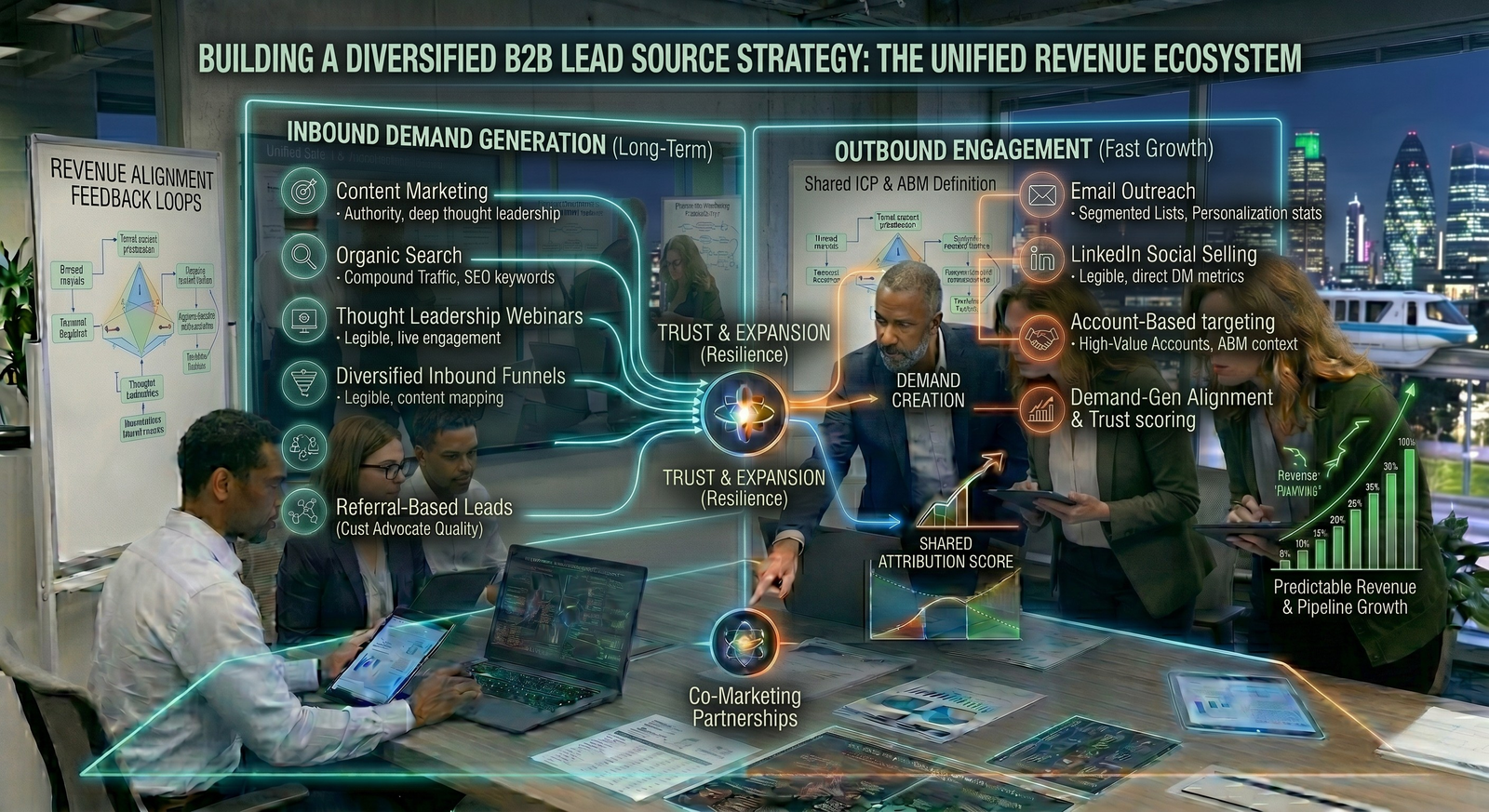
How to Build a Diversified B2B Lead Source Strategy
Building a predictable pipeline is rarely about finding one perfect channel. In most high performing B2B teams, growth comes from combining multiple B2B Lead Sources that work together across different stages of the buyer journey.
A diversified approach helps companies reduce risk, stabilize lead flow, and improve conversion quality over time. Instead of depending on one acquisition method, businesses build a system where inbound, outbound, partnerships, and intent driven channels reinforce each other.
This article breaks down how to structure a diversified lead source strategy that is practical, scalable, and aligned with modern B2B buying behavior.
Why a Diversified B2B Lead Source Strategy Matters
How B2B lead generation channels reduce dependency risk
Relying on a single channel creates vulnerability. If performance drops in one area, the entire pipeline suffers. Diversification spreads risk across multiple B2B lead generation channels, ensuring continuity even when one source underperforms.
Practically, this means combining SEO, outbound outreach, referrals, and paid acquisition instead of depending on just one.
Why relying on a single channel limits growth potential
A single channel also limits reach. Each channel connects with different buyer segments. For example, SEO captures active researchers, while outbound reaches untouched prospects. Using only one reduces overall market coverage.
Balancing sources of B2B leads for stable pipeline flow
A balanced system ensures that pipeline generation is not seasonal or inconsistent. When inbound slows, outbound can compensate. When outbound takes time to ramp, inbound continues building awareness.
Building resilience through multi-channel acquisition
Resilient companies design their systems so no single failure breaks growth. Multi-channel acquisition creates redundancy, stability, and long-term scalability.
Mapping Lead Acquisition Channels for a Balanced Strategy
How lead acquisition channels for businesses support scalability
Different lead acquisition channels for businesses serve different roles in scaling. Some generate immediate opportunities, while others build long-term demand.
Structuring inbound, outbound, and hybrid lead sources
A strong framework typically includes:
- Inbound channels like SEO and content marketing
- Outbound channels like cold email and LinkedIn outreach
- Hybrid channels like webinars and intent based ABM
Each plays a distinct role in pipeline creation.
Aligning channels with different stages of the funnel
Top funnel channels build awareness, mid funnel nurtures interest, and bottom funnel drives conversions. Mapping channels to funnel stages prevents inefficiencies.
Creating a unified view of all lead sources
Without central visibility, optimization becomes difficult. A unified dashboard helps teams understand which sources of B2B leads contribute most to revenue.
Inbound Lead Sources for Long-Term Demand Generation
How inbound lead sources attract high-intent prospects
Inbound leads are often self qualified. These prospects are already searching for solutions, making them highly valuable.
Using content marketing lead sources to build authority
Educational content positions your brand as a trusted advisor. Blogs, guides, and case studies drive organic discovery and improve trust.
Leveraging organic search lead generation for consistent traffic
SEO driven discovery remains one of the most stable B2B Lead Sources, especially for long-term compounding growth.
Scaling inbound systems for predictable growth
Once optimized, inbound systems continue generating leads without proportional increases in cost.
Outbound Lead Sourcing Strategies for Fast Pipeline Growth
How outbound lead sourcing strategies create immediate opportunities
Outbound creates direct access to target accounts, making it ideal for fast pipeline generation.
Using cold outreach and personalized messaging at scale
Cold email and LinkedIn outreach allow precise targeting when combined with personalization.
Combining outbound with intent signals for better results
Outbound becomes significantly more effective when aligned with behavioral or intent data.
Optimizing outbound for conversion efficiency
Testing messaging, refining targeting, and improving sequencing increases reply and conversion rates over time.
Account Based Marketing Lead Sources for High-Value Accounts
How account-based marketing lead sources improve targeting precision
ABM focuses resources on high value accounts rather than broad audiences.
Identifying high-value accounts using behavioral and firmographic data
Data signals help prioritize accounts most likely to convert.
Aligning sales and marketing in ABM execution
When both teams work from the same account list, engagement becomes more coordinated and effective.
Increasing ROI through account-level focus
ABM often delivers higher deal sizes because efforts are concentrated on quality over volume.
Referral Based Lead Generation for Trust Driven Growth
How referral-based lead generation produces high-quality leads
Referrals carry built-in trust, making them easier to convert.
Leveraging customer relationships for new opportunities
Satisfied customers naturally become advocates when properly nurtured.
Building structured referral programs for scalability
Systemizing referrals ensures they are not accidental but repeatable.
Tracking referral performance across pipelines
Understanding referral contribution helps measure true channel value.
LinkedIn B2B Lead Generation as a Core Channel
How LinkedIn B2B lead generation supports both inbound and outbound
LinkedIn works as both a content and outreach platform, making it highly versatile.
Building authority through content and engagement
Consistent posting builds visibility and trust within target markets.
Direct outreach strategies for decision makers
Personalized messaging enables direct access to high level stakeholders.
Converting social interactions into qualified leads
Engagement often becomes the first step toward pipeline conversations.
Email Outreach Lead Generation Channels for Scalable Outreach
How email outreach lead generation channels drive direct engagement
Cold email remains one of the most scalable outbound systems when executed properly.
Personalization strategies for higher response rates
Relevant messaging significantly improves engagement and reply rates.
Segmenting lists for better targeting
Segmentation ensures messaging matches audience needs and intent levels.
Improving deliverability and conversion performance
Proper infrastructure and testing help maintain inbox placement and response quality.
Event and Webinar Lead Sources for High-Intent Engagement
How event and webinar lead sources generate qualified leads
Live events attract highly engaged prospects actively exploring solutions.
Capturing real-time engagement during live sessions
Questions, attendance duration, and participation signals indicate strong interest.
Converting attendees into pipeline opportunities
Follow up sequences turn engagement into meetings and demos.
Post-event nurturing for long-term conversion
Not all conversions happen immediately, making structured follow up essential.
Paid Advertising for B2B Leads and Scalable Acquisition
How paid advertising for B2B leads accelerates pipeline growth
Paid campaigns provide immediate visibility and scalable reach.
Targeting high-intent audiences with precision ads
Intent targeting improves efficiency by focusing on relevant prospects.
Measuring ROI across paid campaigns
Tracking cost per lead and conversion rate ensures profitability.
Scaling ad spend efficiently without losing quality
Continuous optimization prevents diminishing returns as spend increases.
Partner and Affiliate Lead Sources for Expansion
How partner and affiliate lead sources extend market reach
Partnerships allow access to new audiences without building from scratch.
Building co-marketing and ecosystem partnerships
Joint webinars and content expand visibility across networks.
Sharing pipeline opportunities across networks
Collaborative selling increases deal flow and trust.
Tracking partner-driven lead performance
Clear attribution ensures fairness and optimization.
Data Driven Lead Sourcing Strategies for Smarter Decisions
How data-driven lead sourcing strategies improve channel selection
Data helps identify which B2B Lead Sources actually generate revenue.
Using analytics to evaluate channel performance
Metrics like CAC, conversion rate, and deal size guide decisions.
Identifying high ROI lead sources across platforms
Not all channels perform equally, and data highlights winners.
Continuously optimizing lead generation mix
Ongoing testing ensures the system evolves with market changes.
Building a Unified Diversified Lead Generation System
Integrating inbound and outbound channels effectively
A strong system blends inbound demand with outbound precision.
Avoiding overdependence on any single lead source
Diversification ensures stability during market shifts.
Aligning sales and marketing across all channels
Shared goals improve execution and reduce friction.
Creating a scalable and predictable growth engine
The end goal is not more channels, but a system where channels reinforce each other.
Final Thoughts
A diversified approach to B2B Lead Sources is not just a growth tactic, it is a stability strategy. Companies that rely on multiple channels build stronger pipelines, reduce risk, and improve long term revenue predictability.
The most successful teams do not chase more leads in one place. Instead, they design systems where inbound, outbound, and partnership driven channels work together to create consistent and scalable growth.
Find what you’re reading informative so far? Then why not read more by visiting our blog? We keep you up-to-date every week with how-to guides and strategies to B2B lead generation every single week! Click here to get started!