

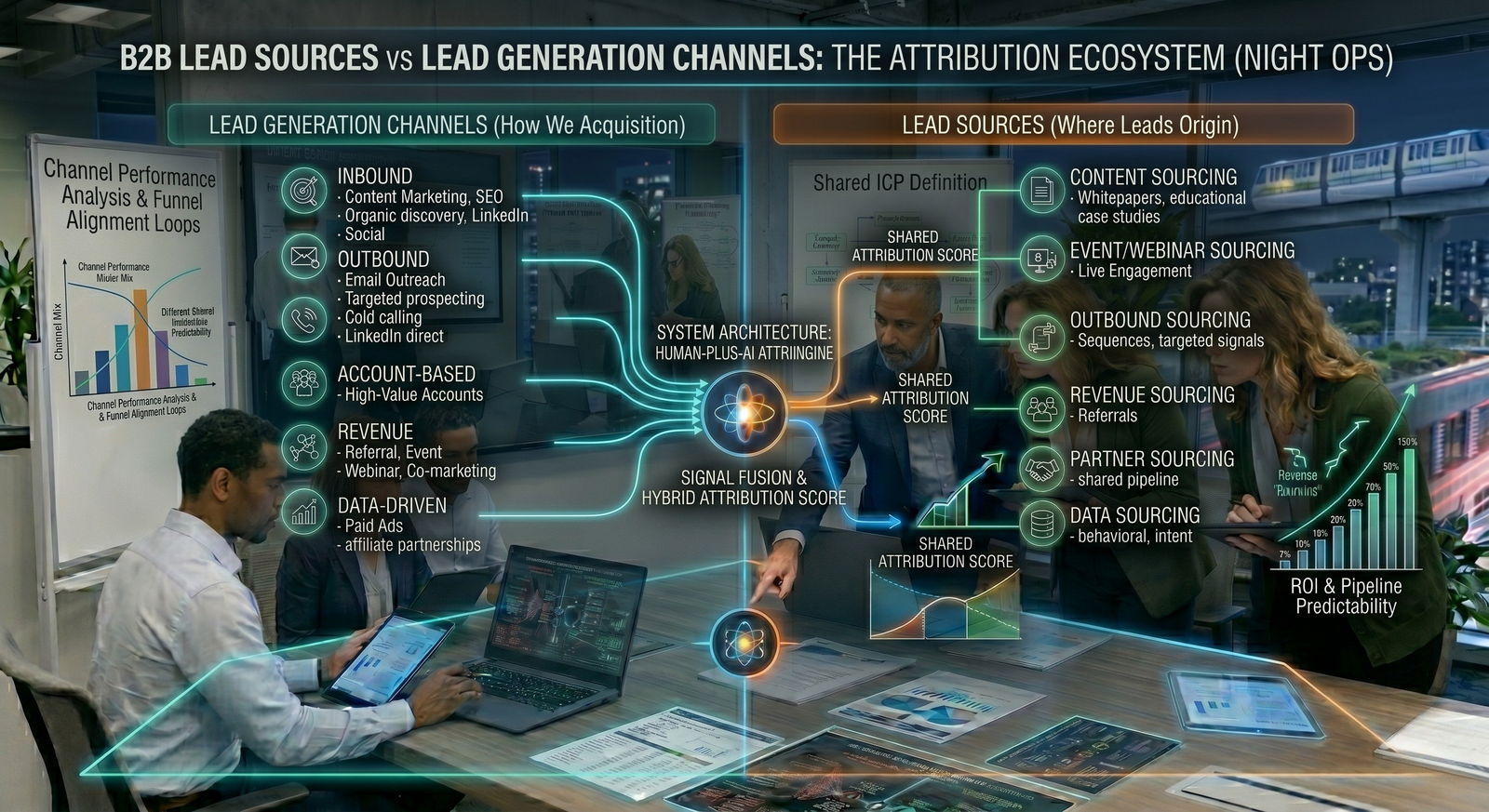
B2B Lead Sources vs Lead Generation Channels: What’s the Difference?
In B2B marketing and sales, the terms B2B Lead Sources and lead generation channels are often used interchangeably, but they actually describe two very different parts of the acquisition process. Understanding the distinction is essential if you want to improve attribution, optimize spend, and build a predictable pipeline.
Channels explain how you generate leads. Sources explain where those leads actually come from. When these two are mixed up, teams often misread performance data and end up scaling the wrong activities.
This article breaks down both concepts in detail and shows how they work together in a modern B2B growth system.
Understanding the Difference Between Lead Sources and Lead Generation Channels
The difference between sources and channels is subtle but critical. One focuses on distribution, while the other focuses on origin and attribution.
What B2B lead generation channels actually refer to in modern marketing
Lead generation channels are the systems or platforms used to attract and convert prospects. These include:
- SEO and organic search
- Paid advertising platforms
- Email outreach systems
- Social media platforms
- Events and webinars
Channels define the mechanism through which demand is captured or created.
Defining sources of B2B leads in a practical sales context
Lead sources refer to the actual origin point of a lead before they enter your CRM. For example:
- A prospect found you via Google search
- A referral from an existing customer
- A webinar registration
- A LinkedIn post interaction
Sources answer the question: Where did this specific lead come from?
Why the distinction matters for pipeline growth and attribution
Without separating sources and channels, teams often:
- Overvalue certain marketing activities
- Misattribute conversions
- Misallocate budget across channels
Clear separation improves visibility into what actually drives revenue.
How confusion between the two impacts marketing performance
When teams confuse sources with channels, reporting becomes misleading. For example, a paid ad may be the channel, but the true source could be a retargeted organic visitor who converted later.
This leads to incorrect optimization decisions and inefficient scaling.
B2B Lead Generation Channels Explained
Channels form the backbone of any scalable B2B lead generation strategy.
How B2B lead generation channels drive scalable acquisition
Channels allow businesses to consistently generate demand through repeatable systems. Once optimized, they become predictable engines for pipeline growth.
Mapping channel types across inbound and outbound strategies
Channels generally fall into two categories:
Inbound channels:
- SEO and content marketing
- Organic social media
- Webinars and events
Outbound channels:
- Cold email outreach
- LinkedIn prospecting
- Paid advertising targeting cold audiences
Each plays a different role in pipeline creation.
Channel selection based on buyer journey stage
Different channels perform better at different stages:
- Early stage: content and SEO
- Mid stage: webinars and remarketing
- Late stage: outbound and direct sales engagement
Matching channel to intent stage improves efficiency.
Why channels are the foundation of consistent lead flow
Without channels, there is no structured way to generate leads at scale. They are the infrastructure behind every modern B2B growth system.
Sources of B2B Leads and Where They Actually Come From
Sources focus on the true origin of leads, not just the system that delivered them.
Breaking down sources of B2B leads in real business environments
Common sources include:
- Organic search discovery
- Direct website visits
- Referral introductions
- Partner recommendations
- Event participation
These represent the real entry points into your funnel.
Direct vs indirect lead origin points in the funnel
Direct sources occur when a lead intentionally seeks you out, such as searching your brand name.
Indirect sources occur when a lead is influenced by multiple touchpoints before converting.
Understanding both is important for accurate attribution.
How attribution models identify lead sources
Modern attribution models use:
- First touch tracking
- Multi touch attribution
- Last touch attribution
Each model assigns credit differently depending on the customer journey.
Why source tracking is critical for ROI measurement
Without accurate source tracking, it becomes impossible to know which efforts are actually generating revenue. This leads to inefficient spending and unclear performance metrics.
Lead Acquisition Channels for Businesses Across the Funnel
Lead acquisition channels support growth at every stage of the buyer journey.
How lead acquisition channels for businesses support growth
These channels ensure a steady flow of leads by combining inbound attraction and outbound activation strategies.
Aligning channels with different stages of the funnel
- Top of funnel: SEO, content marketing
- Middle of funnel: email nurturing, webinars
- Bottom of funnel: sales outreach, demos
Balancing short term vs long term acquisition strategies
Outbound channels deliver short term results, while inbound channels build long term sustainability.
Optimizing channel mix for predictable pipeline
A balanced mix ensures consistent lead flow and reduces dependency on a single channel.
Inbound Lead Sources and Their Role in Demand Creation
Inbound sources attract high intent prospects organically.
How inbound lead sources attract high intent prospects
Inbound leads are typically self qualified because they actively search for solutions.
Content, SEO, and organic discovery as inbound engines
Key inbound drivers include:
- Blog content
- SEO optimized landing pages
- Educational resources
Why inbound leads often convert at higher rates
Because inbound leads initiate the interaction, they often have higher intent and stronger buying signals.
Scaling inbound without increasing acquisition cost
Once established, inbound systems scale efficiently without proportional cost increases.
Outbound Lead Sourcing Strategies for Proactive Growth
Outbound strategies allow companies to actively target ideal customers.
How outbound lead sourcing strategies generate predictable pipeline
Outbound provides control over who is contacted and when, making pipeline generation more predictable.
Cold outreach, sequencing, and targeted prospecting approaches
Common tactics include:
- Cold email campaigns
- LinkedIn outreach
- Account based prospecting sequences
Combining outbound with intent signals for higher efficiency
Using intent data improves targeting accuracy and response rates.
Challenges in scaling outbound lead generation
Key challenges include:
- Deliverability issues
- Personalization at scale
- Data accuracy limitations
Account Based Marketing Lead Sources for High Value Accounts
ABM focuses on quality over volume.
How account-based marketing lead sources focus on quality over volume
ABM targets specific accounts instead of broad audiences, increasing relevance.
Identifying target accounts through intent and firmographic data
Accounts are selected based on:
- Company size
- Industry
- Behavioral intent signals
Coordinating sales and marketing in ABM campaigns
Alignment ensures consistent messaging across touchpoints.
Increasing conversion rates through account level targeting
Targeting entire accounts improves deal size and win rates.
Referral Based Lead Generation as a Trust Driven Channel
How referral-based lead generation builds high trust pipelines
Referrals come pre-qualified through trust, making them highly valuable.
Leveraging existing customers for new opportunities
Happy customers become advocates for new business.
Why referral leads often have the highest conversion rates
Trust reduces friction in the buying process.
Systematizing referrals for scalable growth
Structured referral programs ensure consistent pipeline contribution.
Content Marketing Lead Sources for Long Term Demand
How content marketing lead sources generate inbound interest
Content educates and attracts prospects organically over time.
Educational content as a trust building mechanism
Helpful content builds authority and credibility.
Mapping content to buyer intent stages
Different content types match different stages of awareness.
Scaling organic visibility through consistent publishing
Consistency drives compounding traffic and lead flow.
LinkedIn B2B Lead Generation as a Social Channel
How LinkedIn B2B lead generation supports outbound and inbound strategies
LinkedIn combines content visibility with direct outreach.
Using content and direct outreach together
Posting builds awareness, while messaging drives conversion.
Building authority through social engagement
Engagement increases trust and visibility.
Converting professional networks into pipeline
Connections often turn into long term opportunities.
Email Outreach Lead Generation Channels for Direct Engagement
How email outreach lead generation channels support scalable outbound
Email remains one of the most scalable outbound channels.
Personalization and segmentation in cold email campaigns
Relevance improves response rates significantly.
Improving deliverability and response rates
Proper setup ensures messages reach inboxes.
Integrating email with intent based targeting
Intent signals improve timing and targeting accuracy.
Event and Webinar Lead Sources for High Intent Engagement
How event and webinar lead sources generate qualified prospects
Participants are already engaged and interested.
Capturing high intent leads through live engagement
Live participation signals strong interest.
Post event nurturing strategies for conversion
Follow up is essential to convert interest into pipeline.
Using events to accelerate trust and decision making
Events shorten the sales cycle significantly.
Paid Advertising for B2B Leads and Demand Capture
How paid advertising for B2B leads accelerates pipeline growth
Paid ads provide immediate visibility and traffic.
Targeting high intent audiences through paid channels
Advanced targeting improves lead quality.
Optimizing ad spend for lead quality
Not all clicks are equal, optimization matters.
Combining paid media with other channels for scale
Paid works best when combined with inbound and outbound.
Organic Search Lead Generation for Sustainable Growth
How organic search lead generation builds long term visibility
SEO drives consistent inbound traffic over time.
SEO driven traffic as a consistent lead source
Organic search is one of the most stable channels.
Ranking for intent driven keywords
Targeting high intent keywords improves conversions.
Reducing dependency on paid channels
Organic reduces long term acquisition costs.
Partner and Affiliate Lead Sources for Scalable Expansion
How partner and affiliate lead sources expand reach
Partners extend your market reach.
Leveraging ecosystems for shared pipeline growth
Mutual value drives collaboration.
Co marketing and referral partnerships
Joint campaigns amplify visibility.
Increasing efficiency through channel collaboration
Shared efforts reduce acquisition cost.
Data Driven Lead Sourcing Strategies for Modern B2B Teams
How data-driven lead sourcing strategies improve targeting accuracy
Data improves precision in targeting decisions.
Using intent, behavioral, and firmographic data together
Combined data provides full context.
Building unified lead sourcing systems across channels
Integration improves consistency.
Improving ROI through smarter attribution
Better data leads to better investment decisions.
Why Understanding the Difference Improves Lead Generation Performance
Better attribution between source and channel
Clear separation improves reporting accuracy.
Smarter budget allocation across acquisition strategies
Teams invest where results are strongest.
Improved forecasting and pipeline predictability
Reliable data improves planning.
Stronger alignment between sales and marketing efforts
Shared understanding improves collaboration.
Final Thoughts
Understanding B2B Lead Sources versus lead generation channels is essential for building a predictable and scalable revenue engine. Channels define how leads are generated, while sources explain where they originate. When both are tracked correctly, businesses gain clearer attribution, better ROI visibility, and stronger alignment between sales and marketing.
In modern B2B growth systems, success comes from mastering both sides of the equation and using them together to drive consistent pipeline performance.
Find what you’re reading informative so far? Then why not read more by visiting our blog? We keep you up-to-date every week with how-to guides and strategies to B2B lead generation every single week! Click here to get started!