

Intent Based Targeting vs Demographic Targeting
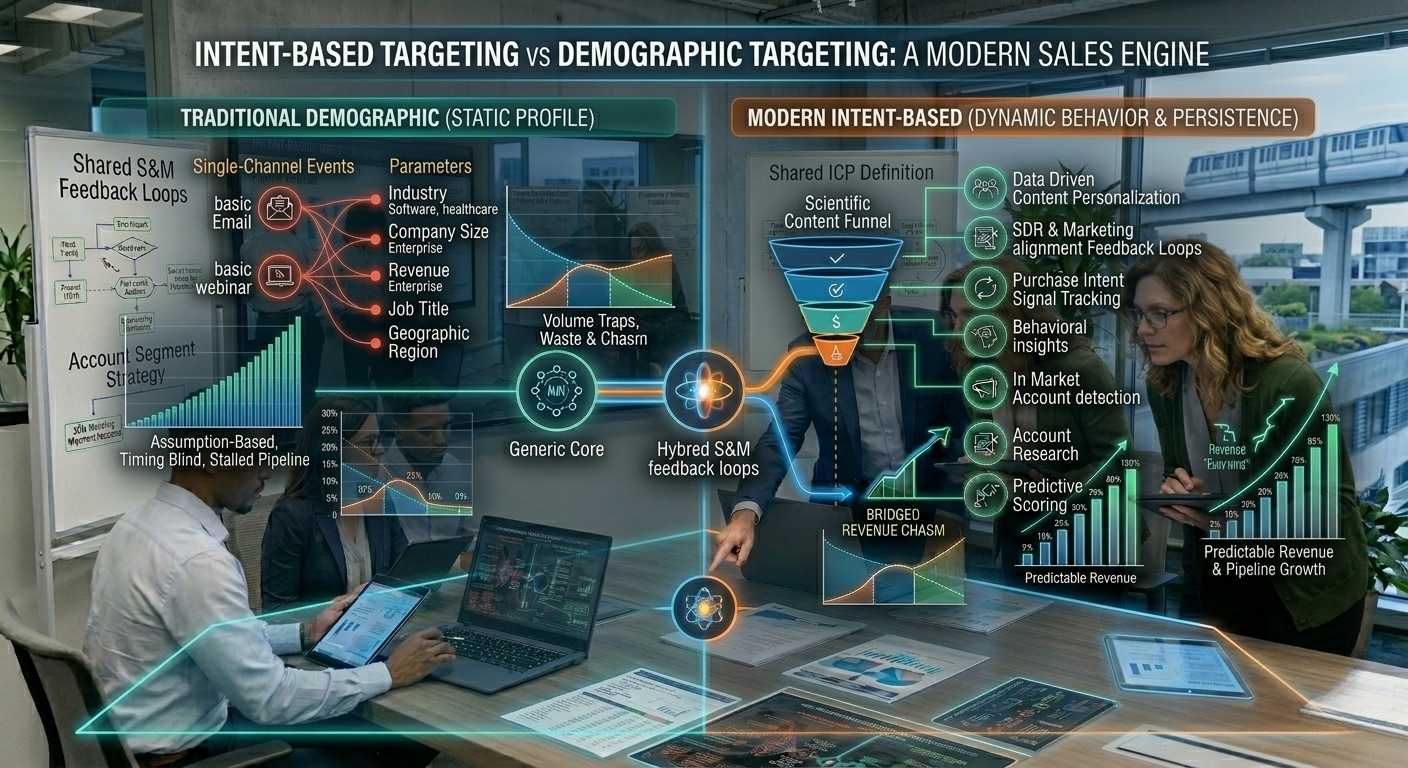
In modern B2B sales and marketing, targeting has evolved far beyond static audience definitions. Traditional demographic targeting once formed the backbone of prospecting strategies, focusing on firmographics like industry, company size, or job title. While still useful, it no longer reflects how real buying decisions happen.
Today, buyers reveal their intent through behavior long before they ever match a “perfect demographic profile.” This shift has made intent-based targeting a more powerful approach for identifying active opportunities, improving conversion rates, and reducing wasted outreach.
This article breaks down how intent based targeting compares with demographic targeting across key areas of B2B sales and marketing.
Understanding the Core Difference Between Intent and Demographic Targeting
At the core, these two approaches answer very different questions. Demographic targeting focuses on who the buyer is, while intent based targeting focuses on what the buyer is doing right now.
Why an intent-based targeting strategy focuses on behavior, not static attributes
Intent-based targeting relies on real-time actions such as:
- Content consumption patterns
- Website visits
- Search behavior
- Engagement with pricing or product pages
These signals reveal active interest, not just potential fit.
How demographic targeting relies on fixed audience characteristics
Demographic targeting uses static filters such as:
- Industry type
- Company size
- Location
- Job title
While helpful for segmentation, these attributes do not indicate buying readiness.
Shifting from “who they are” to “what they are doing”
Modern sales strategies prioritize behavioral signals over identity-based assumptions. This shift improves timing and relevance in outreach.
Why modern B2B sales prioritizes intent over demographics
Intent signals help sales teams focus on accounts already in motion, reducing time spent on cold or inactive prospects.
B2B Buyer Intent Data Targeting vs Traditional Demographics
How B2B buyer intent data targeting identifies active buyers
Intent data highlights accounts that are actively researching solutions, allowing teams to prioritize outreach effectively.
Key signals include:
- Repeat website visits
- Competitor research activity
- Product comparison behavior
Limitations of demographic only targeting in B2B sales
Demographic targeting often leads to:
- Broad, unfocused outreach
- Low engagement rates
- High acquisition costs
Because it does not reflect real-time interest, timing is often off.
Using behavioral signals instead of surface level attributes
Behavioral targeting adds depth by showing intent strength, not just profile fit.
Improving accuracy through intent driven insights
Combining multiple behavioral signals significantly improves targeting precision and reduces wasted outreach.
High Intent Account Targeting Compared to Static Segments
How high-intent account targeting improves conversion potential
High intent accounts are already in the consideration phase, making them more likely to convert.
Why demographic segments miss buying readiness signals
A perfect demographic fit may still show no purchase intent, leading to inefficient targeting.
Prioritizing accounts showing active purchase behavior
High intent indicators include:
- Pricing page visits
- Demo requests
- Multiple stakeholder engagement
Reducing wasted outreach with intent based focus
Focusing on active accounts helps sales teams avoid chasing cold or unqualified leads.
Predictive Audience Targeting vs Demographic Assumptions
How predictive audience targeting forecasts buyer behavior
Predictive models analyze historical and behavioral data to identify likely future buyers.
Limitations of static demographic profiles
Demographic assumptions cannot account for:
- Timing
- Market shifts
- Behavioral changes
Using behavioral patterns to predict future buyers
Patterns such as repeated research behavior can indicate future purchase likelihood.
Increasing efficiency with data driven predictions
Predictive targeting helps prioritize accounts before competitors engage.
Intent Driven Account Based Marketing (ABM) vs Traditional Targeting
How intent-driven account-based marketing (ABM) improves precision
Intent-driven ABM focuses campaigns only on accounts showing real buying signals.
Moving from firmographic lists to intent enriched accounts
Instead of static lists, teams use dynamic accounts enriched with behavioral insights.
Aligning ABM campaigns with real buyer activity
Messaging becomes more relevant when aligned with actual research behavior.
Increasing ROI through behavior driven personalization
Intent signals enable deeper personalization, increasing engagement and conversion rates.
In Market Buyer Identification vs Demographic Filtering
How in-market buyer identification detects active purchase intent
In-market accounts are actively researching and evaluating solutions.
Why demographics cannot reveal buying timing
Demographics cannot answer when a buyer is ready to purchase.
Identifying accounts already in decision mode
Intent signals help identify accounts that are close to making a decision.
Improving speed to opportunity with intent signals
Faster identification leads to faster outreach and higher win rates.
Behavioral Targeting for B2B Sales vs Static Audience Targeting
How behavioral targeting for B2B sales tracks real engagement
Behavioral targeting monitors:
- Page visits
- Content engagement
- Email interactions
Understanding buyer journeys through digital actions
These actions reveal how far a buyer is in the decision-making process.
Why behavior is a stronger indicator than demographics
Behavior reflects real-time interest, while demographics remain static.
Turning engagement into actionable outreach
Sales teams can trigger outreach based on meaningful engagement patterns.
Purchase Intent Signal Targeting vs Broad Segmentation
How purchase intent signal targeting identifies ready buyers
Intent signals such as pricing page visits or demo requests indicate strong buying readiness.
Detecting signals that demographics miss completely
Demographics cannot detect urgency or timing, but intent signals can.
Prioritizing accounts based on intent strength
Accounts are ranked based on intensity and frequency of engagement.
Increasing conversion rates through timing precision
Reaching buyers at the right moment significantly improves conversion outcomes.
Data Driven Prospect Targeting vs Demographic Guesswork
How data-driven prospect targeting improves accuracy
Data-driven targeting reduces guesswork by relying on real behavioral insights.
Combining intent, behavioral, and firmographic data
The strongest systems integrate all three layers for full visibility.
Reducing inefficiency in outbound targeting
Better targeting reduces wasted outreach and improves sales productivity.
Building scalable targeting systems based on real data
This creates repeatable and scalable revenue generation systems.
Real Time Intent Signal Tracking vs Static Audience Lists
How real-time intent signal tracking captures live buyer behavior
Real-time tracking allows teams to act as soon as interest emerges.
Why demographic lists become outdated quickly
Static lists do not reflect changing buyer behavior or priorities.
Acting on signals as they happen
Speed is critical in capturing high intent opportunities.
Gaining competitive advantage through speed
Early engagement often determines which vendor wins the deal.
Sales Intelligence Targeting Methods vs Traditional Segmentation
How sales intelligence targeting methods improve decision making
Sales intelligence integrates multiple data sources for deeper insight.
Integrating multiple behavioral and intent sources
This creates a unified view of buyer activity.
Moving beyond static segmentation models
Static segmentation fails to reflect real-time buyer behavior.
Improving targeting precision with intelligence tools
Modern tools help refine targeting with greater accuracy.
Lead Prioritization Using Intent Data vs Demographic Ranking
How lead prioritization using intent data improves efficiency
Intent-based prioritization ensures teams focus on the most promising accounts.
Ranking prospects based on engagement and intent
Leads are scored based on behavioral intensity.
Reducing focus on low value demographic matches
This prevents wasted effort on unqualified leads.
Increasing pipeline quality through smarter prioritization
Higher quality leads lead to better conversion rates.
Hyper Targeted Outbound Campaigns vs Demographic-Based Outreach
How hyper-targeted outbound campaigns outperform generic messaging
Intent-based outreach is more relevant and timely than demographic messaging.
Using intent signals for personalized outreach
Messages are tailored based on actual buyer behavior.
Why demographic targeting leads to lower engagement
Generic messaging often fails to resonate with real buyer needs.
Increasing response rates through relevance
Relevant messaging significantly improves engagement.
Intent Segmentation for Marketing Campaigns vs Static Segments
How intent segmentation for marketing campaigns improves precision
Intent segmentation groups audiences based on real behavior, not assumptions.
Grouping audiences based on behavior and intent stage
This allows more relevant messaging at each stage.
Dynamic segmentation vs fixed demographic lists
Dynamic segments update as behavior changes.
Aligning messaging with buyer readiness
This improves campaign effectiveness significantly.
Conversion Focused Targeting Strategy vs Demographic Targeting
How conversion-focused targeting strategy improves ROI
Intent-based strategies focus only on accounts likely to convert.
Why intent signals outperform demographic assumptions
Behavior is a stronger predictor of conversion than static attributes.
Aligning targeting with actual buying behavior
This ensures outreach matches buyer readiness.
Driving higher conversion rates with intent based systems
Better alignment leads to stronger revenue outcomes.
Why Intent Based Targeting Wins in Modern B2B Sales
Intent based targeting consistently outperforms demographic approaches because it reflects real buyer behavior, not assumptions.
Key advantages include:
- Better timing through real signals
- Higher conversion rates
- Reduced wasted outreach
- Stronger sales and marketing alignment
Final Thoughts
Demographic targeting still has a role in defining audiences, but it is no longer sufficient on its own. Modern B2B success depends on understanding intent, behavior, and timing.
Companies that combine these elements move beyond guesswork and build systems that consistently identify and convert real buyers.
Find what you’re reading informative so far? Then why not read more by visiting our blog? We keep you up-to-date every week with how-to guides and strategies to B2B lead generation every single week! Click here to get started!