

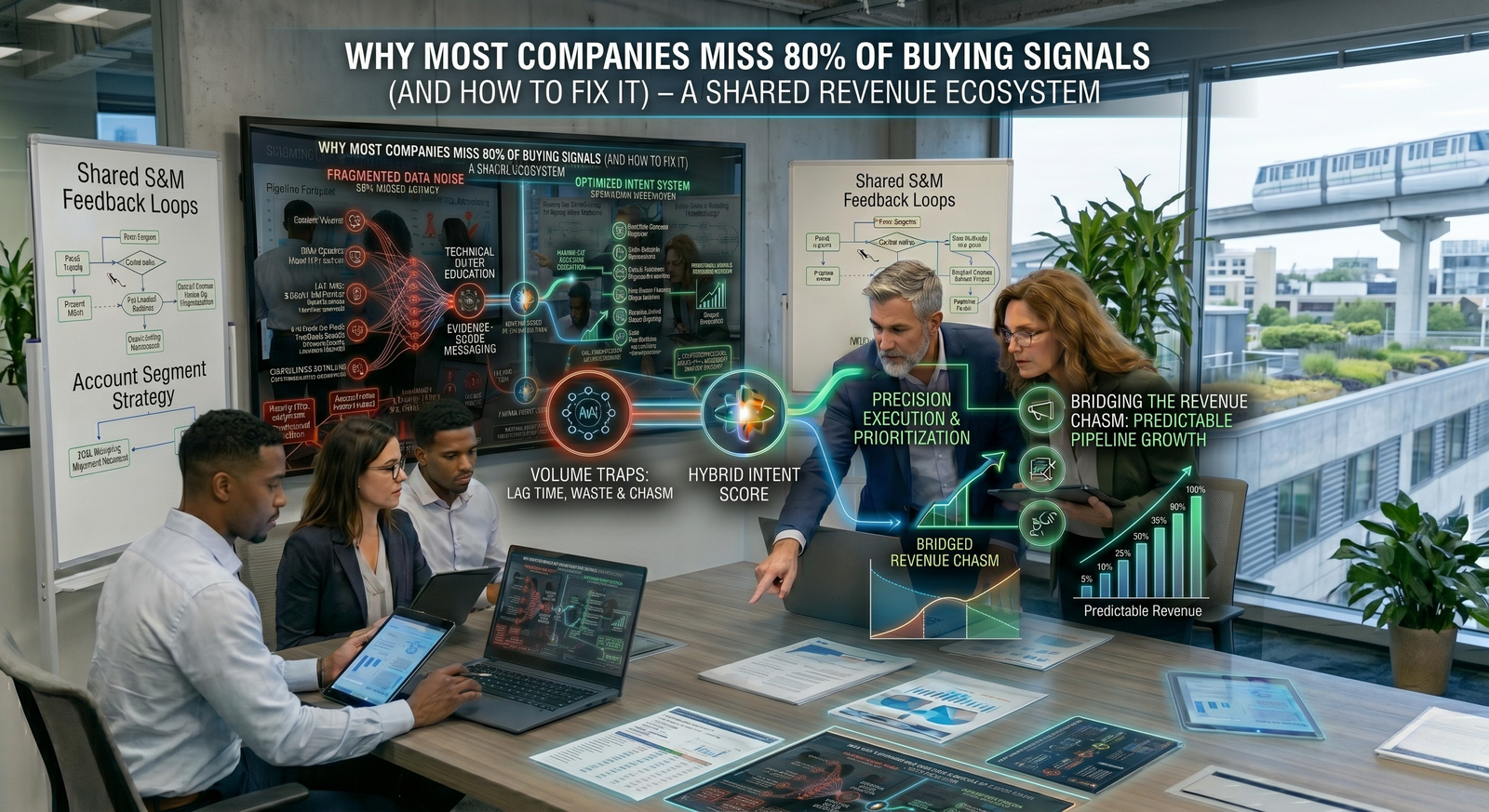
Why Intent Based Targeting Doesn’t Work Without the Right Strategy
Intent based targeting has become one of the most widely adopted approaches in modern B2B sales and marketing. The idea is simple: identify signals that indicate buying interest and focus outreach on those accounts. In practice, however, many teams fail to see meaningful results.
The problem is not the data itself. It is the lack of structure, alignment, and strategy behind how that data is used. Without a clear system, intent signals become noise instead of direction, leading to wasted outreach, inconsistent prioritization, and missed opportunities.
This article breaks down why intent based targeting fails without strategy and what needs to change to make it effective.
The Problem With Intent Based Targeting Without Strategy
Intent based targeting only works when it is guided by clear rules, definitions, and execution systems. Without that foundation, teams end up reacting to signals rather than using them strategically.
At a high level, failure usually comes from a combination of weak interpretation and disconnected execution.
Why an intent-based targeting strategy is essential for consistent results
A structured strategy ensures that everyone interprets signals the same way. Without it, one team may treat content downloads as strong intent, while another ignores them completely.
Consistency is what turns raw data into usable decision making.
Common misconceptions about intent data and automation
Many teams assume intent data will automatically generate high quality leads. In reality, intent data only shows behavior, not meaning. Interpretation still requires strategy.
Why tools alone cannot replace strategic thinking
Tools can surface activity, but they cannot decide what matters. Without human defined rules, prioritization becomes random.
The gap between data availability and execution quality
Most companies already have enough data. The real issue is not access, but how effectively that data is turned into action.
Weaknesses in B2B Buyer Intent Data Targeting Without Structure
When intent data is used without structure, targeting becomes inconsistent and unreliable.
How poor B2B buyer intent data targeting leads to inaccurate decisions
Without clear filtering rules, teams often chase the wrong accounts. This leads to:
- Misaligned outreach
- Low conversion rates
- Wasted sales effort
Using intent data without context or prioritization
A single website visit means very little without understanding:
- Buyer stage
- Role in decision making
- Historical engagement
Fragmented data causing inconsistent targeting outcomes
When data is spread across multiple platforms, no single source provides a complete picture of intent.
Misalignment between marketing and sales execution
Marketing may score an account as “hot,” while sales sees no reason to engage. This disconnect reduces trust in the system.
High Intent Account Targeting Without a Clear Framework
High intent accounts are valuable, but only when properly defined and prioritized.
Why high-intent account targeting fails without prioritization logic
Without scoring rules, every “signal” looks important, which removes any real sense of priority.
Confusing engagement signals with real buying intent
Not all engagement indicates readiness. For example:
- Blog reads = awareness
- Pricing page visits = stronger intent
Missing account level context in targeting decisions
Intent is rarely individual. Most B2B purchases involve multiple stakeholders.
Poor qualification of revenue ready accounts
Without validation, teams waste time on accounts that are still in early research stages.
Predictive Audience Targeting Without Strategic Direction
Predictive models can be powerful, but they must be guided by real-world validation.
How predictive audience targeting becomes unreliable without validation
If predictions are not continuously tested against actual outcomes, accuracy declines over time.
Overdependence on models without human oversight
Models can identify patterns, but they cannot understand business context or shifting market dynamics.
Ignoring real time behavioral changes in audiences
Buyer intent can shift quickly. Static predictions often miss these changes.
Lack of alignment between predictions and sales goals
If predictive models are not tied to revenue outcomes, they lose practical value.
Intent Driven Account Based Marketing (ABM) Without Alignment
ABM depends heavily on coordination between teams and data interpretation.
Why intent-driven account-based marketing (ABM) fails without coordination
When teams operate in silos, intent signals are used inconsistently, reducing campaign effectiveness.
Poor integration between sales and marketing teams
Without shared definitions of intent, ABM becomes fragmented and inefficient.
Targeting accounts without validated intent signals
This leads to campaigns being sent to accounts with no real buying activity.
Weak personalization despite access to intent data
Even with data available, messaging often remains generic and misses real buyer context.
In Market Buyer Identification Without Precision
Identifying in-market buyers requires strong filtering and timing.
How in-market buyer identification becomes ineffective without strategy
Without clear rules, early research activity is often mistaken for purchase readiness.
Misinterpreting early research as buying readiness
Downloading educational content does not always mean the buyer is ready to purchase.
Missing true in market accounts due to poor filtering
Over-filtering can also cause real opportunities to be ignored.
Delayed response to real buyer activity
Slow reaction time often results in losing deals to faster competitors.
Behavioral Targeting for B2B Sales Without Context
Behavioral signals are only useful when interpreted within context.
Why behavioral targeting for B2B sales needs structured interpretation
Without segmentation, behavior becomes noise instead of insight.
Overvaluing low intent engagement signals
Minor actions like page views are often treated as strong intent, which skews prioritization.
Ignoring multi touch behavioral journeys
Buyers rarely convert from a single interaction. Most journeys span multiple channels.
Lack of segmentation across buyer stages
Different behaviors should map to different funnel stages, but many systems fail to do this.
Purchase Intent Signal Targeting Without Prioritization
Not all intent signals are equal, and treating them as such reduces accuracy.
How purchase intent signal targeting loses accuracy without weighting
Without weighting, every signal contributes equally, even when their meaning differs.
Treating all signals equally regardless of strength
A pricing page visit should not carry the same weight as a blog read.
Misreading content engagement as purchase intent
Content consumption often reflects research, not readiness.
Poor timing in outreach execution
Even correct signals lose value if outreach happens too early or too late.
Data Driven Prospect Targeting Without Alignment
Data becomes ineffective when systems are disconnected.
Why data-driven prospect targeting fails without unified systems
Fragmented tools create fragmented insights, leading to inconsistent decisions.
Using incomplete or disconnected datasets
No single dataset captures the full buyer journey.
Lack of alignment between marketing and sales data
When teams rely on different systems, prioritization breaks down.
Weak integration of insights into workflows
Even strong insights fail if they are not embedded into daily sales processes.
Real Time Intent Signal Tracking Without Actionability
Speed matters, but only when action systems exist.
How real-time intent signal tracking fails without response systems
Collecting real-time data is useless if there is no process for acting on it.
Collecting signals but not acting on them
Many teams track intent but fail to operationalize it.
Slow reaction to in market behavior
Delayed outreach significantly reduces conversion probability.
Missing competitive opportunities due to delays
Competitors who act faster often win the deal.
Sales Intelligence Targeting Methods Without Strategy
Sales intelligence is only useful when simplified into actionable workflows.
Why sales intelligence targeting methods lose effectiveness without structure
Too much data without clear rules leads to confusion rather than clarity.
Overcomplicated data without actionable insights
Teams often struggle to translate intelligence into next steps.
Lack of clear decision frameworks
Without rules, prioritization becomes subjective.
Poor integration into outbound workflows
Insights must be embedded directly into outreach systems to be effective.
Lead Prioritization Using Intent Data Without Rules
Prioritization only works when consistent logic is applied.
How lead prioritization using intent data breaks down without scoring logic
Without scoring, teams cannot agree on which leads matter most.
Inconsistent prioritization across teams
Different interpretations lead to different actions.
Misalignment between intent signals and sales actions
Strong signals may not lead to immediate outreach.
Inefficient pipeline focus
Time gets wasted on low value opportunities.
Hyper Targeted Outbound Campaigns Without Strategy
Targeting alone is not enough without timing and relevance.
Why hyper-targeted outbound campaigns fail without intent alignment
Even personalized campaigns fail if they target the wrong stage of intent.
Over personalization without relevance
Messages can become overly specific but still irrelevant.
Poor segmentation of audiences
Without proper grouping, messaging loses focus.
Missing timing alignment with buyer readiness
Outreach too early or too late reduces effectiveness.
Intent Segmentation for Marketing Campaigns Without Clarity
Segmentation must reflect real buyer behavior.
How intent segmentation for marketing campaigns becomes ineffective
Unclear segmentation leads to overlapping audiences and diluted messaging.
Overlapping or inconsistent segmentation rules
When rules are unclear, audiences become misclassified.
Ignoring dynamic buyer intent changes
Segments must evolve as buyer behavior changes.
Lack of coordination with sales priorities
Marketing segmentation must align with sales goals to be effective.
Conversion Focused Targeting Strategy Without Execution Discipline
Strategy without execution discipline leads to inconsistent outcomes.
Why conversion-focused targeting strategy fails without structure
Without discipline, teams focus only on short term wins.
Short term focus over long term pipeline health
This reduces sustainable revenue growth.
Poor alignment with revenue goals
Targeting must reflect broader business objectives.
Lack of continuous optimization
Without iteration, targeting systems quickly become outdated.
How to Build a Strong Intent Based Targeting Strategy
Fixing these issues requires structure, alignment, and continuous refinement.
Key steps include:
- Aligning sales and marketing on intent definitions
- Building structured scoring and prioritization systems
- Combining real time signals with predictive insights
- Creating clear execution workflows for action
- Continuously validating performance against outcomes
When these elements are in place, intent based targeting becomes a predictable and scalable revenue driver instead of a noisy data exercise.
Final Thoughts
Intent based targeting fails not because the concept is weak, but because it is often applied without structure. Data alone does not create results. Strategy, alignment, and execution discipline are what turn intent into revenue.
Companies that invest in these foundations gain a major advantage: clearer prioritization, faster response times, and more predictable pipeline growth.
Find what you’re reading informative so far? Then why not read more by visiting our blog? We keep you up-to-date every week with how-to guides and strategies to B2B lead generation every single week! Click here to get started!