

Buying Signals vs Intent Signals: What’s the Difference?
In modern B2B sales, knowing when to engage a prospect is often more important than how many prospects you have. This is where the ability to identify buying signals and interpret intent signals becomes critical. While both concepts are closely related, they serve different roles in understanding buyer behavior.
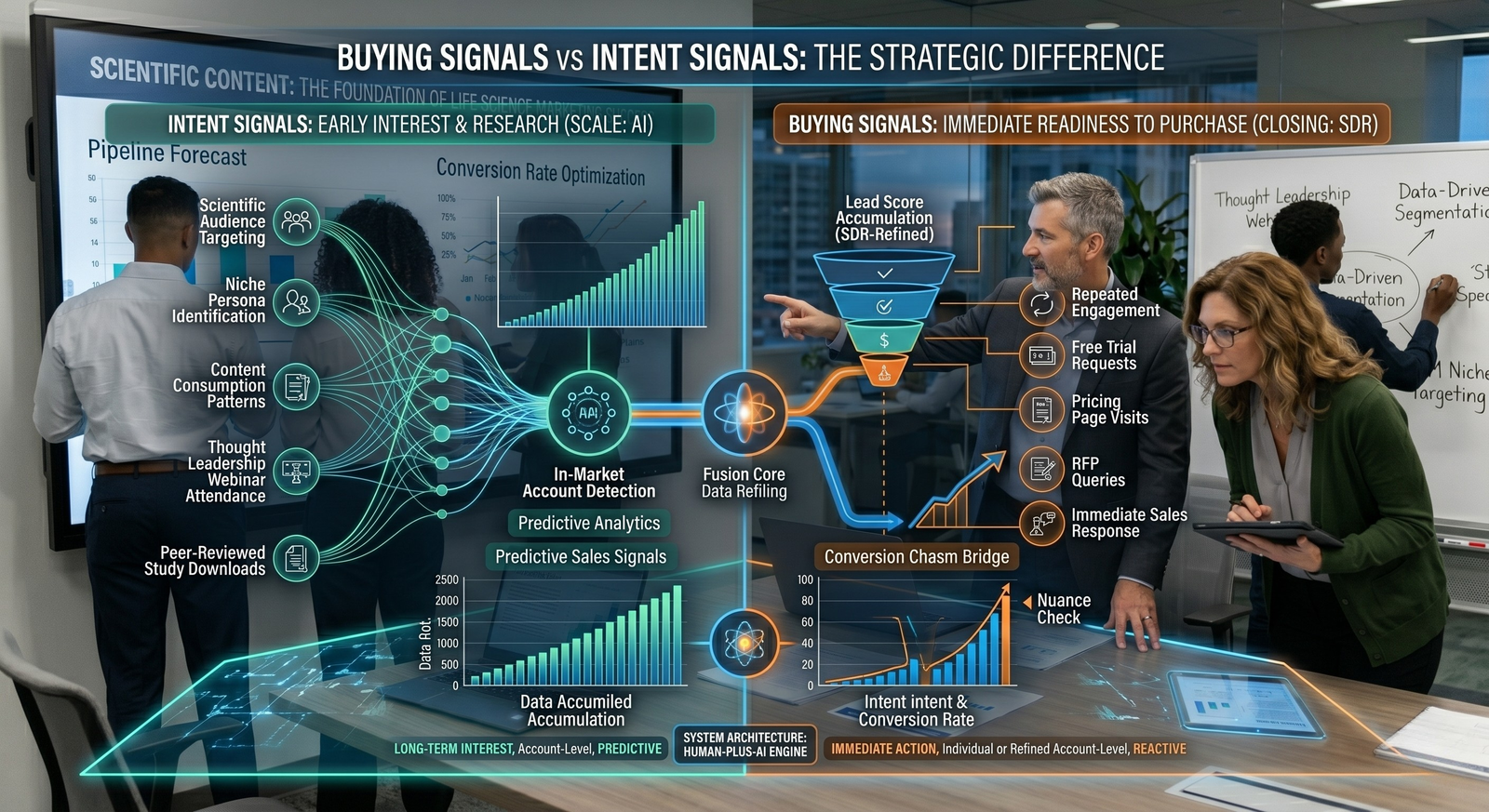
Buying signals indicate immediate readiness to purchase, while intent signals reveal early interest and research behavior. Sales teams that understand the difference between the two can prioritize better, engage at the right time, and improve conversion rates significantly.
Understanding Buying Signals and Intent Signals in Modern B2B Sales
How B2B buyer behavior tracking reveals both intent and buying readiness
Modern B2B buyer behavior tracking captures a wide range of digital actions, from website visits to content downloads, that help teams identify both early curiosity and late stage readiness.
Why distinguishing between signals improves sales efficiency
Without separation between signal types, sales teams risk chasing low value leads or missing high intent opportunities.
The role of timing in interpreting engagement data
The same behavior can mean different things depending on timing. A second visit to a pricing page may indicate urgency, while an early visit may signal research.
From passive interest to active purchase readiness
Buyer journeys evolve from exploration to evaluation to decision making, and signals reflect that progression.
What Are Buying Signals in B2B Sales?
How buying signal detection in B2B sales identifies immediate opportunities
Buying signals represent behaviors that strongly indicate a prospect is close to making a purchase decision. Learning to identify buying signals helps sales teams focus on high probability deals.
Common purchase intent indicators in real buyer journeys
Examples include requesting demos, visiting pricing pages multiple times, or engaging with sales representatives.
Examples of strong vs weak buying signals
Strong signals include contract inquiries or implementation questions, while weak signals include general content downloads or blog visits.
How sales teams respond to high urgency behavior
When strong signals appear, sales teams prioritize immediate outreach to maximize conversion chances.
Sales Intent Signals Identification and Early Stage Interest
How sales intent signals identification captures early engagement
sales intent signals identification helps detect early stage interest before a prospect is ready to buy.
Understanding research phase behavior in prospects
Prospects often explore educational content before showing purchase intent.
Differentiating curiosity from purchase readiness
Not all engagement indicates buying intent. Some users are simply gathering information.
Using intent signals for early pipeline development
Intent data helps fill the top of the pipeline with qualified prospects early.
Purchase Intent Indicators vs Broader Engagement Signals
What purchase intent indicators actually reveal about readiness
purchase intent indicators show how close a prospect is to making a decision.
The difference between exploration and decision making behavior
Exploration signals are informational, while decision signals show urgency.
Mapping engagement depth to intent strength
Deeper engagement typically signals stronger intent.
Why not all activity signals equal buying intent
A single website visit does not necessarily indicate purchase readiness.
High Intent Prospect Recognition in Sales Pipelines
How high-intent prospect recognition improves conversion efficiency
Recognizing high intent prospects allows teams to prioritize effectively.
Behavioral patterns that indicate strong buying readiness
Repeated visits, product comparisons, and pricing interest are strong indicators.
Prioritizing accounts showing repeated engagement
Repeated activity often signals serious consideration.
Reducing wasted outreach through intent filtering
Filtering ensures sales teams focus on the most valuable leads.
Account Based Buying Signals in Enterprise Sales
How account-based buying signals differ from individual signals
Account level signals reflect collective interest across multiple stakeholders.
Identifying group level interest across stakeholders
Enterprise deals involve multiple decision makers interacting with content.
Tracking engagement across departments and roles
Different stakeholders contribute different types of signals.
Using account signals for ABM prioritization
Accounts with multiple engaged users are prioritized in ABM strategies.
Lead Scoring Based on Behavior and Engagement Depth
How lead scoring based on behavior improves qualification accuracy
Behavioral scoring helps quantify intent more accurately.
Weighting different engagement types effectively
Not all actions should carry equal weight in scoring models.
Combining demographic and behavioral signals
Firmographic and behavioral data together improve accuracy.
Reducing false positives in lead qualification
Better scoring reduces misclassification of low quality leads.
Real Time Buyer Intent Data and Predictive Insights
How real-time buyer intent data improves sales responsiveness
Real time insights allow sales teams to act quickly on emerging opportunities.
Predictive sales analytics signals in modern pipelines
Predictive models help identify accounts likely to convert.
Detecting in-market accounts early
Early detection gives teams a competitive advantage.
Turning signals into immediate outreach actions
Signals must be operationalized into timely engagement.
Sales Opportunity Qualification Signals in Complex Deals
How sales opportunity qualification signals define true pipeline value
Qualification signals help separate real opportunities from noise.
Separating active opportunities from passive interest
Only active engagement should move into the sales pipeline.
Using multi touch data to confirm intent
Multiple interactions provide stronger validation.
Improving forecast accuracy through signal validation
Validated signals improve revenue forecasting reliability.
Website Engagement Tracking for Leads and Behavioral Insights
How website engagement tracking for leads reveals intent depth
Website behavior is one of the strongest sources of intent data.
Pages that indicate strong buying interest
Pricing, demo, and product pages often indicate high intent.
Time on site and repeat visits as signals
Longer and repeated visits suggest stronger interest.
Linking web behavior to sales readiness
Web engagement helps determine readiness stage.
Email Engagement Signals in Sales Outreach
How email engagement signals in sales reflect buyer interest
Email behavior provides direct insight into engagement.
Open rates, replies, and click behavior interpretation
Replies signal higher intent than opens or clicks.
Differentiating curiosity from decision intent
Clicking educational content differs from requesting a meeting.
Using email data for timing follow ups
Engagement data helps optimize outreach timing.
Content Consumption Patterns for Buyers and Intent Strength
How content consumption patterns for buyers indicate research stage
Content behavior reveals how deeply a buyer is researching.
Identifying high value content engagement paths
Case studies and technical guides indicate stronger interest.
Mapping educational behavior to sales readiness
Content progression often reflects buying journey stage.
Using content data for personalization
Content insights help tailor messaging.
In Market Account Detection and Sales Prioritization
How in-market account detection identifies active buyers early
In-market detection helps identify accounts actively researching solutions.
Signals that indicate readiness to purchase
Multiple high intent interactions suggest purchase readiness.
Prioritizing accounts before competitors engage
Early detection creates competitive advantage.
Improving win rates through timing advantage
Engaging earlier increases conversion probability.
Intent Driven Prospect Prioritization for Sales Efficiency
How intent-driven prospect prioritization improves pipeline focus
Prioritization ensures sales teams focus on high value prospects.
Aligning outreach with strongest behavioral signals
Messaging is more effective when aligned with intent.
Reducing wasted sales effort on low intent leads
Sales teams spend less time on unqualified prospects.
Increasing conversion rates through smarter targeting
Better prioritization leads to higher efficiency.
Key Differences Between Buying Signals and Intent Signals
Immediate action vs long term interest signals
Buying signals indicate immediate readiness, while intent signals show ongoing interest.
Account level vs individual level interpretation
Intent can be individual or account wide, depending on data source.
Reactive vs predictive use cases in sales
Buying signals are reactive, intent signals are predictive.
How both work together in modern revenue systems
Both signal types complement each other in full funnel strategy.
Why Both Signal Types Matter for Modern B2B Sales Teams
Combining intent and buying signals for full funnel visibility
Together they provide a complete view of buyer behavior.
Improving sales timing and conversion rates
Better timing leads to higher conversion rates.
Building smarter qualification frameworks
Signal based qualification improves accuracy.
Turning signal data into predictable revenue growth
Consistent use of signals drives more predictable pipeline outcomes.
Final Thoughts
The ability to identify buying signals and interpret intent signals is essential for modern B2B sales success. While intent signals help teams understand early interest, buying signals reveal when a prospect is ready to act.
Sales organizations that effectively combine both approaches gain stronger pipeline visibility, better timing, and higher conversion rates. In a competitive environment, understanding these differences is not optional, it is a core driver of revenue efficiency.
Find what you’re reading informative so far? Then why not read more by visiting our blog? We keep you up-to-date every week with how-to guides and strategies to B2B lead generation every single week! Click here to get started!