

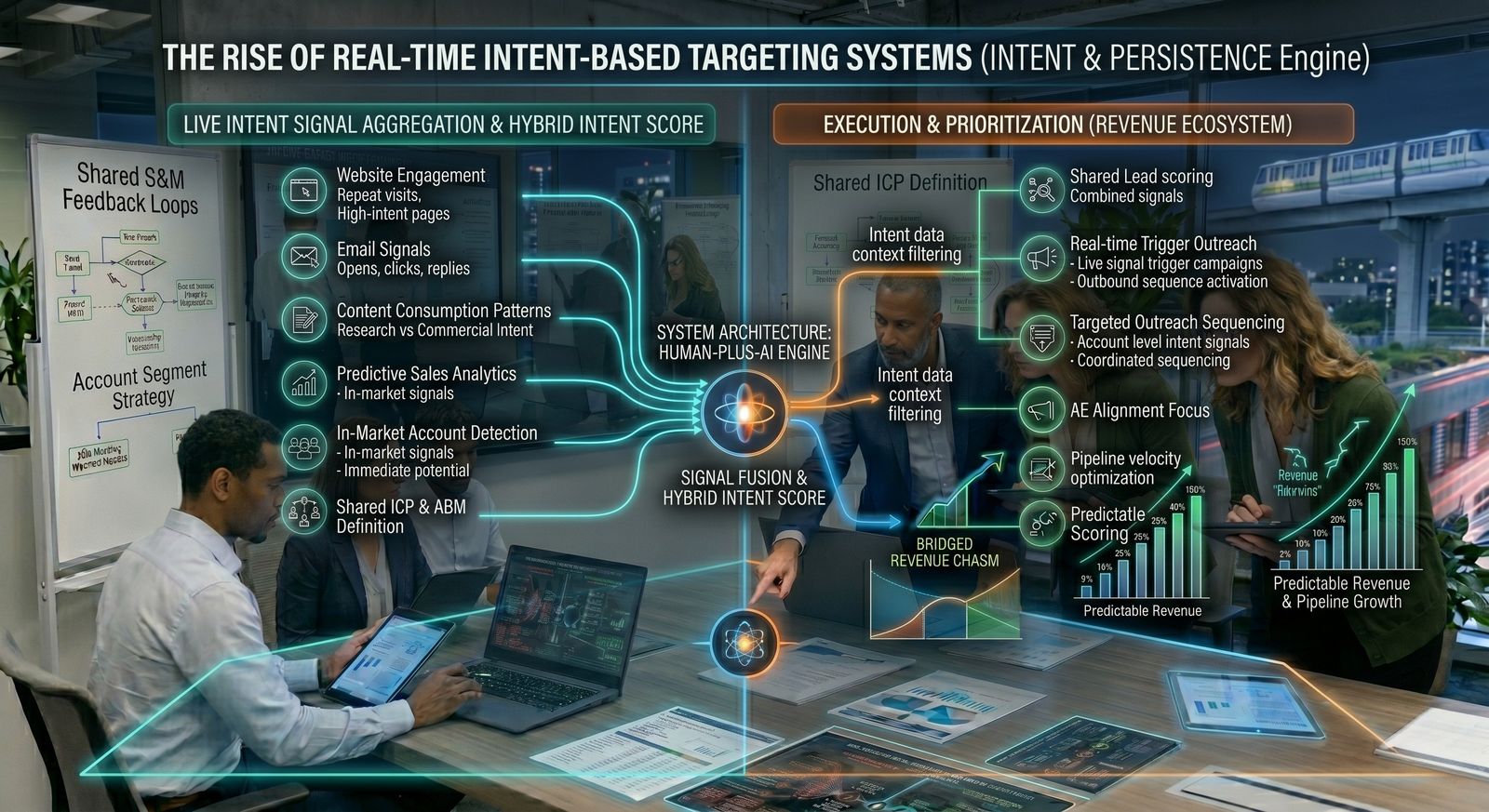
The Rise of Real-Time Intent Based Targeting Systems
In modern B2B sales, the ability to reach the right buyer at the right moment has become more important than ever. Traditional targeting methods that rely on static lists or outdated firmographic filters are no longer enough to keep up with how quickly buyer behavior changes. This is where intent-based targeting is reshaping the entire approach to prospecting, account based marketing, and revenue generation.
Instead of guessing who might be interested, real time systems now help teams understand who is actively researching, comparing, or preparing to buy. This shift is not just technological, it is structural. It changes how sales and marketing teams prioritize accounts, allocate resources, and design outreach strategies.
The result is a more dynamic, responsive, and accurate way to identify in market buyers before competitors do.
Why Real Time Intent Based Targeting Is Transforming B2B Sales
Real time intent based targeting is changing how revenue teams operate because it replaces assumptions with live behavioral insight. Instead of relying on outdated segments, teams now respond to what buyers are doing right now.
How an intent-based targeting strategy evolves with real time data
An intent-based targeting strategy becomes significantly more powerful when it is continuously updated with live signals. Buyer behavior is not static, it shifts daily based on research needs, internal discussions, and budget cycles.
Key improvements include:
- Faster identification of in market accounts
- More accurate prioritization of outreach
- Reduced reliance on cold outbound lists
- Higher relevance in messaging and timing
This continuous feedback loop helps sales teams stay aligned with real demand instead of historical assumptions.
Moving from static lists to live buyer behavior signals
Static lists often become outdated within weeks. In contrast, real time systems track actions such as:
- Website visits
- Content downloads
- Product page interactions
- Search behavior
These signals provide a clearer picture of buyer readiness than demographic data alone. Instead of targeting “ideal customers,” teams now focus on “active buyers.”
Why timing has become the most critical factor in targeting success
Timing often determines whether a deal moves forward or is lost. Even highly relevant outreach fails if it arrives too early or too late.
Real time intent based targeting solves this by:
- Detecting early research activity
- Triggering outreach at peak engagement
- Reducing delays between interest and contact
In many B2B environments, speed now matters as much as accuracy.
The shift toward always on buyer intelligence systems
Modern targeting systems are becoming “always on,” meaning they continuously monitor behavior across channels. This shift enables teams to respond instantly rather than periodically reviewing reports.
The outcome is a more proactive sales motion, where opportunities are identified while they are still forming.
B2B Buyer Intent Data Targeting in Real Time Systems
Real time B2B buyer intent data targeting focuses on capturing and interpreting live behavioral signals from prospects across digital touchpoints.
How B2B buyer intent data targeting works in live environments
In real time systems, data is continuously collected from:
- Website behavior
- Social engagement
- Search activity
- Content consumption patterns
This data is then processed immediately to identify patterns that indicate buying intent. Instead of waiting for weekly reports, sales teams act on signals as they occur.
Capturing continuous behavioral updates from multiple channels
Buyers rarely interact through a single channel. They move between:
- Blogs
- Product pages
- Webinars
- Email campaigns
Real time systems unify these actions into a single behavioral profile, allowing teams to see the full journey instead of fragmented interactions.
Turning raw intent signals into immediate action
Raw data alone is not useful unless it is operationalized. Real time systems convert signals into:
- Lead scoring updates
- CRM alerts
- Automated outreach triggers
This ensures that no high intent activity goes unnoticed.
Improving accuracy with real time data streams
The more frequently data is updated, the more accurate targeting becomes. Real time streams reduce lag and ensure that intent scoring reflects current behavior rather than outdated activity.
High Intent Account Targeting With Live Signal Detection
High intent account targeting becomes significantly more powerful when powered by real time signals.
How high-intent account targeting identifies active buyers instantly
Accounts showing repeated or high value engagement are flagged immediately. These may include:
- Multiple visits from the same organization
- High engagement with pricing pages
- Repeated content downloads
These patterns indicate strong purchase readiness.
Detecting sudden spikes in account engagement
One of the strongest indicators of intent is a sudden increase in activity. Real time systems detect:
- Unusual traffic spikes
- Multi user engagement from one company
- Increased return visits
These signals often precede active buying conversations.
Prioritizing accounts based on real time activity
Instead of relying on static scoring models, accounts are continuously reprioritized based on live behavior. This ensures that sales teams always focus on the most active opportunities.
Increasing conversion rates through immediate outreach
When outreach happens shortly after intent is detected, conversion rates increase significantly. Timing alignment ensures relevance and improves response rates.
Predictive Audience Targeting Powered by Real Time Data
Predictive targeting becomes more accurate when combined with live behavioral inputs.
How predictive audience targeting improves with live behavioral inputs
Predictive models traditionally rely on historical data. When combined with real time signals, they become more adaptive and responsive to current buyer behavior.
Combining predictive models with real time signals
The strongest systems combine:
- Historical conversion data
- Firmographic attributes
- Live engagement signals
This hybrid approach improves forecasting accuracy.
Identifying future buyers earlier and more accurately
By detecting early stage behaviors, predictive systems can identify accounts that are likely to enter the buying cycle soon.
Enhancing targeting precision at scale
At scale, predictive + real time systems reduce noise and help teams focus only on accounts with real potential.
Intent Driven Account Based Marketing (ABM) in Real Time
ABM becomes significantly more effective when driven by live intent signals.
How intent-driven account-based marketing (ABM) becomes more responsive
Campaigns adjust automatically based on account behavior. If intent increases, messaging becomes more aggressive and sales focused.
Triggering ABM campaigns based on live intent signals
Examples of triggers include:
- Multiple stakeholders visiting pricing pages
- Increased content engagement
- Webinar attendance spikes
These signals activate tailored ABM workflows.
Increasing personalization with real time insights
Messaging becomes more relevant because it reflects current behavior, not outdated assumptions.
Improving ABM ROI through faster activation
Faster activation reduces wasted impressions and increases engagement from high intent accounts.
In Market Buyer Identification Using Real Time Signals
How in-market buyer identification improves with live tracking
Real time systems detect when buyers move from research to decision making stages.
Detecting active purchase behavior as it happens
Signals include:
- Product comparisons
- Pricing page visits
- Demo requests
Reducing lag between research and outreach
The shorter the delay, the higher the chance of engagement.
Capturing opportunities before competitors
Speed becomes a competitive advantage in crowded markets.
Behavioral Targeting for B2B Sales in Real Time Systems
How behavioral targeting for B2B sales adapts instantly
Targeting adjusts dynamically based on ongoing engagement patterns.
Tracking multi channel buyer interactions continuously
All interactions are merged into a unified behavioral profile.
Converting behavior into immediate outreach actions
Sales teams receive alerts when meaningful engagement occurs.
Improving relevance through live behavioral insights
Messaging aligns with what buyers are currently interested in.
Purchase Intent Signal Targeting With Instant Activation
How purchase intent signal targeting works in real time environments
Signals are evaluated instantly to determine urgency and relevance.
Detecting high value buying signals instantly
Examples include:
- Repeated pricing page visits
- High engagement content consumption
Triggering outbound sequences automatically
Automation ensures immediate follow up.
Increasing conversion rates through timing precision
Outreach aligned with intent peaks performs significantly better.
Data Driven Prospect Targeting Using Live Intelligence
How data-driven prospect targeting becomes more dynamic
Targeting is continuously updated using live behavioral input.
Integrating streaming data into targeting workflows
Streaming data ensures decisions reflect current behavior.
Reducing reliance on outdated prospect lists
Static lists become less relevant in fast moving markets.
Improving targeting accuracy with real time updates
Accuracy improves as signals become fresher.
Real Time Intent Signal Tracking as the Core Engine
How real-time intent signal tracking powers modern targeting systems
It acts as the central layer connecting all behavioral data.
Capturing continuous buyer engagement signals
Every interaction contributes to intent scoring.
Turning live data into immediate sales action
Signals are directly tied to outreach workflows.
Enabling faster speed to lead performance
Speed to lead becomes nearly instantaneous.
Sales Intelligence Targeting Methods in Real Time Systems
How sales intelligence targeting methods evolve with live data
Intelligence tools now integrate real time behavior.
Combining intent, behavioral, and predictive signals
This creates a multi layered targeting system.
Improving decision making with instant insights
Teams respond faster with better context.
Enhancing outbound precision with intelligence tools
Precision improves significantly at scale.
Lead Prioritization Using Intent Data in Real Time
How lead prioritization using intent data becomes dynamic
Leads are constantly reordered based on activity.
Re-ranking leads based on live engagement
High activity moves leads to the top automatically.
Focusing sales efforts on active buyers
Sales teams stop wasting time on cold leads.
Increasing pipeline efficiency through instant prioritization
Pipeline velocity increases due to better focus.
Hyper Targeted Outbound Campaigns Powered by Real Time Signals
How hyper-targeted outbound campaigns achieve higher engagement
Relevance improves response rates significantly.
Triggering outreach based on live buyer activity
Campaigns activate based on behavior changes.
Personalizing messaging using real time context
Messages reflect current buyer interests.
Reducing wasted outreach with precise timing
Fewer irrelevant messages are sent.
Intent Segmentation for Marketing Campaigns in Real Time
How intent segmentation for marketing campaigns becomes dynamic
Segments update automatically based on behavior.
Updating audience segments based on live behavior
Users move between segments as intent changes.
Aligning messaging with current intent stage
Content matches buyer readiness.
Improving campaign responsiveness and relevance
Campaigns become more adaptive.
Conversion Focused Targeting Strategy With Real Time Optimization
How conversion-focused targeting strategy benefits from live data
Optimization happens continuously.
Adjusting targeting based on real time performance
Low performing segments are adjusted or removed.
Increasing conversion rates through instant optimization
Better timing improves outcomes.
Driving more efficient pipeline generation
Resources focus only on high value opportunities.
The Future of Real Time Intent Based Targeting Systems
Why real time systems will dominate B2B targeting
Speed and accuracy will define competitive advantage.
Integration of AI, predictive analytics, and live intent data
These systems will become fully integrated.
Moving toward fully automated buyer identification
Automation will handle most targeting decisions.
The competitive advantage of speed and precision in targeting
Companies that act fastest will win more deals.
Final Thoughts
Real time intent based targeting is fundamentally changing how B2B organizations identify and engage buyers. By combining live behavioral signals, predictive insights, and automated workflows, companies can move from reactive outreach to proactive engagement.
The future belongs to systems that understand buyer intent as it happens and act on it instantly.
Find what you’re reading informative so far? Then why not read more by visiting our blog? We keep you up-to-date every week with how-to guides and strategies to B2B lead generation every single week! Click here to get started!